

Escucha gratis este podcast en la aplicación: Descarga gratuita en la App Store
radio.es
Sleep timer
Favoritos
32 episodios
Dr. Chris Irwin -- Prepare to be Shocked!
01/10/2026 | 55 minShockwaves are a familiar phenomenon here on Earth. In astrophysics, they play a role in some of the most powerful events in the universe, from exploding stars to gamma ray bursts. Shockwaves can transform enormous amounts of energy and carry information about events that are otherwise impossible to observe directly. Dr. Chris Irwin studies how these shocks form and evolve, and how we can use them to learn about cosmic explosions.Dr. Ranadeep Dastidar -- Astrophysics at the Speed of Light
01/07/2026 | 1 h 6 minThe Theory of Relativity was discovered by Einstein over a century ago, and it tells us how time and space are distorted when moving close to the speed of light. We mere earthlings don't get the opportunity to move that fast, but there are some phenomena in astrophysics that move very fast; more than 99.9999% of the speed of light. Ranadeep Dastidar is a computational modeler who writes code to predict and interpret these "relativistic" phenomena.Dr. Abigail Polin -- Astrophysics Q & A #3
01/06/2026 | 1 h 17 minAbigail Polin is back, and we are doing another astrophysics Q&A! This time, our questions come from a class of third graders in Indiana. You'll be surprised at how some of the simplest questions can lead us down a very complex path!Dr. Jeff Gerber -- Let's Talk Stars
01/05/2026 | 1 h 5 minThis episode we get back to the objects that inspired the whole field of astrophysics -- stars. Those little points of light that first inspired us as children are incredible physics laboratories that we can still use today to learn about plasma physics, turbulence, and nuclear reactions. Dr. Jeff Gerber tells us why he made his career out of studying how stars work, and how much we still have to learn about these giant balls of plasma.Dr. Charles Law -- All the Molecules in Protoplanetary Disks
01/04/2026 | 50 minJust how much do we know about how the planets formed? How much of this can we learn from getting images of young solar systems? Why does it help to look at the disk using radio waves instead of optical wavelengths? Dr. Charles Law discusses these questions and more as we talk about radio astronomy and the birth of the solar system.
Más podcasts de Astronomía
 Supersónicos AnónimosAstronomía, Ciencias
 Coffee Break: Señal y RuidoAstronomía, Ciencias
 The Supermassive PodcastAstronomía, Ciencias, Física, Historia
 El sueño de LaikaAstronomía, Ciencias
 Conversemos de astronomíaAstronomía, Ciencias
 Astrum SpaceAstronomía, Ciencias
 Astronomía AutodidactaAstronomía, Ciencias
 AWESOME ASTRONOMYAstronomía, Ciencias, Ciencias naturales, Física
 The Actual Astronomy PodcastAstronomía, Ciencias
 Átomos y BitsAstronomía, Ciencias, Noticias, Noticias tecnológicas
Podcasts a la moda de Astronomía
Acerca de The Astrophysics Podcast
Once a month, Purdue University's Professor Paul Duffell discusses astronomy and astrophysics with experts from around the world. Duffell and guests discuss supernovae, galaxies, planets, black holes, and the nature of space and time.Supported by the National Science Foundation under grant AAG-2206299.Music by Brittain Ashford.Produced in beautiful Lafayette, Indiana by Paul Duffell.Follow us on BlueSky!
Sitio web del podcastEscucha The Astrophysics Podcast, Supersónicos Anónimos y muchos más podcasts de todo el mundo con la aplicación de radio.es
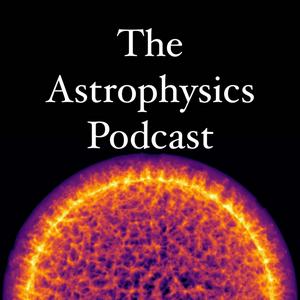
Descarga la app gratuita: radio.es
- Añadir radios y podcasts a favoritos
- Transmisión por Wi-Fi y Bluetooth
- Carplay & Android Auto compatible
- Muchas otras funciones de la app
Descarga la app gratuita: radio.es
- Añadir radios y podcasts a favoritos
- Transmisión por Wi-Fi y Bluetooth
- Carplay & Android Auto compatible
- Muchas otras funciones de la app
The Astrophysics Podcast
Escanea el código,
Descarga la app,
Escucha.
Descarga la app,
Escucha.
 España