
Escucha gratis este podcast en la aplicación: Descarga gratuita en la App Store
radio.es
Sleep timer
Favoritos
46 episodios
De Motu [Galileo - Part 2]
24/10/2026 | 19 minAt twenty-five, Galileo was back in Pisa, this time as its Professor of Mathematics. The salary was roughly that of a good stonemason, and the university was firmly in the hands of the Aristotelians, some of whom had once been his teachers. In this episode we look at Aristotle’s ideas on motion, and why even his most devoted followers couldn’t agree on what they meant. Galileo had little patience for any of it. Instead he turned to Archimedes and to a new generation of Italian mathematicians who were asking the same questions. Encouraged by his friends, he made his first real attempt at a theory of his own. Not very originally, he called it De Motu. Whether it actually worked was another matter.
Support the show
Support the show and get episodes early: https://www.patreon.com/TheCompleteHistoryofScience
Website: https://thecompletehistoryofscience.com/
Contact: thecompletehistoryofscience@gmail.com
BlueSky: https://bsky.app/profile/gethinrichards.bsky.social
Music Credit: Folk Round Kevin MacLeod (incompetech.com) Licensed under Creative Commons: By Attribution 3.0 LicenseI Follow Archimedes [Galileo - Part 1]
10/10/2026 | 21 minIn 1583, Galileo Galilei was eighteen years old and enrolled as a medical student at the University of Pisa. On the surface, life was good. There was, however, one problem: he couldn't stand medicine. We begin with his early years, from his musician father and difficult mother to the monks who very nearly kept him for good. Nicknamed The Wrangler for arguing with his professors, Galileo slipped uninvited into a lecture on geometry and was captivated. Mathematics was poorly paid and held in low regard, but in Archimedes he had found his master. Abandoning a safe career was a gamble, and the road to a university post was not a smooth one.
Support the show
Support the show and get episodes early: https://www.patreon.com/TheCompleteHistoryofScience
Website: https://thecompletehistoryofscience.com/
Contact: thecompletehistoryofscience@gmail.com
BlueSky: https://bsky.app/profile/gethinrichards.bsky.social
Music Credit: Folk Round Kevin MacLeod (incompetech.com) Licensed under Creative Commons: By Attribution 3.0 LicenseSpecial: The History of Reproductive Science with Prof. Michael Carroll
22/03/2026 | 1 h 12 minMichael, an Associate Professor in Reproductive Science, joins us for a wide-ranging dive into the history of reproductive science. From ancient Galenic theories and Leonardo da Vinci's anatomical drawings, through the gradual unravelling of how sperm and eggs work, to the breakthroughs that ultimately made IVF possible.
We trace the key milestones: sperm capacitation, early animal studies, and the pioneering work of Edwards, Steptoe, and Purdy that led to the birth of Louise Brown in 1978, and the 12 million IVF babies who have followed since.
Support the show
Support the show and get episodes early: https://www.patreon.com/TheCompleteHistoryofScience
Website: https://thecompletehistoryofscience.com/
Contact: thecompletehistoryofscience@gmail.com
BlueSky: https://bsky.app/profile/gethinrichards.bsky.social
Music Credit: Folk Round Kevin MacLeod (incompetech.com) Licensed under Creative Commons: By Attribution 3.0 LicenseThe Harmony of Johannes Kepler [Kepler - Part 4]
25/01/2026 | 43 minIn 1610 reports reached Prague that Galileo had discovered new planets, and Kepler felt compelled to find out for himself what had actually been seen. Reading Starry Messenger and later observing through a borrowed telescope, he became one of Galileo’s earliest and most important defenders. Kepler not only confirmed the existence of Jupiter’s moons but also argued publicly for the reliability of telescopic observations, and went further by explaining, for the first time, how the telescope worked in theory through his optical treatise Dioptrice.
Alongside this defence of new instruments, the episode follows Kepler’s search for harmony in the structure of the cosmos, culminating in the discovery of his third law of planetary motion. It then traces his long and difficult effort to complete the Rudolphine Tables, based on Tycho Brahe’s observations. Published in 1627, the tables proved vastly more accurate than anything before them and made possible the successful prediction of planetary transits. Though Kepler did not live to see their full impact, the tables ensured that his astronomy could no longer be ignored.
Support the show
Support the show and get episodes early: https://www.patreon.com/TheCompleteHistoryofScience
Website: https://thecompletehistoryofscience.com/
Contact: thecompletehistoryofscience@gmail.com
BlueSky: https://bsky.app/profile/gethinrichards.bsky.social
Music Credit: Folk Round Kevin MacLeod (incompetech.com) Licensed under Creative Commons: By Attribution 3.0 LicenseChristmas Special 2025 - Q and A
24/12/2025 | 28 minMerry Christmas!
Answering listener questions as well as some long standing FAQs. Enjoy!
Support the show
Support the show and get episodes early: https://www.patreon.com/TheCompleteHistoryofScience
Website: https://thecompletehistoryofscience.com/
Contact: thecompletehistoryofscience@gmail.com
BlueSky: https://bsky.app/profile/gethinrichards.bsky.social
Music Credit: Folk Round Kevin MacLeod (incompetech.com) Licensed under Creative Commons: By Attribution 3.0 License
Más podcasts de Ciencias







Podcasts a la moda de Ciencias
















Acerca de The Complete History of Science
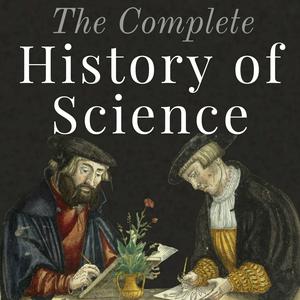
A podcast exploring the history of science from the beginning. We will cover all of the most important scientific discoveries from Archimedes to Newton to Einstein. The aim is to give a complete overview of how science evolved and how it shaped the modern world.Support the show and keep it going: https://www.patreon.com/TheCompleteHistoryofScienceWebsite:https://www.thecompletehistoryofscience.com/Follow me on BlueSky for updates: https://www.bsky.app/profile/gethinrichards.bsky.socialYouTube:https://www.youtube.com/@thecompletehistoryofscienceMusic credit:Folk Round Kevin MacLeod (incompetech.com)Licensed under Creative Commons: By Attribution 3.0http://www.creativecommons.org/licenses/by/3.0/Photo credit: "L0015096EB" by Wellcome Library, London is licensed under CC BY 4.0. Image has been cropped.
Sitio web del podcastEscucha The Complete History of Science, Mindfacts: Historia y futuro de la Ciencia y la Tecnología y muchos más podcasts de todo el mundo con la aplicación de radio.es
Descarga la app gratuita: radio.es
- Añadir radios y podcasts a favoritos
- Transmisión por Wi-Fi y Bluetooth
- Carplay & Android Auto compatible
- Muchas otras funciones de la app
Descarga la app gratuita: radio.es
- Añadir radios y podcasts a favoritos
- Transmisión por Wi-Fi y Bluetooth
- Carplay & Android Auto compatible
- Muchas otras funciones de la app
The Complete History of Science
Escanea el código,
Descarga la app,
Escucha.
Descarga la app,
Escucha.
 España

