

Escucha gratis este podcast en la aplicación: Descarga gratuita en la App Store
radio.es
Sleep timer
Favoritos
132 episodios
LFP 132: Matteo Rossi MacDermant - Technoprogressive Worldbuilding
21/07/2026 | 50 minThis is the first of a number of episodes on the broad theme of “the technoprogressive opportunity”. That’s the name of a conference taking place in London on the weekend of 19th and 20th September, co-organised by London Futurists and the IEET – the Institute for Ethics and Emerging Technologies. In these episodes, some of the speakers from that conference will be appearing as guests on this show.
Our guest today is one of these speakers, Matteo Rossi MacDermant, a technophilosopher from the University of New Mexico. Matteo hosts a show called “Bread and Robots”, which covers subjects such as post-scarcity economics, universal basic income, the tech workers movement, and how technology can be steered toward collective abundance rather than corporate exploitation. Matteo is also the instructor for an online course called “An introduction to technoprogressive worldbuilding”.
Selected follow-ups:
The Technoprogressive Opportunity: Event in London, Sept 19-20
The IEET - A Technoprogressive Think-Tank
Matteo Rossi MacDermant - LinkedIn
Bread and Robots - Podcast and Substack by Matteo Rossi MacDermant
An Introduction to Technoprogressive Worldbuilding
"Technoprogressive Declaration" - from Transvision 2014
2017 update to the Technoprogressive Declaration
UBI Guide - by Scott Santens
Universal Basic Capital - Windfall Trust
"How a Land Value Tax Can Fund a UBI" - Scott Santens
Universal Basic Income and/or Alternatives - London Futurists conference held in 2018
"Why the AI world is suddenly obsessed with a 160-year-old economics paradox" - Jevon's Paradox explained by Greg Rosalsky
"The Longevity City: Cities as the Engines of Healthy Longevity" - essay by Matteo Rossi MacDermant
"The London boroughs with the best and worst 'healthy life' expectancy"
"The Abolition of Aging" - book by David Wood (includes analysis of economic implications)
Music: Spike Protein, by Koi Discovery, available under CC0 1.0 Public Domain Declaration
C-Suite Perspectives
Elevate how you lead with insight from today’s most influential executives.
Listen on: Apple Podcasts SpotifyLFP 131: Ben Luong - The Discontinuity Thesis
28/06/2026 | 35 minAI-driven automation of cognitive labour is not merely another technological transition but a structural discontinuity that will end, sooner or later, the central role of wages in how society operates. This discontinuity can be called “The End of Postwar Capitalism”. That’s the conclusion of a tightly argued set of essays, “The Discontinuity Thesis”, written by our guest in this episode, Ben Luong.
The essays look at a range of arguments that all try to make the case that wages paid for cognitive labour will remain significant for the majority of people, so that capitalism can continue in place, even with AI having greatly expanded capabilities. According to Ben, each of these arguments fail. These back-and-forth debates are what we explore in this episode.
Selected follow-ups:
"The Discontinuity Thesis: A Sequence of Seven Essays on Why Postwar Capitalism Ends" by Ben Luong
"Mark Zuckerberg just declared war on the entire advertising industry" - The Verge
"P versus NP problem" - Wikipedia
"KPMG Pulls AI Report After Hallucinated Claims About Major Organisations" - AI Insider
"GDPval-AA v2 Leaderboard" - Artificial Analysis
"OSWorld: 369 real computer tasks across Windows, macOS, and Ubuntu requiring GUI interaction... Much harder than web-only benchmarks"
"Sorites paradox" - Wikipedia
"Young people not in education, employment or training (NEET), UK: May 2026" - Office of National Statistics
"Five Years" - Song by David Bowie
"How ZEISS and ASML Enable the Modern Chip Industry" - Rob Hoeijmakers
"Mistral AI’s $830 Million Debt Financing: Inside the European Bet on 13,800 Nvidia GPUs and a Paris AI Data Center" - Marcus Chen
"Colossus (data center)" - Wikipedia
"Canaries in the Coal Mine? Six Facts about the Recent Employment Effects of Artificial Intelligence" - Stanford Digital Economy Lab
"Appendix I: What Would Refute the Thesis" - by Ben Luong
"The Cope Index: Tracking who's coping hardest about the end of work" - by Ben Luong
"The AI Alignment Problem" - from "The Singularity Principles"
Music: Spike Protein, by Koi Discovery, available under CC0 1.0 Public Domain Declaration
C-Suite Perspectives
Elevate how you lead with insight from today’s most influential executives.
Listen on: Apple Podcasts SpotifyLFP 130: Gerry Tsoukalas and Brett Falk - The AI Automation Layoff Trap
01/06/2026 | 42 minThis episode continues our investigation into the implications of advanced AI for jobs, and specifically, how to design an economic system that makes a huge success of full automation by AI.
Back in 2017, Bill Gates mused that governments should address radical automation by taxing robots. Gates may not have known it at the time, but he was suggesting a Pigouvian tax. In a 1920 book called “The Economics of Welfare”, Arthur Pigou proposed levying taxes on activities that generate negative externalities — costs on third parties to a transaction. The classic example of that is pollution: a factory produces goods but creates pollution. The market price of the goods doesn't reflect the pollution costs, so the factory managers don’t try very hard to minimise them.
A Pigouvian tax adds the social cost of the pollution into the price, so the producer is incentivised to minimise it.
Gerry Tsoukalas and Brett Falk have published a well-received paper called “The AI Layoff Trap”, which recommends introducing a Pigouvian tax on automation that eliminates human jobs. Their proposal deserves credit for taking seriously the idea that AI may well cause severe automation, perhaps full automation – i.e. the Economic Singularity.
The paper describes how firms face a prisoner’s dilemma. If they automate all their jobs then there will be no consumers to pay for any of their products. But if any of them don’t, their automating competitors will drive them out of business. Tsoukalas and Falk point out, counter-intuitively, that the fiercer the competition, the more acute the dilemma, so if we want to hold back automation, we might be better off with monopoly-ridden economies.
Selected follow-ups:
Gerry Tsoukalas
Brett Hemenway Falk
The AI Layoff Trap - The Wharton School Research Paper
PDF of the AI Layoff Trap paper
Arthur Pigou - Wikipedia
Prisoner's dilemma - Wikipedia
"Microsoft AI chief gives it 18 months—for all white-collar work to be automated by AI"
"Chinese court rules firms can’t lay off workers on AI grounds"
Music: Spike Protein, by Koi Discovery, available under CC0 1.0 Public Domain Declaration
C-Suite Perspectives
Elevate how you lead with insight from today’s most influential executives.
Listen on: Apple Podcasts SpotifyLFP 129: Ted Shelton - Post-labour economics and the future of capitalism
09/05/2026 | 45 minThis episode continues our investigation into the potential wide-ranging implications of advanced AI for economics.
Traditionally, value is said to be created by a combination of capital, which covers the cost of materials and equipment, and labour, whereby humans exercise skills, ingenuity, diligence, attention, and more. What has been a constant debate is the appropriate division of rewards between capital and labour. Critics of the operation of capitalism have often predicted that an accumulation of value within small groups of owners of capital will cause economic instabilities and a subsequent collapse. Despite these forecasts, capitalism has, so far, demonstrated great resilience, defying predictions of its collapse. But if human labour is increasingly displaced by advanced automation, the balance of labour and capital will be fundamentally changed, and capitalism will come under unprecedented pressures.
That’s the thesis of our guest today, Ted Shelton. David first met Ted about 25 years ago, when Ted was Chief Strategy Officer of the software development tools company Borland, and David was an executive within the early smartphone industry. Since that time, Ted has worked for a variety of companies in and around Silicon Valley, including PwC, Cognizant Technology Solutions, Catalytic, Bain, and Inflection AI. Recently, he has been giving a great deal of thought to where AI is taking the economy.
Selected follow-ups:
Ted Shelton's posts on LinkedIn
"On the Transformation of Capitalism's Fundamental Assumptions Under Conditions of Scaling Machine Intelligence" - working paper by Ted Shelton
"The Industrial Economy Is Ending. What Comes Next?" - by Ted Shelton
Thomas Piketty's book "Capital in the Twenty-First Century" - Wikipedia
Nicholas Eberstadt's book "Men Without Work: America's Invisible Crisis" - Wikipedia
Richard Sutton's essay "Bitter Lesson" - Wikipedia
"Technofeudalism" - articles by Yanis Varoufakis
Music: Spike Protein, by Koi Discovery, available under CC0 1.0 Public Domain Declaration
C-Suite Perspectives
Elevate how you lead with insight from today’s most influential executives.
Listen on: Apple Podcasts SpotifyLFP 128: Adrian Brown - Windfall Trust and the Economic Singularity
22/04/2026 | 45 minWhat happens if AI delivers major advances in capability and productivity, but also creates significant disruption to jobs, incomes, and public finances? That question sits at the heart of today’s episode.
Our guest is Adrian Brown, the Founder and Chief Executive of Windfall Trust, a nonprofit focused on helping governments and societies prepare for the economic consequences of advanced AI. Windfall describes itself not as a think tank, but as a “policy accelerator for the age of artificial intelligence”.
Their work starts from a simple premise: if AI systems significantly reshape the economy, then the question is not only how we build them, but how we prepare for their impacts, and how the gains are ultimately shared.
Before founding Windfall Trust, Adrian was the founding Executive Director of the Centre for Public Impact, worked as a policy advisor in the UK Cabinet Office, and held roles at McKinsey and the Boston Consulting Group.
Selected follow-ups:
Windfall Trust
Exercise Cygnus (Wikipedia)
Erik Brynjolfsson (personal site)
Canaries in the Coal Mine? Six Facts about the Recent Employment Effects of Artificial Intelligence (paper by Erik Brynjolfsson and colleagues)
Anton Korinek (personal site)
Windfall's UK Scenarios exercise
The Economic Singularity (recent discussion paper by Calum Chace)
Industrial Policy for the Intelligence Age (OpenAI)
UK Government announcement of the formation of "The AI and Future of Work Unit"
UK Chancellor Rachel Reeve's announcement of a new "AI Economics Institute"
"AI will kill income tax" - episode of Robert Peston's podcast "The Rest is Money"
Windfall Policy Atlas
Task-Completion Time Horizons of Frontier AI Models (METR)
Music: Spike Protein, by Koi Discovery, available under CC0 1.0 Public Domain Declaration
C-Suite Perspectives
Elevate how you lead with insight from today’s most influential executives.
Listen on: Apple Podcasts Spotify
Más podcasts de Noticias
 La Trinchera de LlamasNoticias, Política
 La noche de CuestaNoticias, Política
 Global News PodcastNoticias, Noticias diarias
 Más de unoNoticias
 En casa de HerreroNoticias, Política
 Es la Mañana de FedericoNoticias, Política
 Hora 25Noticias
 Crónica RosaNoticias, Noticias de entretenimiento
 Hoy en EL PAÍSNoticias, Noticias diarias
 A vivir que son dos díasNoticias
Podcasts a la moda de Noticias
 Ley 40/2015 de Régimen Jurídico del Sector Público (LRJSP)Noticias, Política
 Decoding Geopolitics Podcast with Dominik PreslNoticias, Política
 Operación salidaCultura y sociedad, Noticias
 Game Over with Max Kellerman and Rich PaulNoticias, Noticias deportivas
 Software Engineering DailyNoticias, Noticias tecnológicas, Tecnología
 ФЕЙГИН LIVECultura y sociedad, Gobierno, Noticias, Política
 Up First from NPRNoticias, Noticias diarias
 El programa de CuestaNoticias, Política
 Lo que vieneNoticias
 Fin de SemanaNoticias
 Leña al mono que es de gomaNoticias, Noticias tecnológicas
 The World in Brief from The EconomistNoticias, Noticias diarias
 NewscastNoticias, Noticias diarias, Política
 La Nit Més FoscaNoticias
 Что случилосьNoticias
 Las noticias en Onda CeroNoticias
Acerca de London Futurists
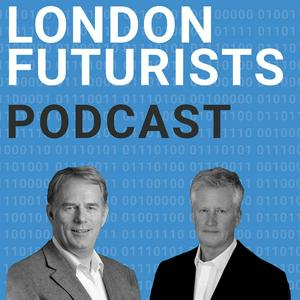
Anticipating and managing exponential impact - hosts David Wood and Calum ChaceCalum Chace is a sought-after keynote speaker and best-selling writer on artificial intelligence. He focuses on the medium- and long-term impact of AI on all of us, our societies and our economies. He advises companies and governments on AI policy.His non-fiction books on AI are Surviving AI, about superintelligence, and The Economic Singularity, about the future of jobs. Both are now in their third editions.He also wrote Pandora's Brain and Pandora’s Oracle, a pair of techno-thrillers about the first superintelligence. He is a regular contributor to magazines, newspapers, and radio.In the last decade, Calum has given over 150 talks in 20 countries on six continents. Videos of his talks, and lots of other materials are available at https://calumchace.com/.He is co-founder of a think tank focused on the future of jobs, called the Economic Singularity Foundation. The Foundation has published Stories from 2045, a collection of short stories written by its members.Before becoming a full-time writer and speaker, Calum had a 30-year career in journalism and in business, as a marketer, a strategy consultant and a CEO. He studied philosophy, politics, and economics at Oxford University, which confirmed his suspicion that science fiction is actually philosophy in fancy dress.David Wood is Chair of London Futurists, and is the author or lead editor of twelve books about the future, including The Singularity Principles, Vital Foresight, The Abolition of Aging, Smartphones and Beyond, and Sustainable Superabundance.He is also principal of the independent futurist consultancy and publisher Delta Wisdom, executive director of the Longevity Escape Velocity (LEV) Foundation, Foresight Advisor at SingularityNET, and a board director at the IEET (Institute for Ethics and Emerging Technologies). He regularly gives keynote talks around the world on how to prepare for radical disruption. See https://deltawisdom.com/.As a pioneer of the mobile computing and smartphone industry, he co-founded Symbian in 1998. By 2012, software written by his teams had been included as the operating system on 500 million smartphones.From 2010 to 2013, he was Technology Planning Lead (CTO) of Accenture Mobility, where he also co-led Accenture’s Mobility Health business initiative.Has an MA in Mathematics from Cambridge, where he also undertook doctoral research in the Philosophy of Science, and a DSc from the University of Westminster.
Sitio web del podcastEscucha London Futurists, La Trinchera de Llamas y muchos más podcasts de todo el mundo con la aplicación de radio.es
Descarga la app gratuita: radio.es
- Añadir radios y podcasts a favoritos
- Transmisión por Wi-Fi y Bluetooth
- Carplay & Android Auto compatible
- Muchas otras funciones de la app
Descarga la app gratuita: radio.es
- Añadir radios y podcasts a favoritos
- Transmisión por Wi-Fi y Bluetooth
- Carplay & Android Auto compatible
- Muchas otras funciones de la app

London Futurists
Escanea el código,
Descarga la app,
Escucha.
Descarga la app,
Escucha.
 España