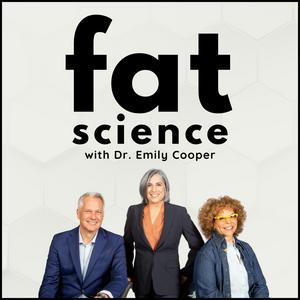
Fat Science

Dr Emily Cooper
Fat Science
Último episodio

127 episodios

  • Fat Science

    Mailbag: Your GLP-1 Questions: Hair Loss, Blood Sugar Spikes & Hormone Therapy

    09/03/2026 | 50 min
    Think squashing your post-meal glucose spike is the healthy thing to do? What if that flat line on your CGM is actually telling your brain you didn't eat — and slowing your metabolism as a result?
    This week on Fat Science, Dr. Emily Cooper, Mark Wright, and Andrea Taylor open the mailbag to tackle listener questions from around the world — Australia, New Zealand, and across the U.S. They dig into hormone replacement therapy and metabolism, why your GLP-1 medication might be causing hair loss, what a normal blood sugar response actually looks like, and how lipedema differs from obesity. Dr. Cooper also revisits metabolic syndrome and why it's not outdated — just underutilized.
    Key Takeaways
    Hormone replacement therapy isn't a reliable tool for improving metabolism — it's better suited for symptom relief and bone health in specific situations.

    Progesterone, which must accompany estrogen if you still have your uterus, can actually disrupt metabolism in some women — acting almost like a steroid.

    A flat glucose line after eating isn't the goal — your brain needs to see glucose go up to register that you've been nourished and keep your metabolism running.

    Hair loss on GLP-1 medications is more likely tied to nutrient deficiencies (especially iron and protein) than the drugs themselves.

    Lipedema is a disease of the fat tissue itself — separate from obesity — and tirzepatide may help reduce the inflammatory symptoms even though it won't eliminate the fat deposits.

    Notable Quote
    "If your glucose is flat line, your brain's not very convinced that you ate much — and then you're not getting the metabolic benefit." — Dr. Emily Cooper
    Links & Resources
    Podcast Home: fatsciencepodcast.com

    Cooper Center for Metabolism: coopermetabolic.com

    Resources from Dr. Cooper: coopermetabolic.com/resources

    Join Our Community: patreon.com/cw/FatSciencePodcast

    Submit Your Question: [email protected] or [email protected]

    Fat Science is supported by the Diabesity Institute, a nonprofit dedicated to increasing access to effective, science-based metabolic care.
    Disclaimer: This podcast is for informational purposes only and is not intended as medical advice. Please consult with a qualified healthcare provider for personalized recommendations.
  • Fat Science

    Why GLP-1s Alone May Not Be Enough: A Listener's Real Story

    02/03/2026 | 56 min
    What happens when you do everything "right" — the GLP-1, the protein shake, the tracking — and the scale still won't budge? This episode reveals why doing everything “right” might actually be a big part of the problem.
    This week on Fat Science, Dr. Emily Cooper, Mark Wright, and Andrea Taylor welcome Sandy, a listener from Pennsylvania who has been on the metabolic health journey for over a year. Sandy's story is one many listeners will recognize: decades of dieting starting in childhood, a body that kept adapting against her, and a medical system that kept telling her to try harder. But when Dr. Cooper reviews Sandy's actual lab work live on air, what she finds reframes everything — and offers a path forward that has nothing to do with restriction.
    Key Takeaways
    Suppressed leptin hides a portion of your body fat from your brain, and possibly signals your brain that you're underweight — so your brain fights weight loss even when your body doesn't need protecting.

    Low insulin isn't always healthy; it can be a sign of the "selfish brain" redirecting precious glucose to the brain at the expense of your muscles.

    Weight cycling — losing and regaining the same weight repeatedly — creates cardiovascular and metabolic risk.

    Mechanical eating is the antidote to disordered eating: structured, non-restrictive fueling that rebuilds metabolic trust.

    GLP-1 medications can suppress appetite, so under-eating becomes a real risk — especially for people already conditioned to restrict.

    The goal isn't the number on the scale. It's metabolic stability and metabolic health, and those things are not the same.

    Notable Quote
    "It was such a revelation to me to hear you guys talk about it — it's a metabolic disorder. It's not a willpower issue, it's not a personal failing. It's something absolutely beyond my control. Like diabetes would be. Like migraines would be." — Sandy

    Links & Resources
    Podcast Home: fatsciencepodcast.com

    Cooper Center for Metabolism: coopermetabolic.com

    Resources from Dr. Cooper: coopermetabolic.com/resources

    Join Our Community: patreon.com/cw/FatSciencePodcast

    Submit Your Question: [email protected] or [email protected]

    Fat Science is supported by the Diabesity Institute, a nonprofit dedicated to increasing access to effective, science-based metabolic care.
    Disclaimer: This podcast is for informational purposes only and is not intended as medical advice. Please consult with a qualified healthcare provider for personalized recommendations.
  • Fat Science

    The Science Behind the New Wegovy Pill: One-On-One with Novo Nordisk’s Dr. Jason Brett.

    23/02/2026 | 1 h
    The Science Behind the New Wegovy Pill (with Novo Nordisk’s Dr. Jason Brett)
    What actually makes a GLP-1 pill work in the real world—and why does taking it come with such specific rules? And if these meds improve health beyond weight, why does the conversation still get stuck on the scale?
    This week on Fat Science, Dr. Emily Cooper, Mark Wright, and Andrea Taylor are joined by Dr. Jason Brett of Novo Nordisk to break down the science behind the newly approved Wegovy pill. They talk about what it takes to deliver a peptide medication orally, what the dosing and day-to-day routine really look like, and why access and pricing remain such a big part of the story. The conversation also zooms out to the bigger point: treating obesity is about improving health outcomes—like liver and cardiovascular risk—not just weight.
    Key Takeaways
    Oral semaglutide requires specific formulation technology to survive the stomach and be absorbed at a meaningful level.

    The “30-minute rule” isn’t random—it’s part of how the pill has a chance to work as intended.

    Treating obesity is about improving health outcomes (like liver and heart risk), not just “moving a number on a scale.”

    Pricing and access shape who can actually benefit, even when the science is strong.

    Calorie-restriction messaging can backfire for people already dealing with metabolic adaptation and under-nutrition.

    Notable Quote
    "Fat Science has no financial relationship with Novo Nordisk. No sponsorship. No consulting fees, no affiliate arrangements. Zero." — Mark Wright
    Links & Resources

    Podcast Home: fatsciencepodcast.com

    Cooper Center for Metabolism: coopermetabolic.com

    Resources from Dr. Cooper: coopermetabolic.com/resources

    Join Our Community: patreon.com/cw/FatSciencePodcast

    Submit Your Question: [email protected] or [email protected]

    Fat Science is supported by the Diabesity Institute, a nonprofit dedicated to increasing access to effective, science-based metabolic care.
    Disclaimer: This podcast is for informational purposes only and is not intended as medical advice. Please consult with a qualified healthcare provider for personalized recommendations.
  • Fat Science

    Mailbag: Your GLP-1 Questions on Pregnancy, Dosing, and Why Diets Cause Fat Gain

    16/02/2026 | 43 min
    Mailbag: Your GLP-1 Questions on Pregnancy, Dosing, and Why Diets Cause Fat Gain
    What happens when you stop GLP-1 medications before getting pregnant? Why might your thyroid numbers change on Zepbound? And why do people gain more body fat after dieting — even when they're still eating well? Dr. Cooper tackles your toughest questions.
    This week on Fat Science, Dr. Emily Cooper, Mark Wright, and Andrea Taylor answer listener questions covering pregnancy planning on GLP-1s, unmasked thyroid problems, injection site reactions, mechanical eating after bariatric surgery, why diets cause fat regain at a cellular level, and discussing with your doctor whether you should (or shouldn't) increase your medication dose.
    Key Takeaways
    GLP-1 medications aren't causing gestational diabetes — they may have been masking underlying metabolic dysfunction that becomes visible when the medication is stopped

    Thyroid problems can be "unmasked" by GLP-1 treatment because the medications signal to your brain that you're not starving, allowing the pituitary TSH to rise, sometime uncovering a pre-existing thyroid issue

    Zepbound may improve iron absorption — if iron levels go too high, testing for hemochromatosis may be warranted

    To reduce injection site reactions: warm the medication to room temperature, clean and prep skin but don't over-rub with alcohol, inject at exactly 90 degrees, don't pinch the skin, and stay relaxed

    Diets cause fat regain at the cellular level — it's chemistry, not willpower — and the fat often accumulates in the visceral area around organs

    There's no need to increase your GLP-1 dose if you're making good progress — an annual weight loss rate of 15% or higher is considered strong

    Notable Quote
    "You can't think that just because somebody's weight is high, it's because something they're doing is wrong. That is just not founded in science whatsoever." — Dr. Emily Cooper
    Links & Resources
    Podcast Home: fatsciencepodcast.com

    Cooper Center for Metabolism: coopermetabolic.com

    Resources from Dr. Cooper: coopermetabolic.com/resources

    Join Our Community: patreon.com/cw/FatSciencePodcast

    Submit Your Question: [email protected] or [email protected]

    Fat Science is supported by the Diabesity Institute, a nonprofit dedicated to increasing access to effective, science-based metabolic care.
    Disclaimer: This podcast is for informational purposes only and is not intended as medical advice. Please consult with a qualified healthcare provider for personalized recommendations.
  • Fat Science

    Wegovy Pill vs. Injection — A Doctor Breaks Down the Newest Form of GLP-1

    09/02/2026 | 46 min
    Wegovy Pill: Who's It For?
    The new Wegovy pill is generating massive buzz — but is it actually better than the injection? Before you ask your doctor to switch, there are some surprising requirements that could make or break whether this option works for you.
    This week on Fat Science, Dr. Emily Cooper, Mark Wright, and Andrea Taylor break down the new oral semaglutide approved for obesity treatment. They explain how the Wegovy pill differs from Rybelsus, who's a good candidate to switch (and who isn't), the strict dosing protocol most people don't know about, and what's coming next in the GLP-1 pill landscape — including a less fussy competitor from Eli Lilly.
    Key Takeaways
    The Wegovy pill uses an upgraded "version two" formulation with enhanced absorption — it's not the same as Rybelsus

    Semaglutide targets deep metabolic dysfunction, not just appetite — reducing inflammation, visceral fat, and cardiovascular risk

    The pill must be taken first thing in the morning on an empty stomach with minimal water, then nothing else for 30 minutes — breaking this protocol negates effectiveness

    The pill is slightly less effective than the highest-dose Wegovy injection, so switching isn't ideal for patients still making progress at maximum dose

    Novo Nordisk's cash pay program starts at $149/month for lower doses and $299/month for the highest dose

    Eli Lilly's upcoming orforglipron pill uses small molecule technology that won't require the strict dosing ritual

    Notable Quote
    "When people say it works because it just makes you eat less, that's really missing the point of the sophistication of these meds." — Dr. Emily Cooper

    Links & Resources
    Podcast Home: fatsciencepodcast.com

    Cooper Center for Metabolism: coopermetabolic.com

    Resources from Dr. Cooper: coopermetabolic.com/resources

    Join Our Community: patreon.com/cw/FatSciencePodcast

    Submit Your Question: [email protected] or [email protected]

    Fat Science is supported by the Diabesity Institute, a nonprofit dedicated to increasing access to effective, science-based metabolic care.
    Disclaimer: This podcast is for informational purposes only and is not intended as medical advice. Please consult with a qualified healthcare provider for personalized recommendations.

Más podcasts de Salud y forma física

Acerca de Fat Science

Fat Science is a podcast on a mission to explain where our fat really comes from and why it won’t go (and stay!) away. In each episode, we share little-known facts and personal experiences to dispel misconceptions, reduce stigma, and instill hope. Fat Science is committed to creating a world where people are empowered with accurate information about metabolism and recognize that fat isn’t a failure. This podcast is for informational purposes only and is not intended to replace professional medical advice.
Sitio web del podcast

Escucha Fat Science, On Purpose with Jay Shetty y muchos más podcasts de todo el mundo con la aplicación de radio.es

Descarga la app gratuita: radio.es

  • Añadir radios y podcasts a favoritos
  • Transmisión por Wi-Fi y Bluetooth
  • Carplay & Android Auto compatible
  • Muchas otras funciones de la app
Aplicaciones
Redes sociales
v8.7.2 | © 2007-2026 radio.de GmbH
Generated: 3/11/2026 - 2:24:24 PM