

Escucha gratis este podcast en la aplicación: Descarga gratuita en la App Store
radio.es
Sleep timer
Favoritos
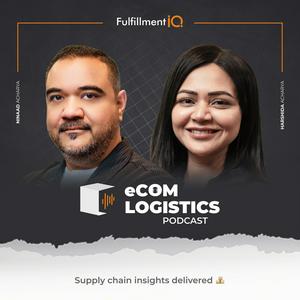
eCom Logistics Podcast
Fulfillment IQ, Ninaad Acharya, Dan Coll
Último episodio
121 episodios
Why Yard Management Is the Last Broken Node in Supply Chain
22/04/2026 | 30 minWHAT YOU’LL LEARN
Why yard management is still one of the most manual parts of the supply chain
How to identify if your yard is the hidden bottleneck in operations
What causes congestion, idle time, and poor trailer visibility
How gate delays impact warehouse throughput and carrier performance
What “Smart Yard 3.0” means (and how it differs from traditional YMS)
How AI improves gate check-in, asset visibility, and workflow orchestration
The stages of AI maturity in yard operations—from visibility to autonomous decisioning
Where security, fraud detection, and damage tracking fit into yard technology
What operators should prioritize first when modernizing the yard
HIGHLIGHTS
00:00 – Why the yard is still the last broken node in supply chain
01:39 – Why yard operations stayed manual while WMS and TMS evolved
05:00 – Signs your yard is under-managed (congestion, delays, visibility gaps)
06:44 – Smart Yard 3.0: from tracking systems to real-time orchestration
10:11 – AI maturity in yard operations (visibility → automation → optimization)
17:00 – How yard performance impacts the entire supply chain network
20:06 – Security, fraud detection, and damage tracking in the yard
23:19 – What AI-native logistics platforms look like next
QUOTES
[00:00:29] "The yard often remains the manual reactive, hard to see in real time type of solution." - Ninaad
[00:01:39] “The yard is one of three of the major nodes in the supply chain, about 50 billion in goods flow every single day. It is stunning to realize that it is the most un modernized node in the entire supply chain." - Darin Brannan
[00:04:53] "It was an afterthought. Now it's a constraint." - Darin Brannan
[00:08:07] "And a AI and agentic done right, is a game changer for the art." - Darin Brannan
[00:17:39] "Yards don't fall into isolation. It has the ability to have second-order effects across the network." - Harshida
KEY TAKEAWAYS
The yard is no longer a passive space—it’s a control point for the entire network
Most yard systems digitize workflows but don’t improve decision-making
Real transformation comes from redesigning workflows, not just automating them
Small inefficiencies in the yard create large downstream operational impact
AI shifts the yard from a tracking system to a movement orchestration platform
ABOUT THE GUEST
Darin Brannan, CEO, Terminal Industries
Darin Brannan is a founder-operator and CEO with 25+ years of experience scaling SaaS and infrastructure platforms. At Terminal Industries, he leads the development of an AI-native Yard Operating System that uses computer vision and agentic AI to automate and optimize yard operations across enterprise supply chains.
Learn more:
https://terminal-industries.com/
https://www.linkedin.com/in/darinbrannan/
Subscribe and Keep Learning!
If you’re a logistics leader looking to scale sustainably, don’t miss out! Subscribe for more expert strategies on tackling modern supply chain challenges.
Be sure to follow and tag the eCom Logistics Podcast on LinkedIn and YouTubeFrom AI Pilot to Production: PepsiCo Lab’s Innovation Playbook
11/03/2026 | 25 minWHAT YOU’LL LEARN
How digital twins reduce CapEx before construction begins
How to move AI from pilot to enterprise-wide deployment
How to cut corporate red tape for rapid pilot execution
How to design KPIs for objective pilot success measurement
Why 50% pilot failure is a healthy innovation benchmark
How to productize AI use cases for warehouse scale
How to avoid “pilot purgatory” in logistics transformation
HIGHLIGHTS
00:00–02:00 | AI Fatigue & The Shift to Production
02:00–05:00 | Scaling Digital Twin Across 100+ Buildings
05:00–07:30 | CapEx Reduction & Engineering Simulation ROI
07:30–10:00 | Run-State Optimization & 20% Throughput Gains
10:00–14:00 | The PepsiCo Labs Pilot Framework
14:00–18:00 | Designing a Culture That Celebrates Failure
18:00–23:00 | Quantifying Innovation & Moving to Production
TOP QUOTES
[00:06:00] “Here you can simulate and debug everything before you've invested your first CapEx dollar.” - Anna Farberov
[00:08:00] “So I think we were able to demonstrate 20% throughput increase in a pick rate.” - Anna Farberov
[00:12:00] “By design, we want 50% of our pilots to fail.” - Anna Farberov
[00:18:00] “Move to production. Don’t just test.” - Anna Farberov
ABOUT THE GUEST
Anna Farberov is GM of PepsiCo Labs, where she leads PepsiCo’s global engagement with technology companies—from breakthrough startups to the world’s largest enterprises. In this role, she partners with senior executives and innovators to identify, test, and scale technologies that are transforming how PepsiCo operates across data, AI, manufacturing, supply chain, agriculture, and commercial functions. Her work powers growth, efficiency, and resilience across one of the world’s largest consumer goods companies.
Beyond PepsiCo, Anna is recognized for building innovation models that bridge corporations, technology providers, and investors—accelerating adoption of cutting-edge solutions at scale. She has worked across industries to help leaders translate complexity into clarity, align technology with strategy, and move with speed and impact in times of disruption.
A frequent speaker at global conferences, Anna shares insights on how leaders can harness innovation ecosystems, build future-ready organizations, and lead with clarity and purpose in an era of rapid technological change.
LINKS MENTIONED
Pepsico Labs: https://www.labs.pepsico.com/
Anna Farberov on LinkedIn: https://www.linkedin.com/in/anna-farberov/
Subscribe and Keep Learning!
If you’re a logistics leader looking to scale sustainably, don’t miss out! Subscribe for more expert strategies on tackling modern supply chain challenges.
Be sure to follow and tag the eCom Logistics Podcast on LinkedIn and YouTubeMeeting the AI-Empowered Consumer: Logistics Strategy in a Comparison-Driven Economy
04/03/2026 | 30 minWHAT YOU’LL LEARN
Why retail is now a demand chain, not a supply chain
How AMRs deliver 6–12 month ROI in high-variability e-commerce
Why robotics-as-a-service changes peak capacity planning
The real bottleneck in AI adoption: structured WMS data
Why dashboards are dying and exception-based orchestration is rising
How consolidation will reshape 3PL economics
Why operational excellence remains the ultimate differentiator
HIGHLIGHTS
00:01–00:12 | Consumer expectations and the “fast + free + cheap” reality
00:12–00:15 | AMRs, ASRS, RaaS, and 6–12 month automation ROI
00:15–00:16 | Buy vs build: what’s commodity vs “secret sauce”
00:16–00:19 | Agentic AI in warehouse ops: labor planning + execution
00:19–00:22 | AI proof, case studies, and demand planning as the next frontier
00:22–00:24 | Dashboards vs operators: turning analytics into actions
00:24–00:28 | Operator advice: efficiency, mechanization, and competition shifts
00:29–00:31 | Manifest trends: retail channels evolving + tech-driven 3PL future
QUOTES
[00:04:10] “One of the biggest changes is you used to have a choice. You could either have it fast, you could have it free, or you could have it cheap. The consumer today wants all three.” – Jeff Wolpov
[00:05:10] “We as logistics supply chain companies need to lean in and figure out how to do more with less. Today it's a necessity.” – Jeff Wolpov
[00:07:30] “You need automation... We need to be faster and more flexible. Peaks have gotten much higher.” – Jeff Wolpov
[00:16:00] "The hard part isn't building AI or using AI. It's what do you do with the results?" - Gary Allen
[00:16:50] “Operators shouldn't hunt dashboards, they should get alerts, exception-based triggers. AI takes analytics to the next level.” – Gary Allen
[00:23:00] "Reporting is the death of analytics." - Gary Allen
ABOUT THE GUESTS
Jeff Wolpov
Jeff Wolpov is Senior Vice President of E-commerce and Ryder Last Mile at Ryder System, Inc., where he leads the vision and strategy for omnichannel fulfillment and big & bulky home delivery.
Previously, he served as CEO of Whiplash (formerly Port Logistics Group), achieving nearly 30% year-over-year revenue growth before its acquisition by Ryder in 2022. Earlier in his career, Jeff founded Distribution Solutions, scaling it from a startup into a $50 million regional logistics firm that became the foundation of Whiplash’s national network.
He holds a degree from the University of Michigan.
Gary Allen
Gary Allen is Vice President of Supply Chain Excellence at Ryder, overseeing Solution Design, Continuous Improvement, Data Analytics, and Automation across the supply chain organization.
With more than 32 years of experience, he previously led EY’s logistics consulting practice and held leadership roles at DHL and FedEx in product innovation, solution design, sustainability, and operations.
Gary helped launch and co-author the “Annual Third Party Logistics Study” with Dr. John Langley of Penn State University and holds a Bachelor of Arts in Materials and Logistics Management from Michigan State University.
LINKS MENTIONED
Ryder report: https://www.ryder.com/en-us/insights/white-papers/e-comm/2025-ryder-e-commerce-consumer-study
Ryder website: https://www.ryder.com/en-us
Subscribe and Keep Learning!
If you’re a logistics leader looking to scale sustainably, don’t miss out! Subscribe for more expert strategies on tackling modern supply chain challenges.
Be sure to follow and tag the eCom Logistics Podcast on LinkedIn and YouTubeLaura Ritchey, CEO of GEODIS in Americas, on Building Agile 3PL Operations That Scale
23/02/2026 | 19 minWHAT YOU’LL LEARN
Why balancing cost, speed, and quality is now table stakes in logistics strategy
How to design a flexible 3PL platform without hardcoding yourself into rigidity
The operational difference between supporting enterprise brands vs. high-growth brands
Why scenario planning still matters in an era of tariffs, snowstorms, and volatility
How to avoid over-engineering automation that limits long-term flexibility
What defines a true strategic partnership beyond SLAs and QBRs
Why solving problems together—not alone—is the real measure of partnership maturity
TIMESTAMPED SEGMENTS
00:00 – 01:00 | Balancing Cost, Speed & Quality Post-Pandemic
01:00 – 02:30 | Becoming the Customer: Operational Audits & CX Insight
02:30 – 04:00 | Agility, Uncertainty & Platform-First Thinking
04:00 – 05:30 | Defining High-Growth vs. Enterprise Brands
05:30 – 07:00 | Capability-Based Support Models vs. Split Teams
07:00 – 09:00 | What Real Strategic Partnerships Actually Look Like
TOP QUOTES
[00:01:00] “We know the cost of customer acquisition has increased exponentially. So the customer you have is the customer that you wanna keep.” - Laura Ritchey
[00:03:00] “I think obviously the overused word of agility these days… how quickly can you divert to warehouses that aren't closed or to transportation options that are still running?” - Laura Ritchey
[00:05:00] “We were doing 10,000 orders a day. All of a sudden we have to do 100,000, and that's really different.” - Laura Ritchey
[00:08:15] “Are we solving them together, or are we solving them alone?” - Laura Ritchey
[00:18:00] “The team is looking to us to be the calm in the storm.” - Laura Ritchey
ABOUT THE GUEST
Laura Ritchey is President & CEO of the Americas region at GEODIS and a member of the Group’s Executive Board. She leads nearly 20,000 teammates across eight countries, overseeing contract logistics, freight forwarding, and transportation operations throughout North and South America. With more than 30 years of experience—including 15 years in supply chain leadership across retail and third-party logistics—Laura previously served as CEO of Radial, Inc., driving growth through operational excellence. Her background spans finance, sourcing, distribution, and strategic transformation. She holds a J.D., MBA, and bachelor’s degree from The Ohio State University.
LINKS MENTIONED
Laura's LinkedIn: https://www.linkedin.com/in/laura-ritchey-55836a8/
GEODIS website: https://geodis.com/
Subscribe and Keep Learning!
If you’re a logistics leader looking to scale sustainably, don’t miss out! Subscribe for more expert strategies on tackling modern supply chain challenges.
Be sure to follow and tag the eCom Logistics Podcast on LinkedIn and YouTubeWhat Supply Chain Leaders Are Re-Thinking Ahead of Manifest 2026
05/01/2026 | 30 minWHAT YOU’LL LEARN
Why decision quality matters more than perfect systems in today’s supply chains
How leaders are shifting from growth-at-all-costs to margin-first thinking
What’s actually breaking inside warehouses amid labor churn and volatility
Where AI is helping operators—and where hype still outpaces reality
Why explainability, KPIs, and guardrails matter for AI adoption in operations
How leadership expectations are changing across supply chain organizations
What conversations operators are prioritizing heading into Manifest 2026
HIGHLIGHTS
00:00–02:35 | Why 2025 forced hard reflection across supply chain
03:17–04:30 | Decisions feel heavier, mistakes cost more
05:23–06:49 | The shift from growth to margin as a first principle
07:05–07:43 | Why warehouse systems lag brand expectations
08:08–08:58 | Recalibration after stacked volatility
09:48–11:20 | Why peak season planning never really ends
12:32–13:45 | Labor, churn, and execution pressure inside warehouses
14:35–16:51 | AI as decision enablement—not the strategy itself
18:14–21:43 | From AI fear to outcome-driven adoption
22:23–25:44 | What leadership looks like in volatile environments
26:47–28:16 | What leaders are watching heading into Manifest 2026
QUOTES
[00:03:17] “Decisions feel heavier. Mistakes are more expensive.” – Tanzil Uddin
[00:05:45] “There’s a shift away from growth at all costs, really a repositioning of margin as a first principle.” – Kinta Gates
[00:12:32] “The complexity with labor, training of the labor, churn of the labor, weather events, and the geopolitical state really impacts warehouse services.” – Linda Ewing
[00:22:23] “Leadership looks like getting in the weeds. We don’t have the luxury of just delegating.” – Kinta Gates
ABOUT THE GUESTS
Tanzil Uddin
SVP of Content & Partnerships at Manifest, where he works closely with supply chain leaders to shape programming around real operator priorities, partnerships, and emerging challenges across logistics and technology.
Kinta Gates
VP of Supply Chain & Operations at Glossier, overseeing end-to-end product operations. Kinta brings a people-first, margin-aware approach to scaling fulfillment, manufacturing, and supply chain execution.
Linda Ewing
SVP Strategy & Operations at ID Logistics with deep experience across manufacturing, supply chain, and warehouse services. Linda focuses on execution reality inside 3PL environments, labor challenges, and responsible technology adoption.
LINKS MENTIONED
Manifest 2026 Agenda: https://manife.st/agenda/
💡 Planning to attend Manifest 2026? Use this exclusive link for $200 off the current registration price: https://partner.manife.st/partner/ecomlogistics
Subscribe and Keep Learning!
If you’re a logistics leader looking to scale sustainably, don’t miss out! Subscribe for more expert strategies on tackling modern supply chain challenges.
Be sure to follow and tag the eCom Logistics Podcast on LinkedIn and YouTube
Más podcasts de Economía y empresa









Podcasts a la moda de Economía y empresa


















Acerca de eCom Logistics Podcast
Get the inside perspective on how successful supply chain technology companies and e-commerce fulfillment providers win in today's competitive landscape. eCom Logistics Podcast gives you insights from the top leaders and experts to get you the answers to your most pressing supply chain issues.
Sitio web del podcastEscucha eCom Logistics Podcast, Market Maker y muchos más podcasts de todo el mundo con la aplicación de radio.es
Descarga la app gratuita: radio.es
- Añadir radios y podcasts a favoritos
- Transmisión por Wi-Fi y Bluetooth
- Carplay & Android Auto compatible
- Muchas otras funciones de la app
Descarga la app gratuita: radio.es
- Añadir radios y podcasts a favoritos
- Transmisión por Wi-Fi y Bluetooth
- Carplay & Android Auto compatible
- Muchas otras funciones de la app

eCom Logistics Podcast
Escanea el código,
Descarga la app,
Escucha.
Descarga la app,
Escucha.
 España