
Escucha gratis este podcast en la aplicación: Descarga gratuita en la App Store
radio.es
Sleep timer
Favoritos
859 episodios
The Life Scientific: Gillian Forrester
26/10/2026 | 26 minWhat do the very first writhing movements of babies have in common with orangutans solving problems for food? Well, according to Gillian Forrester they may both offer clues about how we humans developed language. Working with her great ape colleagues, Gilly Forrester – Professor of Comparative Cognition at the University of Sussex – has dedicated her career to finding out how we became the talkative, tool-using troop we are today. Examining the link between movement, spoken language and social communication, Gilly’s research has looked at how brain organisation could affect the likelihood of being diagnosed with autism and ADHD, as well as how training dexterity may improve linguistic fluency in children. In conversation with Professor Jim Al-Khalili, Gilly reveals what she believes it really means to be human, and the pair discover that despite his PhD in nuclear physics, Jim might not be quite as smart as a chimp. Presented by Jim Al-KhaliliThe Life Scientific: David Canter
19/10/2026 | 26 minAlthough books and movies might suggest otherwise, catching criminals is of course less about hunches and gut instinct, and more about gruelling analysis of hard data - including when it comes to the psychological side. David Canter is an Emeritus Professor of Psychology at the University of Liverpool, who took exactly this approach in the 1980s when he was asked to help police track down a serial killer. David had built his reputation as an environmental psychologist, studying how people behave in emergency situations and even advising the government on how to prevent disasters in football stadiums. But when he was asked to apply his unique methodology to help track down a serial killer and rapist, he realised that data-driven analysis of a suspect's behavioural patterns could be invaluable to any investigation. David tells Jim Al-Khalili about how he founded the field of investigative psychology - and went on to advise on major criminal investigations, write award-winning books and even make time to pursue a parallel life as a composer.The Life Scientific: Edith Heard
12/10/2026 | 26 minImagine looking at a map of a city you thought you knew inside-out, only to discover a collection of tightly knit neighbourhoods that nobody had ever realised existed... Edith Heard has achieved something rather similar with DNA.
Edith is a leading expert in epigenetics: put simply, the science around how our bodies can turn particular genes on or off without actually altering our DNA. She’s spent her career studying the mechanisms that make us who we are and transforming our understanding of how X chromosomes are expressed; notably, how female cells turn off the spare X chromosome.
Talking to Professor Jim Al-Khalili, Edith discusses her journey from a shy and introverted youngster to the cutting edge of European science - including her latest role as Director of London’s prestigious Francis Crick Institute.The Life Scientific: Ginger Kerrick
05/10/2026 | 26 minWhat do you do when your childhood dream of becoming an astronaut is grounded at the final hurdle?
If you’re physicist Ginger Kerrick, you go on to help run the missions instead.
After failing the medical of her astronaut application process, Ginger went on to become Nasa’s first non-astronaut CAPCOM and its first Hispanic female Flight Director. Across a remarkable three-decade career, she helped train the International Space Station’s first long-term crew, logged thousands of hours in Mission Control, and shaped future missions to the moon and Mars. All with her trademark determination and resilience – qualities forged through life experiences that might have derailed someone else entirely.
In conversation with Professor Jim Al-Khalili, Ginger reveals the highs and lows of life at Nasa, and discusses the future of human spaceflight: from the potential of AI, to missions to Mars.The ocean within us
28/09/2026 | 26 minHere's a little fact you might have heard before: humans are around 70% water. About the same percentage as a sweet potato, incidentally. But what does that actually mean? Sure, there's blood, that accounts for some of it. And the lymphatic system has a fair amount too, sloshing around. There is water in each of our cells. But that does not add up to the full 70%, so where is the rest of it?
In 2018, a scientific paper was published which gives a tantalising clue. The authors revealed for the first time that our 'interstitial spaces' - those gaps, between our bones and joints and all of our organs - spaces which are often sidelined in conventional anatomy - those spaces were full of a kind of soft, gel-like liquid. Flowing around the body. Bringing essential substances to where they are needed. Connecting all the disparate parts of us and communicating between them. They called this massive, fluid-filled system 'The Interstitium', and suggested that it might be a brand new, previously undiscovered organ.
This moist, fibrous network seems to be important, in ways we still do not quite understand. It seems to have a key role in so many of our body's essential functions, from wound repair, to the maintenance of our body-clocks, to the spread of cancer from one tissue to another. And it is everywhere.
Emily Knight takes a journey deep into the human body, into the ocean within us, the spaces in between the things we think of as 'us'. And discovers the way it flows, and the things that flow through it.
Más podcasts de Ciencias




Podcasts a la moda de Ciencias











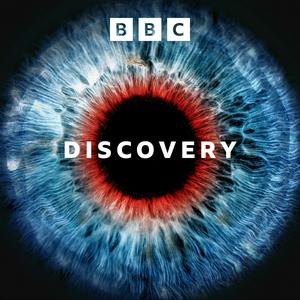
Acerca de Discovery
Explorations in the world of science.
Sitio web del podcastEscucha Discovery, Espacio en blanco y muchos más podcasts de todo el mundo con la aplicación de radio.es
Descarga la app gratuita: radio.es
- Añadir radios y podcasts a favoritos
- Transmisión por Wi-Fi y Bluetooth
- Carplay & Android Auto compatible
- Muchas otras funciones de la app
Descarga la app gratuita: radio.es
- Añadir radios y podcasts a favoritos
- Transmisión por Wi-Fi y Bluetooth
- Carplay & Android Auto compatible
- Muchas otras funciones de la app
Discovery
Escanea el código,
Descarga la app,
Escucha.
Descarga la app,
Escucha.
Discovery: Podcasts del grupo
 España