
Escucha gratis este podcast en la aplicación: Descarga gratuita en la App Store
radio.es
Sleep timer
Favoritos
52 episodios
Episode 49: Tough Choices - Asma Lateef
22/10/2026 | 38 minAs international aid falls sharply, national governments, donors and the nutrition community as a whole face tough choices.
How do we meet urgent needs while investing in prevention and stronger national systems? Is it even possible to do it all? Who decides what comes first? Whose priorities count? Are we getting it right?
N4D’s Carmel, Chris and Jeremy welcome back Asma Lateef to open our new Tough Choices series.
Drawing on the SDG2 Advocacy Hub discussion paper, From Fragmentation to Focus, which she authored, Asma sets the scene for debate during the series.
Please join the debate!
Reading: From Fragmentation to Focus: A Shared Agenda for the Last Mile to 2030 — SDG2 Advocacy Hub discussion paper
Credits: Recorded edited and published by: N4D & Nutriat.co
Theme tune: Saraweto, used with kind permission of Just East of Jazz
© N4D Partners LLP 2026
Hosted on Acast. See acast.com/privacy for more information.Episode 48: The N4D Team. Shrinking Aid, Growing Needs: Why National Nutrition Leadership Matters
31/08/2026 | 47 minIn this episode, the N4D Directors Carmel, Chris and Jeremy, reflect on lessons from supporting country partners in Ethiopia, Niger and Yemen. They discuss why long-term engagement, trust, an understanding of political and institutional contexts, and flexible, demand-driven support matter—particularly in fragile and conflict-affected countries.
As official development assistance declines, the team argues that scarce resources must be better aligned behind nationally agreed multisectoral nutrition priorities to maximise impact and sustainability. This requires investment not only in service delivery, but also in the national and subnational technical leadership, coordination and governance needed to mobilise financing, bridge humanitarian, development and peace efforts, and translate national plans into sustainable results.
The conversation looks ahead to how support for country leadership could be scaled through stronger collaboration between country-based partners and like-minded organisations. It is also an invitation to listeners to share their experiences and help build a more predictable, responsive global support system for countries.
Please join the debate!
Credits: Recorded edited and published by: N4D & Nutriat.co
Theme tune: Saraweto, used with kind permission of Just East of Jazz
© N4D Group 2026
Hosted on Acast. See acast.com/privacy for more information.Episode 47: Dr Joanne Raisin. SUN-RISE or SUN-SET? Where next for the SUN Movement?
23/01/2026 | 52 minIn the final episode of the series reflecting on the future of the Scaling Up Nutrition (SUN) Movement, N4D Directors Chris Leather and Jeremy Shoham are talking to Dr Joanne Raisin, Director of the SUN Movement Secretariat.
This conversation explores what the SUN Movement has achieved since its inception, the key lessons from its third phase and the ambitions of the newly launched SUN 4.0 Strategy (2025–2030). The discussion focuses on how SUN can strengthen country-led action, adapt to a rapidly changing global financing environment and better support fragile and conflict-affected states.
What does the podcast cover?
1. What is the SUN Movement and why does it matter?
SUN as a country-led, multi-stakeholder movement bringing together governments, civil society, donors, UN agencies, and the private sector
The unique value of SUN as a neutral convening platform that supports coordination under country leadership
Reflections on SUN’s achievements to date, including elevating nutrition globally and strengthening multi-sectoral collaboration
Key limitations identified in SUN 3.0, including fragmentation, accountability gaps, and uneven support to fragile states
2. What’s in the SUN 4.0 Strategy (2025–2030)?
SUN 4.0 as a strategic refresh, building on what has worked while adapting to new global realities
Greater attention to:
Fragility, conflict and climate vulnerability
Shifting malnutrition patterns, including overweight and obesity
Future-proofing nutrition outcomes in a constrained financing environment
Looking beyond 2030
Is SUN still needed after 2030?
The future of SUN as a platform shaped by country and regional demand
The importance of localisation, shared ownership and amplifying country voices in global and regional decision-making
Key takeaways
The success of SUN 4.0 will depend less on strategy and more on how the Movement works in practice
Stronger accountability, better coordination and clearer alignment with country-led priorities are essential
Fragile and conflict-affected states must be at the centre of future SUN support
Nutrition integration and sustainable financing require the nutrition community to engage more effectively with other sectors on their own terms
Please join the debate!
Credits: Recorded edited and published by: N4D & Nutriat.co
Theme tune: Saraweto, used with kind permission of Just East of Jazz
© N4D Group 2026
Hosted on Acast. See acast.com/privacy for more information.Episode 46: Madam Manty Tarawalli. SUN-RISE or SUN-SET? Where next for the SUN Movement?
11/12/2025 | 51 minN4D is in conversation for a second time (check out previous short podcast at N4G Summit) with Madam Manty Tarawalli, Minister of State in the Office of the Vice President, discussing Sierra Leone's nutrition progress since joining the SUN Movement in 2012. An acknowledged leader in politics and development, the Honourable Minister is spearheading country-led initiatives to tackle malnutrition: “When you demonstrate leadership as a country by saying to partners, this is the approach you want to take and these are the reasons & expected outcomes you foresee, you get partners following that drive. Without that leadership you get confusion and people doing whatever they want to do,” she affirms.
It seems to be paying off. Recent standout moments include:
High-level political leadership with nutrition anchored in the Office of the Vice President;
Integration of the SUN Secretariat with the Food Systems Coordination Unit for stronger multisectoral alignment;
Introduction of national multisectoral nutrition budget lines (2026) and a new information management system to track investments;
Expansion of home-grown school feeding to 270,000 children; and
Major nutrition gains: exclusive breastfeeding up from 31% (2012) to 50.9% (2023), stunting reduced from 33%(2012) to 25% (2024), and wasting down from 10.7% (2012) to 6.3% (2024).
We also discuss key challenges—food insecurity, climate vulnerability, financing constraints—and why sustained investment and innovative financing mechanisms are critical for continued progress. SUN Movement support has been crucial, providing technical assistance and donor linkages. The Minister advocates for ring-fenced nutrition financing for poorer countries, risk guarantees to boost private sector growth, and multi-country projects to stimulate economic development. The discussion highlights the complexity of multisectoral nutrition efforts and the importance of coordination and tailored support.
Please join the debate!
Credits: Recorded edited and published by: N4D & Nutriat.co
Theme tune: Saraweto, used with kind permission of Just East of Jazz
© N4D Group 2025
Hosted on Acast. See acast.com/privacy for more information.Episode 45: Elisa Gamero. SUN-RISE or SUN-SET? Where next for the SUN Movement?
19/11/2025 | 48 minLike many Latin American countries, El Salvador’s malnutrition problems are increasingly more likely to be Type 2 diabetes amongst eight year-olds than stunting amongst children under 5. Elisa Gamero, Chief of Health and Nutrition Projects in the Office of the First Lady, paints a picture of how the country is tackling high rates of both undernutrition and child overweight/obesity and increased consumption of ultra processed foods. In recent years, El Salvador has made big strides in putting nutrition high in the political agenda, including new laws promoting a healthy start in life, launch of a youth platform, work with the private sector, a national nutrition strategy and more aligned action by UN and other international partners. A multisectoral approach and resource mobilisation, both domestic and international, lie at the heart of these initiatives.
“It was not easy at first… when we first convened these actors, they look at each other [around] this table and say ‘what do I have to do with nutrition? This is a health perspective.’ But when we started developing the actions and they feel that they could connect with all the actions that surround the reduction of malnutrition in El Salvador, they're fully and strongly committed.” SUN’s Latin America regional learning hub and technical support are other features that El Salvador counts as gifts from the SUN Movement - “it’s so important that we learn from countries with a similar political approach and context”.
Please join the debate!
Credits: Recorded edited and published by: N4D & Nutriat.co
Theme tune: Saraweto, used with kind permission of Just East of Jazz
© N4D Group 2025
Hosted on Acast. See acast.com/privacy for more information.
Más podcasts de Ciencias


Podcasts a la moda de Ciencias










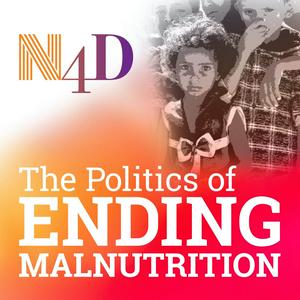
Acerca de The Politics of Ending Malnutrition - Challenging Conversations with Decision Makers
This N4D podcast delivers a series of conversations with country and global decision makers who share their learning on what works, the challenges they face and the support they need to drive political change to end malnutrition.Credits:Recorded edited and published by: N4D & Nutriat.coTheme tune: Saraweto, used with kind permission of Just East of Jazz© N4D Group 2023 Hosted on Acast. See acast.com/privacy for more information.
Sitio web del podcastEscucha The Politics of Ending Malnutrition - Challenging Conversations with Decision Makers, Sapiens y muchos más podcasts de todo el mundo con la aplicación de radio.es
Descarga la app gratuita: radio.es
- Añadir radios y podcasts a favoritos
- Transmisión por Wi-Fi y Bluetooth
- Carplay & Android Auto compatible
- Muchas otras funciones de la app
Descarga la app gratuita: radio.es
- Añadir radios y podcasts a favoritos
- Transmisión por Wi-Fi y Bluetooth
- Carplay & Android Auto compatible
- Muchas otras funciones de la app

The Politics of Ending Malnutrition - Challenging Conversations with Decision Makers
Escanea el código,
Descarga la app,
Escucha.
Descarga la app,
Escucha.
 España