
Escucha gratis este podcast en la aplicación: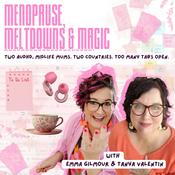 Descarga gratuita en la App Store
radio.es
Sleep timer
Favoritos
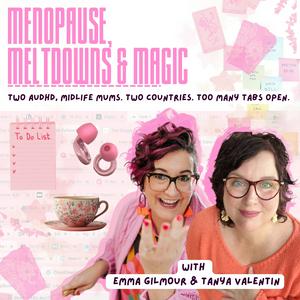
Menopause, Meltdowns & Magic - Two AuDHD, midlife mums. Two countries. Too many tabs open.
Tanya Valentin and Emma Gilmour
Último episodio
17 episodios
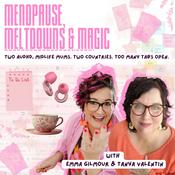
When Support Gets Pulled Apart
21/10/2026 | 1 h 3 minMany of us have felt it lately. Just as lived experience,community and neuro-affirming practice seemed to be gaining ground, the conversation in the media, in policy and across neurodivergent spaces appears to be swinging back toward talk of overdiagnosis, deficit and clinical pathwaysas the only ones that count.
In this conversation, Tanya and Emma share what they arenoticing and how it lands for them, as mothers of neurodivergent children and as neurodivergent women themselves. They talk about being believed, about mothers being blamed and gaslit, and about the very real frustration offamilies whose support needs are high and go unseen. They also wonder aloud about who benefits when a community is divided, and what might become possible when clinicians, peers and lived experience people are able to listen to oneanother.
If you have been feeling unseen, tired or quietly unsure of yourself lately, this may feel like a gentle place to land. You are not the only one noticing.
What we explore:
Why the current mood around neurodivergent diagnosis, support and funding can feel like a step backward.
The difference between the deficit model and the neurodiversity affirming model, and what each asks of systems.
Lived experience, peer support and clinical care as partners rather than opponents.
Mother blaming, gaslighting and the power imbalance many parents describe when seeking help.
The hidden labour of finding practitioners who see you, and why individualised support matters.
Why community spaces, including online ones, can lift shame and offer real belonging.
The nervous system cost of being the one who goes against the grain.
Magic moments
Each episode closes with a magic moment. This week therewere two.
Emma: Sitting with an osteopath who understood the co-occurring conditions that often travel with autism and ADHD, and feeling the quiet relief of being seen and believed, for both parent and child.
Tanya: A little rainbow sticking out of a grey cloud after a rough night, and the reminder that even in a grey season there can still be a little bit of colour and hope.
Need more support
If you are a parent of a neurodivergent child in burnout and you would like something to hold you while you hold everyone else, download the free 10 Tiny Anchors Journey
If you are a woman who is questioning your relationship with alcohol, explore Emma's membership: https://www.hoperisingcoaching.com/bethelighthouseNeeding Space and Still Loving People with Alice Bramhill
02/10/2026 | 1 h 6 minWhat if needing space does not mean you love people any less?
In this episode, Tanya and Emma sit down with Alice Bramhill, a registered mental health nurse, interpersonal psychotherapist and neurodivergent coach, to talk about relationships, retreat and the quiet courage of knowing yourself.
Alice’s first book had only just been released, and it opened a conversation that wandered through grief, friendship, family culture and the pressure to be an “acceptable human”.
Along the way, you may find some gentle permission.
Permission to retreat when the world feelstoo loud.
Permission to follow your own interests rather than someone else’s idea of a social life.
Permission to let your children, and yourself, take space without it meaning anything is wrong.
We close, as always, with a little magic.This week it arrives as a newborn calf, a small black cat hiding in plain sight, and a son who tells his mum she has done apretty good job.You may find this conversation helpful if:
You have ever wondered whether needing timealone says something about how much you care
You are in the in-between of a world that has shrunk and are wondering if that is allowed
You feel the friendships built around your masked self fading, and you are unsure what comes next
You are raising children and hoping they grow up knowing that space is something they never have to apologise for
Who is Alice Bramhill?
Alice is a registered mental health nurse, interpersonal psychotherapist and neurodivergent specialist coach based in the UK.
She began nursing at sixteen, trained in interpersonal psychotherapy through the NHS, and left her full time NHS post in 2018 after her own burnout and as her children came out of school.
She went on to complete an art degree, returned to therapy, and opened her private practice four years ago.
Alice is also a parent of neurodivergent children, a gardener, a reader and the keeper of two dogs and a cat who recently adopted the family.
Her first book, I Need My Space (But I Like You Too!), was published this week, and her second is already written and due next year.A line to carry with you:
“Mixing less is often the medicine. It isn’t the same medicine for everybody.” Alice BramhillResources mentioned in the show:The book: I Need My Space (But I Like YouToo!): A Neurodivergent Guide to All Types of Relationships by Alice Bramhill, published by Jessica Kingsley Publishers. Alice’s book page or the publisher’s page.
Book availability: Alice shared that the publisher expects copies for New Zealand and Australia to arrive in December, and that it can also be ordered online in the meantime.
Alice’s website: alicebramhill.co.uk.
Alice’s Substack: A community for deep feelers and big hearted people, where Alice writes about neurodivergent lifeand relationships.
Interpersonal psychotherapy: The attachment and social theory based talking therapy Alice trained in, which treats relationships as central to how we feel.
Extra Support
The Great Aussie Alcohol Experiment with Emma
Live from 1 October, 30 days, small group coaching, 25spots only.
Join →
Tanya's free 10-Day Tiny Anchors Journey
A gentle, guided starting point for parents wanting asmall, doable anchor in the day to day of burnout recovery.
Start the journey →When School Is Not Working: Unschooling, Burnout and Trust With Guest Melissa Crockett-Joyoue
25/09/2026 | 58 minSome children cannot learn at school, and some parents are left holding that truth while everyone around them has an opinion about it.
In this conversation, Tanya and Emma sit down with Melissa Crockett-Joyoue, a Māori, late-diagnosed AuDHD mama of two unschooled neurodivergent children.
Melissa is also the co-founder of the Unschooling Summit and the founder of Weave ND, an online membership community that supports neurodivergent unschooling families, with a focus on capacity building and connection for the parents.
Melissa shares how her family arrived at unschooling out of crisis rather than choice, and what she has come to understand about learning, trust and nervous systems alongthe way. Together they explore what unschooling actually is, why so many parents feel an unravelling when they step away from a schoolish way of seeing the world, and what learning can look like during burnout when it may not look like learning at all.
There is honest talk about grief, masking, friendship and the quiet work of caring for your own nervous system so that you can hold your child’s. If your child is in burnout and you are wondering whether they are falling behind, this conversation may offer some breathing room.
You may find it supportive to listen for:
Unschooling as child led, parent supported learning that rests on trust and relationship
Why learning during burnout may begin with emotions, connection and environment
Ways to notice the learning already happening in special interests and gaming
The many pathways into further study later, when a young person knows what motivates them
Masking, people pleasing and the cost school can carry for some neurodivergent children
The grief parents carry, and why your own nervous system capacity matters
Melissa Crockett-Joyoue lives in Aotearoa (New Zealand), is Māori and a late diagnosed AuDHD māmā of two unschooled neurodivergent children. Melissa is the founder of Weave ND, an online membership community dedicated to creating connection and building capacity of the parents in neurodivergent unschooling families. She's passionate about advocating for unschooling as an enriching and potentially life-changing path for families, especially those with neurodivergent kids. This lead her to co-found the international online 'The Unschooling Summit' with Esther Jones, which has reached over 11,000 families from 60+ countries over the last two years.
https://weave-community.mn.co/
https://www.instagram.com/weave.nd.unschooling
Offers & further support
FREE 3-Day Alcohol Reset with Emma
22-24 September, 7:30pm AEST (replays available). Ajudgement-free space to learn tools for a take it or leave it relationship withalcohol.
Register →
The Great Aussie Alcohol Experiment with Emma
Live from 1 October, 30 days, small group coaching, 25spots only.
Join →
Tanya's free 10-Day Tiny Anchors Journey
A gentle, guided starting point for parents wanting asmall, doable anchor in the day to day of burnout recovery.
Start the journey →Neurodivergent Marriages and Partnerships
16/09/2026 | 1 h 4 minTanya and Emma sit down for an honest, unscripted conversation about what happens to a marriage or partnership when one or both parents are neurodivergent, and when a child moves into burnout.
They talk about co-regulation, the invisible load carried by the primary caregiver, the grief of an imagined future that never arrived, and why so many parents feel trapped between their own safety and their family's survival. It is a tender, sometimes raw episode, and one both hosts say could easily have run for hours.In this episode
The long middle of a neurodivergent marriage - Tanya reflects on her own thirty-year marriage, marriedat twenty with no idea either of them was neurodivergent, a hard decade of not knowing if they would stay together, and the slow, ongoing work of rediscovering the relationship as two neurodivergent people.
One partner usually leads, the other catches up (or doesn't) - Parenting differently is heavily conditioned against. Often one partner takes the lead in learning new, more neuroaffirming ways and becomes the primary caregiver during a child's burnout, while the other defaults to managing finances and logistics, a split that can breed resentment and feel like judgment rather than support.
Co-regulation quietly shifts from partner to child - Many neurodivergent couples unconsciously co-regulate each other, often without realising it's a foundation of the relationship. When children arrive, that co regulation frequently shifts onto them instead, leaving the partnership without the thing that was holding it steady.
Financial dependency and fawning history can trap people in unsafe places - Stepping back from career to caregiver comes with a real cost: less financial independence, less agency, and more vulnerability,especially layered on top of a fawning, people-pleasing history. Both hosts hear from women, especially in school can't and PDA communities, who stay in relationships that aren't safe or fulfilling because there's no financial way out.
The exhausting performance of the 'perfect parent' is a safety response - Pinterest parties, working-mother guilt, and the pressure to look like you have it all together aren't vanity. Tanya and Emma name these as nervous system safety responses to a deep fear of being seen asfaulty, and talk about the grief underneath it all for the imagined future and community that didn't turn out as hoped.
It's especially hard for dads to be vulnerable or ask for help - Cultural conditioning tells men to toughen up and solve things themselves, therapy carries cost and stigma, and shame often sits underneath anger or control when a father feels powerless to fix his child'sstruggles. For Tanya, the biggest turning point in her marriage was her husband seeking outside support and the two of them doing the Tuning into Teens course together.
Mentioned in this episodeUntamed by Glennon Doyle — referenced for the 'your house is your drawbridge' concept
Tuning into Teens — the parenting course Tanya and her husband completed together
Practical Magic 2 — the film Tanya's magic moment references
Offers & further support
FREE 3-Day Alcohol Reset with Emma
22-24 September, 7:30pm AEST (replays available). Ajudgement-free space to learn tools for a take it or leave it relationship withalcohol.
Register →
The Great Aussie Alcohol Experiment with Emma
Live from 1 October, 30 days, small group coaching, 25spots only.
Join →
Tanya's free 10-Day Tiny Anchors Journey
A gentle, guided starting point for parents wanting asmall, doable anchor in the day to day of burnout recovery.
Start the journey →Rupture and Repair: Healing the Cracks in Our Relationships
07/09/2026 | 59 minMost of us grew up believing that a good relationship never has disagreements, conflict, or angry words.
In this episode, Tanya and Emma sit with the opposite idea: that rupture is inevitable, and the real skill we were never taught is repair.
Together they trace how their families of origin handled conflict (mostly by not handling it at all), why saying sorry to your own children can feel like breaking a generational rule, and how becoming the first generation to actually apologise reshapes the relationship on both sides.
The conversation moves from parenting into perimenopause, masking and unmasking, and the friendships and family ties that do not survive us becoming more honest about our needs. It closes with a set of practical strategies for the relationships we cannot walk away from and a reminder that a relationship which can survive rupture and repair is stronger for it.In This Episode
Why rupture and repair is the topic, and how it kept showing up everywhere this week
Growing up where adults had the final say and feelings were not up for discussion
The myth that parents must know everything and never make mistakes
Being the first generation in the family to say sorry to their children, and meaning it
The shame wired into asking for what you need: “don't be so needy”
A therapist's reframe: would you take offence if your own child told you that you hurt them?
What it looked like when their children, post-burnout, told them everything that had hurt
ADHD, executive functioning, and the “why can't you just do the thing” spiral
How it took their children collapsing into burnout for the pattern to become visible
Why the absence of repair hurts more than the original rupture
Being judged as a parent by how “well-behaved” your children are in public
Practical strategies for hard family visits: time-boxing, radical acceptance, and taking breaks
Glennon Doyle's Untamed and the “leave your fear at the door” family boundary
Naming family culture rules in advance, including no commentary on bodies
Fawning, courage, and finding the words in the moment
The core ingredient of repair: holding two truths (multiplicity) at once.
Resources & Mentions
Untamed by Glennon Doyle — referenced for the “leave your fear at the door” boundary with visitors
Magic Moments (Glimmers)
Tanya - Ordering dinner-plate-sized dahlia bulbs and getting anticipatory joy from the wait
Emma - Buying a trans and LGBTIQ+ ally pin that says “you are safe with me”
If you are a parent of a neurodivergent child in burnout and you would like something to hold you while you hold everyone else, download the free 10 Tiny Anchors Journey
If you are a woman who is questioning your relationship with alcohol, explore Emma's membership: https://www.hoperisingcoaching.com/bethelighthouse
Más podcasts de Familia






Podcasts a la moda de Familia






Acerca de Menopause, Meltdowns & Magic - Two AuDHD, midlife mums. Two countries. Too many tabs open.
Join Tanya Valentin (NZ neuro-affirming family coach) and Emma Gilmour (AUS alcohol-free & neurodivergent women’s coach) for honest, heart-led chats about being late-diagnosed AuDHD, perimenopausal, parenting teens in burnout, and trying not to lose ourselves (again).
We cover masking, menopause, motherhood, identity, friendship, grief, and the messy magic of raising neurodivergent kids.
This is a podcast for every mum who’s ever felt like she’s doing it wrong, too much, or not enough.
Expect laughter, raw honesty, a little swearing, and a whole lot of validation.
Sitio web del podcastEscucha Menopause, Meltdowns & Magic - Two AuDHD, midlife mums. Two countries. Too many tabs open., Adolescencia positiva y muchos más podcasts de todo el mundo con la aplicación de radio.es
Descarga la app gratuita: radio.es
- Añadir radios y podcasts a favoritos
- Transmisión por Wi-Fi y Bluetooth
- Carplay & Android Auto compatible
- Muchas otras funciones de la app
Descarga la app gratuita: radio.es
- Añadir radios y podcasts a favoritos
- Transmisión por Wi-Fi y Bluetooth
- Carplay & Android Auto compatible
- Muchas otras funciones de la app
Menopause, Meltdowns & Magic - Two AuDHD, midlife mums. Two countries. Too many tabs open.
Escanea el código,
Descarga la app,
Escucha.
Descarga la app,
Escucha.
 España

