
Escucha gratis este podcast en la aplicación: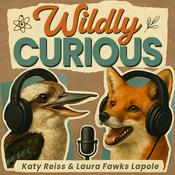 Descarga gratuita en la App Store
radio.es
Sleep timer
Favoritos
192 episodios
The World's Okayest Dog Trainer
22/10/2026 | 49 minSend us Fan Mail
What do dog trainers, invasive insects, and cheese sticks have in common? More than you'd think.
Wildly Curious is BACK for Season 15! We're joined by longtime friend, professional dog trainer, and author Melissa McCue-McGrath to explore the fascinating science of dog training, canine behavior, and scent detection.
From the hilarious realities behind her new book, Misadventures of the World's Okayest Dog Trainer, to training dogs to sniff out invasive spotted lanternfly eggs, we're discovering just how extraordinary our four-legged friends really are.
It's animal behavior, weird science, and plenty of laughs. Welcome back to Wildly Curious!
Buy Melissa's book here! or visit your favorite book distributor and search for "Misadventures of the World's Okayest Dog Trainer".
Support the show
🎉 Support us on Patreon to keep the episodes coming! 🪼🦤🧠 For more laughs, catch us on YouTube!
Track a real wild animal. Support conservation. Feel slightly cooler than you did five seconds ago. Visit www.myfahlo.com to get 20% off tracking bracelets with code WildlyKaty.Nature's Worst Nightmares: The Creepiest Animals on Earth
28/07/2026 | 51 minSend us Fan Mail
Subscribe and unleash your inner science goblin. We see you. We respect it.
Some animals are majestic.
Others...
...should probably stay very, very far away.
In this hilariously horrifying episode of Wildly Curious, Katy Reiss and Laura Fawks Lapole debate the animals they could absolutely live without. From parasites that replace organs to frogs that break their own bones, this episode dives into some of evolution's strangest—and most disturbing—creations.
Along the way you'll meet:
The Hairy Frog—a frog that breaks its own toe bones and pushes them through its skin to create Wolverine-like claws.
Human Botflies—parasites that hitchhike on mosquitoes before developing beneath the skin of mammals.
Brown Marmorated Stink Bugs—the invasive insects that invade homes, destroy crops, and somehow make everything smell worse.
The Tongue-Eating Louse—the only known parasite that functionally replaces an entire organ by becoming a fish's new tongue.
Sloths—beloved by millions... and passionately roasted by Laura for nearly every evolutionary decision they've ever made.
Bobbit Worms—giant ambush predators that hide beneath the sand and explode upward to capture unsuspecting prey—and occasionally hitchhike into home saltwater aquariums.
Of course, beneath all the jokes is real science. Every one of these bizarre animals evolved these adaptations for a reason, proving once again that evolution doesn't care whether humans think something is creepy—it only cares if it works.
If you love weird animals, parasites, wildlife biology, evolution, gross nature facts, or hilarious science podcasts, this episode is guaranteed to make you laugh... and maybe never look at nature the same way again.
Support the show
🎉 Support us on Patreon to keep the episodes coming! 🪼🦤🧠 For more laughs, catch us on YouTube!
Track a real wild animal. Support conservation. Feel slightly cooler than you did five seconds ago. Visit www.myfahlo.com to get 20% off tracking bracelets with code WildlyKaty.The Real-Life Dragon You've Never Heard Of
14/07/2026 | 10 minSend us Fan Mail
Subscribe and unleash your inner science goblin. We see you. We respect it.
What if dragons were real... and they could run across water?
In this minisode of Wildly Curious, Katy Reiss and Laura Fawks Lapole explore one of the most incredible reptiles you've probably never heard of: the sailfin dragon, also known as the sailfin lizard (Hydrosaurus). Native to the rainforests of Southeast Asia and New Guinea, this dragon-like reptile combines the best features of an iguana, a basilisk, and a dinosaur.
With giant sail-like fins, vivid colors, powerful swimming abilities, and juveniles capable of running across water, it's one of the most unique lizards on Earth.
In this episode:
🐉 Why the sailfin dragon looks like a miniature dinosaur
🌊 How young sailfin lizards can run across water before diving to safety
🌴 Why these reptiles split their lives between trees and rivers
🦎 The purpose of their enormous sail-like fins
👁️ The mysterious "third eye" that helps regulate light and biological rhythms
💜 Why some males turn brilliant violet during breeding season
🌏 Where these incredible reptiles live throughout Southeast Asia and New Guinea
From convergent evolution to dragon-worthy adaptations, the sailfin dragon proves that some of the world's most extraordinary animals are hiding in plain sight.
If you love reptiles, dinosaurs, dragons, weird wildlife, evolutionary biology, or discovering animals you've never heard of, this episode is for you.
🎧 Part of our ongoing Animals You've Probably Never Heard Of minisode series.
Support the show
🎉 Support us on Patreon to keep the episodes coming! 🪼🦤🧠 For more laughs, catch us on YouTube!
Track a real wild animal. Support conservation. Feel slightly cooler than you did five seconds ago. Visit www.myfahlo.com to get 20% off tracking bracelets with code WildlyKaty.How Scientists Track Wild Animals (Without Ever Seeing Them)
07/07/2026 | 49 minSend us Fan Mail
Subscribe and unleash your inner science goblin. We see you. We respect it.
How do scientists study animals that spend their lives hiding, migrating thousands of miles, or living deep underwater?
In this episode of Wildly Curious, Katy Reiss and Laura Fawks Lapole explore the incredible technology that's transforming wildlife research. From radar that detects millions of migrating birds to satellites tracking whales from space, conservation has become a real-life spy mission.
Discover how researchers can monitor animals without disturbing them—and sometimes without ever seeing them at all.
In this episode:
🛰️ How the International Space Station helps scientists track wildlife around the globe through the ICARUS program.
📡 Why weather Doppler radar doesn't just detect storms—it can reveal bird migration, bats leaving caves, and even massive insect swarms.
🌳 How LiDAR lasers create detailed 3D maps of forests to identify critical wildlife habitat hidden beneath the canopy.
🧬 The fascinating science of environmental DNA (eDNA), allowing researchers to identify species from tiny traces of genetic material left behind in water, soil, and even air.
🎙️ How passive acoustic monitoring uses AI and machine learning to recognize birds, frogs, bats, and entire ecosystems simply by listening.
🤖 Why scientists build lifelike robotic "spy animals" that secretly film wildlife behaving naturally in the wild.
These technologies are helping scientists understand migration, protect endangered species, detect invasive animals, monitor habitat health, and make better conservation decisions—all while minimizing disturbance to the wildlife they're trying to protect.
If you love wildlife biology, animal behavior, conservation, bird migration, ecology, or cutting-edge science, this episode is packed with some of the coolest technology you've probably never heard of.
Support the show
🎉 Support us on Patreon to keep the episodes coming! 🪼🦤🧠 For more laughs, catch us on YouTube!
Track a real wild animal. Support conservation. Feel slightly cooler than you did five seconds ago. Visit www.myfahlo.com to get 20% off tracking bracelets with code WildlyKaty.The Real-Life Dragon You've Probably Never Heard Of
09/06/2026 | 9 minSend us Fan Mail
Subscribe and unleash your inner science goblin. We see you. We respect it.
What if dragons were real?
In this minisode of Wildly Curious, Katy Reiss and Laura Fawks Lapole explore one of the strangest reptiles on Earth: the Armadillo Girdled Lizard (Ouroborus cataphractus), a tiny armored lizard from South Africa that looks like it crawled straight out of a fantasy novel.
Covered in spiky scales and equipped with one of the most unusual defense strategies in the animal kingdom, this reptile doesn't run from danger. Instead, it grabs its own tail and curls into a living ball of armor.
In this episode:
🐉 Why this lizard is often called a real-life dragon
🦎 The bizarre defense strategy that inspired its scientific name
🌍 Where Armadillo Girdled Lizards live in South Africa
🛡️ How armor, behavior, and social living help them survive predators
👶 Why these reptiles give birth to live young instead of laying eggs
🏜️ How evolution shaped one of the world's most unique lizards
If you love reptiles, wildlife, weird animal adaptations, dragons, natural history, or bizarre creatures from around the world, this episode is for you.
🎧 Part of our ongoing Animals You've Probably Never Heard Of minisode series.
Support the show
🎉 Support us on Patreon to keep the episodes coming! 🪼🦤🧠 For more laughs, catch us on YouTube!
Track a real wild animal. Support conservation. Feel slightly cooler than you did five seconds ago. Visit www.myfahlo.com to get 20% off tracking bracelets with code WildlyKaty.
Más podcasts de Ciencias







Podcasts a la moda de Ciencias

























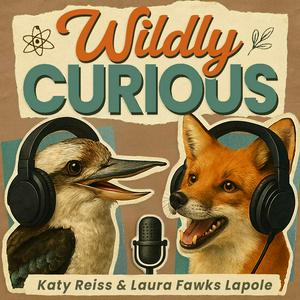
Acerca de Wildly Curious
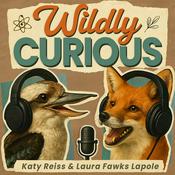
Wildly Curious is a comedy podcast where science, nature, and curiosity collide. Hosted by Katy Reiss and Laura Fawks Lapole, two wildlife experts with a combined 25+ years of conservation education experience, the show dives into wild animal behaviors, unexpected scientific discoveries, and bizarre natural phenomena. With a knack for breaking down complex topics into fun and digestible insights, Katy and Laura make science accessible for all—while still offering fresh perspectives for seasoned science enthusiasts. Each episode blends humor with real-world science, taking listeners on an engaging journey filled with quirky facts and surprising revelations. Whether you're a curious beginner or a lifelong science lover, this podcast offers a perfect mix of laughs, learning, and the unexpected wonders of the natural world.
Sitio web del podcastEscucha Wildly Curious, A hombros de gigantes y muchos más podcasts de todo el mundo con la aplicación de radio.es
Descarga la app gratuita: radio.es
- Añadir radios y podcasts a favoritos
- Transmisión por Wi-Fi y Bluetooth
- Carplay & Android Auto compatible
- Muchas otras funciones de la app
Descarga la app gratuita: radio.es
- Añadir radios y podcasts a favoritos
- Transmisión por Wi-Fi y Bluetooth
- Carplay & Android Auto compatible
- Muchas otras funciones de la app

Wildly Curious
Escanea el código,
Descarga la app,
Escucha.
Descarga la app,
Escucha.
 España

