
Escucha gratis este podcast en la aplicación: Descarga gratuita en la App Store
radio.es
Sleep timer
Favoritos
1987 episodios
Cartwheeling snakes, vocal vultures and a mysterious Martian moon
26/10/2026 | 11 minOn this episode of Science Quickly, host Rachel Feltman discusses Japan’s half-billion-dollar mission to land on Mars’s lumpy little moon Phobos and catches up on animal behavior, both big and small—from newly discovered cartwheeling snakes to the surprisingly complex vocal repertoire of social vultures. We also explore how Japanese macaques developed food caution after surviving a disease outbreak and why adults are actually more creative than preschoolers (they just need more confidence).
See the cartwheeling snakes here!
Recommended Reading:
How did Mars get its moons? Japan’s MMX mission is about to find out
The Primal Pull of People Watching
E-mail us at sciencequickly@sciam.com if you have any questions, comments or ideas for stories we should cover!
Discover something new everyday: subscribe to Scientific American and sign up for Today in Science, our daily newsletter.
Science Quickly is produced by Rachel Feltman, Fonda Mwangi, Sushmita Pathak, Allison Rodgers and Jeff DelViscio. This episode was edited by Alex Sugiura, with fact-checking by Emily Makowski, Marielle Issa and Aaron Shattuck. Our theme music was composed by Dominic Smith.
Learn more about your ad choices. Visit megaphone.fm/adchoicesWhy your brain hates uncertainty
23/10/2026 | 22 minOur brains are constantly trying to predict what comes next, but in an increasingly unpredictable world, that mental workload can fuel stress, anxiety and even depression. In this episode of Science Quickly, author Maia Szalavitz explains how the brain processes uncertainty, why some people are better equipped to handle it than others and how we can build resilience by learning to embrace the unknown.
Recommended Reading:
How uncertainty breaks the brain
E-mail us at sciencequickly@sciam.com if you have any questions, comments or ideas for stories we should cover!
Discover something new every day: subscribe to Scientific American and sign up for Today in Science, our daily newsletter.
Science Quickly is produced by Rachel Feltman, Fonda Mwangi, Sushmita Pathak, Allison Rodgers and Jeff DelViscio. This episode was edited by Alex Sugiura, with fact-checking by Marielle Issa and Aaron Shattuck. Our theme music was composed by Dominic Smith.
Learn more about your ad choices. Visit megaphone.fm/adchoicesSlime molds, Pompeii and alien consciousness with Annalee Newitz
21/10/2026 | 20 minIn this episode of Science Quickly, science journalist and science-fiction author Annalee Newitz discusses their novel A Wall Is Also a Road, a story about a graduate student who also happens to be a conscious slime mold alien. The slime mold, named Gardenpath, has decided to study an alien civilization, and her fieldwork has taken her to Pompeii, where she befriends a local sex worker named Murtis. Newitz and Science Quickly host Rachel Feltman talk about the compelling nature of slime molds, the value of looking at human civilization from the outside and the ordinary people of Pompeii.
Recommended Reading:
Ancient Roman scrolls destroyed by Mount Vesuvius digitally unrolled in full for first time
Tom Hiddleston on Pompeii, Mount Vesuvius and the human stories frozen in time
Slime Mold Helps to Map the Universe’s Tendrils of Dark Matter
How Slime Molds Remember Where They Ate
E-mail us at sciencequickly@sciam.com if you have any questions, comments or ideas for stories we should cover!
Discover something new every day: subscribe to Scientific American and sign up for Today in Science, our daily newsletter.
Science Quickly is produced by Rachel Feltman, Fonda Mwangi, Sushmita Pathak, Allison Rodgers and Jeff DelViscio. This episode was edited by Alex Sugiura, with fact-checking by Marielle Issa and Aaron Shattuck. Our theme music was composed by Dominic Smith.
Learn more about your ad choices. Visit megaphone.fm/adchoicesCover Story: Escaping the Infinite Scroll
20/10/2026 | 29 minHow much screen time is too much? In this episode of Science Quickly, Scientific American associate editor Allison Parshall reads her November cover story, “Escaping the Infinite Scroll.” In the story, she explores the growing debate over screen addiction and problematic social media use. From landmark lawsuits against tech companies to the psychology behind endless scrolling, she explains what researchers know about digital dependence, why social platforms are designed to keep us engaged and how some people are turning to addiction-style recovery programs for help.
Recommended Reading:
Meta to pay $18 billion and make sweeping app changes to settle social media harms lawsuit
E-mail us at sciencequickly@sciam.com if you have any questions, comments or ideas for stories we should cover!
Discover something new every day: subscribe to Scientific American and sign up for Today in Science, our daily newsletter.
Science Quickly is produced by Rachel Feltman, Fonda Mwangi, Allison Rodgers and Jeff DelViscio. This episode was edited by Allison Rodgers. The article was fact-checked by Wudan Yan.
Learn more about your ad choices. Visit megaphone.fm/adchoicesBee stingers, plastic risks and ovarian surprises
19/10/2026 | 9 minIn this episode of Science Quickly: a surprising discovery about postmenopausal ovaries, new evidence that microplastics may harm cells through their physical structure, the secret mechanics of honeybee stingers and a cyberattack that spoiled food in hundreds of supermarkets. Catch up on the latest science and tech news.
Recommended Reading:
Do women hit a biological ‘cliff’ at menopause?
Microplastics are linked to inflammation—scientists might have finally worked out why
Honeybees deemphasize potential ‘misinformation’ in their waggle dances
E-mail us at sciencequickly@sciam.com if you have any questions, comments or ideas for stories we should cover!
Discover something new every day: subscribe to Scientific American and sign up for Today in Science, our daily newsletter.
Science Quickly is produced by Rachel Feltman, Fonda Mwangi, Allison Rodgers and Jeff DelViscio. This episode was edited by Alex Sugiura, with fact-checking by Marielle Issa and Aaron Shattuck. Our theme music was composed by Dominic Smith.
Learn more about your ad choices. Visit megaphone.fm/adchoices
Más podcasts de Ciencias







Podcasts a la moda de Ciencias























Acerca de Science Quickly
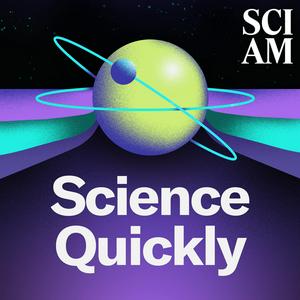
Host Rachel Feltman, alongside leading science and tech journalists, dives into the rich world of scientific discovery in this bite-size science variety show.
Sitio web del podcastEscucha Science Quickly, Sapiens y muchos más podcasts de todo el mundo con la aplicación de radio.es
Descarga la app gratuita: radio.es
- Añadir radios y podcasts a favoritos
- Transmisión por Wi-Fi y Bluetooth
- Carplay & Android Auto compatible
- Muchas otras funciones de la app
Descarga la app gratuita: radio.es
- Añadir radios y podcasts a favoritos
- Transmisión por Wi-Fi y Bluetooth
- Carplay & Android Auto compatible
- Muchas otras funciones de la app

Science Quickly
Escanea el código,
Descarga la app,
Escucha.
Descarga la app,
Escucha.
Science Quickly: Podcasts del grupo
 España