

Escucha gratis este podcast en la aplicación: Descarga gratuita en la App Store
radio.es
Sleep timer
Favoritos
260 episodios
How 5 Masters Triathletes Fuelled the Hilliest 70.3 in the World
17/09/2026 | 1 h 1 minWhat does it take to fuel the hilliest 70.3 in the world?
Six Triathlon Nutrition Academy athletes lined up at the IRONMAN 70.3 World Championship in Nice, France on 12 and 13 September 2026. A 1.9km swim in the Mediterranean, 90km on the bike with around 1190m of climbing, a long grind up the Col de Vence, an 11km technical descent with both hands on the brakes, then a flat half marathon in the baking French sun along the Promenade des Anglais.
One day after the race, five of them sat down with me to talk through what they did, what they would change and what they would tell you if Nice is on your bucket list. Most of them are masters athletes racing in the 60 to 69 age groups. Not one of them raced on the same nutrition plan.
Joining me are Kathleen Gilton, Kelly Estes, Stephen Duquette, Stanford Skelton and Daniel Walker.
WHAT YOU WILL TAKE AWAY
Why the athlete who was most afraid of the bike had the best ride of her life
How bike choice and gearing change what you can carry, and when you can actually drink it
How to ride light on a long climb without under-fuelling the back half of your race
What it takes to run a hot half marathon with no cramping, four years after cramping nearly ended a triathlon career
The race week mistake that cost a well-prepared athlete 20 minutes on the run, and it had nothing to do with training
Why six athletes on the same course, in the same heat, all fuelled differently and all got it right
TIMESTAMPS
01:46 Meet the athletes who raced Nice
02:47 Kathleen on the bike leg she feared most
08:53 Road bike or TT bike, and gearing
11:36 Losing 8kg without losing bike power
15:24 Riding light on the climb without under-fuelling
17:53 A hot run and the cramps that never came
23:02 When race day does not go to plan
31:54 Saturday women, Sunday men: the split day
40:05 What each athlete is most proud of
49:40 Would they have got there without nutrition
If you want to be the athlete who gets off a plane in a foreign country and knows exactly what they are doing, come and join us inside the Triathlon Nutrition Academy.
See omnystudio.com/listener for privacy information.The Next 4 Things I'd Fix If You Were My Athlete
10/09/2026 | 22 minMost triathletes are working their nutrition list backwards. They start at number eight and skip one through seven entirely.
In Episode 229 I walked you through the first four things I fix with every triathlete I work with. The big rocks. This is Part 2, and it picks up at number five. If you have not heard 229 yet, go and listen to that one first, because these next four do not work without the foundations underneath them.
Number five is your hydration and electrolytes, which most athletes think they have sorted and almost never do. Number six is the three micronutrients that quietly put a ceiling on everything else. Number seven is your race nutrition strategy, which is a lot more than deciding which gel you are taking. And number eight is the fun stuff, the sprinkles on the icing on your cake, which is exactly where nearly everybody wants to start.
WHAT YOU WILL TAKE AWAY
Why one standalone sweat test is not a number you can set and forget for life
The three micronutrients that determine whether you can train and race well, and why supplementing blindly is the wrong first move
What a race nutrition strategy actually involves, and why practising your fuel is not the same as practising it at race intensity
The full roll call of supplements and gadgets triathletes ask me about, and where they genuinely belong in the order
Why your recovery nutrition does not finish when you cross the finish line
The order I would work through all eight in, so you get the best bang for your buck
TIMESTAMPS:
01:26 Hydration, sodium and sweat testing for triathletes
04:57 Iron, calcium and vitamin D for endurance athletes
08:59 Race nutrition strategy and recovery after racing
13:36 Performance supplements and what actually works
18:52 How to fix your triathlon nutrition in order
WANT ALL EIGHT BUILT OUT PROPERLY, IN THE RIGHT ORDER, FOR YOU?
That is exactly what the Triathlon Nutrition Academy is. It is not a meal plan and it is not one size fits all. It is me teaching you how to build your own nutrition strategy around your training, your race schedule and your actual life, so you walk out knowing how to do this for yourself for the rest of your racing life. We open the doors a few times a year. Get your name on the list at dietitianapproved.com/academy so you know the moment they open.
SUPPORT THE PODCAST HERE
CONNECT WITH TARYN
Website | Instagram | Facebook | YouTube
The Triathlon Nutrition Academy® is a podcast by Dietitian Approved®. All rights reserved.
See omnystudio.com/listener for privacy information.How to Fuel an Ironman When You've Only Ever Raced 70.3
03/09/2026 | 32 minYou can get away with a fuelling gap over five hours. You cannot get away with it over 13.
Stepping up from 70.3 to Ironman is the exact moment most triathletes work out that their fuelling needs attention. Julie Whitton is 13 weeks out from Ironman Western Australia, her first full distance race after a decade of racing halves. She is a paramedic with New South Wales Ambulance, she has been a shift worker for 21 years, and she trains off a nine day roster that changes constantly. In this episode she takes Taryn through exactly what she has had to upgrade to get to that start line, and where the gaps showed up once the hours went up.
This is not a first Ironman story. This is the step up story, for the triathlete who already races 70.3 well and assumes that skill carries over.
IN THIS EPISODE
What changes in your bike and run fuelling numbers when a race goes from five hours to 13 hours
Why a small hourly shortfall you got away with at 70.3 compounds into a walk at full distance
The shift from liquid fuel to solid food on long rides, and the trap of swapping over too fast
How to gut train on gels without hitting flavour fatigue weeks before race day
What Julie was doing at 70.3 that stopped working the moment the volume climbed
Why she moved her recovery from 90 percent to 100 percent, and what that changed in her week
Fuelling your body for what you want it to do rather than for how you want it to look
TIMESTAMPS
04:37 Training for Ironman around shift work
07:12 Bike fuelling from 70 to 80 grams
13:25 Run fuelling and flavour fatigue
17:35 What stopped working at full distance
23:35 Fuelling for performance not appearance
ABOUT JULIE WHITTON
Julie (Jules) Whitton is an age group triathlete and a paramedic with New South Wales Ambulance, where she has worked shift work for 21 years. She has been a Triathlon Nutrition Academy athlete since January 2023 and is now part of the Supercharged Squad. After a decade racing 70.3, she is stepping up to full distance at Ironman Western Australia on 6 December 2026. Julie was last on the show in Episode 119, Juggling Shift Work and Triathlon.
If you have a couple of halves behind you and a full quietly sitting on your list, the athletes who come unstuck are almost always the ones trying to learn how to fuel and how to train for 226 kilometres at the same time. Do one of those things first. Get your name on the list for our next cohort of the Triathlon Nutrition Academy at [dietitianapproved.com/academy](https://www.dietitianapproved.com/academy) and you will be the first to know when we open doors.
SUPPORT THE PODCAST [HERE](https://www.dietitianapproved.com/legend)
CONNECT WITH TARYN
[Website](https://www.dietitianapproved.com)
[Instagram](https://www.instagram.com/dietitian.approved/)
[Facebook](https://www.facebook.com/DietitianApproved)
[YouTube](https://www.youtube.com/@dietitianapproved)
The Triathlon Nutrition Academy® is a podcast by Dietitian Approved®. All rights reserved.
See omnystudio.com/listener for privacy information.Maurten vs Precision vs SIS Beta Fuel: A Triathlon Dietitian's Verdict
27/08/2026 | 18 minAre you paying up to $5.20 a gel because that is what they hand out on course?
Maurten, Precision Fuel and Hydration and SIS Beta Fuel are the three gels I get asked about more than any others. So I put them side by side and worked out what is actually in the packet, what each one costs you per 100 grams of carbohydrate, and whether that price gap buys you anything at all. No brand has paid me a cent to talk about them. I am Switzerland when it comes to sports nutrition products.
One of these gels costs roughly two thirds more than another for the exact same gram of carbohydrate. Whether that is money well spent comes down to three things most triathletes have never been taught to look for.
WHAT YOU WILL TAKE AWAY
What is actually inside each gel: carbohydrate, sodium, calories, caffeine and the main ingredients
What it costs to fuel at 90 grams of carbohydrate an hour on each brand, in both Aussie and US dollars
What the glucose to fructose ratio means in plain English, and the carbohydrate rate you need to be hitting before it matters to you
Whether the hydrogel does what the marketing implies it does
Which gel makes sense for Sprint, Olympic, 70.3 and full distance racing
How to read a sports nutrition label so you are not at the mercy of whoever has the biggest marketing budget
STUDIES MENTIONED
Currell, K., & Jeukendrup, A. E. (2008). Superior endurance performance with ingestion of multiple transportable carbohydrates. Medicine & Science in Sports & Exercise, 40(2), 275 to 281. [https://doi.org/10.1249/mss.0b013e31815adf19](https://doi.org/10.1249/mss.0b013e31815adf19)
O’Brien, W. J., & Rowlands, D. S. (2011). Fructose-maltodextrin ratio in a carbohydrate-electrolyte solution differentially affects exogenous carbohydrate oxidation rate, gut comfort, and performance. American Journal of Physiology-Gastrointestinal and Liver Physiology, 300(1), G181 to G189. [https://doi.org/10.1152/ajpgi.00419.2010](https://doi.org/10.1152/ajpgi.00419.2010)
ALSO MENTIONED
Episode 47: What is a Hydrogel? Does it improve endurance performance, with Andy King. [Listen here](https://www.dietitianapproved.com/podcast/episode-47)
The exact gel you use is the last 5% of your race nutrition strategy. If you want the other 95%, the Triathlon Nutrition Academy is my nine month education program that teaches you how to fuel your training week, train your gut and build a race plan that is uniquely yours. Doors open again soon, so register your interest at [dietitianapproved.com/academy](https://www.dietitianapproved.com/academy).
SUPPORT THE PODCAST (https://www.dietitianapproved.com/legend)
CONNECT WITH TARYN
[Website](https://www.dietitianapproved.com) | [Instagram](https://www.instagram.com/dietitian.approved/) | [Facebook](https://www.facebook.com/DietitianApproved) | [YouTube](https://www.youtube.com/@dietitianapproved)
The Triathlon Nutrition Academy® is a podcast by Dietitian Approved®. All rights reserved.
See omnystudio.com/listener for privacy information.Over 45 and Losing Power? Your Protein Isn't Working Like It Used To
20/08/2026 | 14 minEverywhere you look, someone is telling you to eat more protein. If you are over 45 and your power is going backwards, more protein is not the fix you have been promised. Back in January the US dietary guidelines roughly doubled their protein recommendation, and that was overdue. But guidelines written for a sedentary population are a very different thing to guidelines for an athlete training 10 to 15 hours a week. Something real does change in your muscles as you get older, and the research on masters triathletes makes for uncomfortable reading. What it does not show is that eating more protein fixes it. In this episode I take you through what is actually happening in ageing muscle, what happened when researchers doubled the protein after a muscle damaging session, and the 5 protein levers to pull instead of just reaching for more.
WHAT YOU WILL TAKE AWAY
• What anabolic resistance is in plain English, and why the rules changed at about 35 without anybody sending you the memo
• Inside the Australian study that compared masters triathletes with younger ones, and what happened to their muscle repair and their cycling time trials
• What doubling the post exercise protein dose actually bought masters triathletes, and what it did not • Why your total protein intake stops paying you back once you are in a reasonable range
• The 5 protein levers, and why most triathletes only ever pull number 5
• Why your breakfast is almost certainly the weak link in your day
• Why the same mistake is happening right now with carbohydrate
TIMESTAMPS
00:00 Everywhere you look, eat more protein
00:27 Over 45 and your power is going backwards
00:55 The number is the easy part, eating it is not
01:22 Welcome
01:43 What actually changes in your body as you get older
02:10 Anabolic resistance, in plain English
02:41 Inside the study: masters versus younger triathletes
03:40 What happened over the 3 days
04:04 It is not your fault, the rules changed at 35
04:43 So should you just eat more protein?
05:08 The follow up study: double the dose
05:57 What doubling the protein actually bought them
06:43 Why simply more is not the fix
07:17 The bit that is genuinely hard for an age-grouper
08:01 What happens in the real world, week by week
09:14 The internet gives you a number and walks away
09:51 The barbecue study, Episode 141
10:14 You are a human, not a snake
10:51 Masters swimmers: the total was fine, the pattern wasn't
11:28 The 5 protein levers
12:17 Eating more is not a strategy
12:48 The recap
13:22 What to actually do about it
ALSO MENTIONED
• Episode 179 with Joe Friel on how masters athletes can get fast and stay fit after 50: https://www.dietitianapproved.com/podcast/episode-179
• Episode 141, affectionately dubbed the barbecue study, on large protein doses in one sitting: https://www.dietitianapproved.com/podcast/episode-141)
STUDIES MENTIONED
• Doering, T. M., Jenkins, D. G., Reaburn, P. R., Borges, N. R., Hohmann, E., & Phillips, S. M. (2016). Lower integrated muscle protein synthesis in masters compared with younger athletes. Medicine & Science in Sports & Exercise, 48(8), 1613-1618. [https://doi.org/10.1249/MSS.0000000000000935](https://doi.org/10.1249/MSS.0000000000000935)
• Doering, T. M., Reaburn, P. R., Borges, N. R., Cox, G. R., & Jenkins, D. G. (2017). The effect of higher than recommended protein feedings post-exercise on recovery following downhill running in masters triathletes. International Journal of Sport Nutrition and Exercise Metabolism, 27(1), 76-82. [https://doi.org/10.1123/ijsnem.2016-0079](https://doi.org/10.1123/ijsnem.2016-0079)
• Santos de Souza, M., Zaleski Trindade, C. D., de Souza Castro, F. A., Buss, C., & Schneider, C. D. (2025). Protein intake by master swimmers: Implications for practice in sports nutrition, a cross-sectional study. Nutrition and Health, 31(3), 1095-1101. [https://doi.org/10.1177/02601060241276918](https://doi.org/10.1177/02601060241276918)
READY TO STOP GUESSING?
Knowing what to eat and when, around your own training program, is the whole game as you get older. That is exactly what I teach inside the Triathlon Nutrition Academy, and then troubleshoot with you every week in our Power Hour calls, so you are still doing it in 12 months time.
Register your interest for our next cohort at https://www.dietitianapproved.com/academy.
Download the FREE audio series The 5 Biggest Nutrition Mistakes Costing You Time on Race Day
Recovery Accelerator Program
SUPPORT THE PODCAST HERE
CONNECT WITH TARYN
Website | Instagram | Facebook | YouTube
The Triathlon Nutrition Academy® is a podcast by Dietitian Approved®. All rights reserved.
See omnystudio.com/listener for privacy information.
Más podcasts de Deportes
 Carrusel DeportivoDeportes
 El tercer temps de LaTdTDeportes
 100 YardasDeportes, Fútbol americano
 El Partidazo de COPEDeportes
 El Primer PaloDeportes, Futbol
 El Barça juga a RAC1 - L'hora a horaDeportes
 Tiempo de JuegoDeportes
 La SotanaDeportes, Futbol
 La Tribu con Raúl VarelaDeportes
 Tu diràs - L'hora a horaDeportes
Podcasts a la moda de Deportes
 De Padres a HijosDeportes, Futbol
 Directo MARCA SevillaBasquetbol, Deportes, Futbol, Fútbol americano, Noticias, Noticias deportivas
 The Race F1 PodcastDeportes
 The Tennis PodcastDeportes, Tenis
 Estrategas del Trail y RunDeportes, Running
 Nacho Losilla - NBA en españolBasquetbol, Deportes
 Play Basket
 The Athletic NBA DailyBasquetbol, Deportes, Humor, Noticias, Noticias deportivas
 Live to Triathlon - Triatlón de media y larga distanciaDeportes
 Tirando a FallarBasquetbol, Deportes
 LaTdTDeportes, Noticias, Noticias deportivas
 Euro LeaguesDeportes, Futbol
 The Dan Le Batard ShowDeportes
 Podcast de La Hora de WalterDeportes, Futbol
 SER RunnerDeportes, Running
 Ecos de la NFLDeportes
 El club de la mitjanitDeportes, Noticias, Noticias deportivas
 TERRITORIO TRAILDeportes, Running
 La Transición - TriatlónDeportes
 Maneras de VivirDeportes, Futbol
 La Escapada Cultura CiclistaDeportes
- El Barça juga a RAC1 - L'hora a horaDeportes
 Sky Sports Premier League PodcastDeportes, Futbol, Noticias, Noticias deportivas
 Barça con Joan PratsDeportes, Futbol
 Radio MARCA ValenciaDeportes, Futbol
Acerca de Triathlon Nutrition Academy
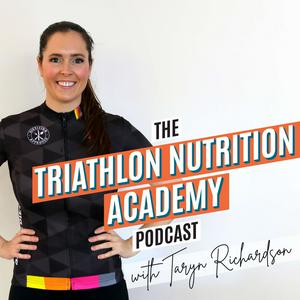
Welcome to the Triathlon Nutrition Academy Podcast! Brought to you by Advanced Sports Dietitian, Taryn Richardson. Listen as I break down the latest science to give you practical, easy to digest strategies to transform yourself into a Supercharged Triathlete! You have so much untapped potential...and I want to help you unlock that with the power of nutrition.
Sitio web del podcastEscucha Triathlon Nutrition Academy, Carrusel Deportivo y muchos más podcasts de todo el mundo con la aplicación de radio.es
Descarga la app gratuita: radio.es
- Añadir radios y podcasts a favoritos
- Transmisión por Wi-Fi y Bluetooth
- Carplay & Android Auto compatible
- Muchas otras funciones de la app
Descarga la app gratuita: radio.es
- Añadir radios y podcasts a favoritos
- Transmisión por Wi-Fi y Bluetooth
- Carplay & Android Auto compatible
- Muchas otras funciones de la app

Triathlon Nutrition Academy
Escanea el código,
Descarga la app,
Escucha.
Descarga la app,
Escucha.
Triathlon Nutrition Academy: Podcasts del grupo
 España