

Escucha gratis este podcast en la aplicación: Descarga gratuita en la App Store
radio.es
Sleep timer
Favoritos
55 episodios
SD53 Carles Guerra “Tosquelles: El diagnóstico de una locura colectiva”
28/06/2026 | 1 h 10 minSD53 Carles Guerra “Tosquelles: El diagnóstico de una locura colectiva”
Carles Guerra nos presenta su trabajo de investigación sobre la increíble figura de Francesc Tosquelles. Ahora que volvemos a vivir en un estado de guerra, hablar de Tosquelles nos puede ayudar a entender cómo se pueden generar herramientas y formas de trabajo colectivas, así como nuevas maneras de relacionarse con las instituciones, transformándolas y cuestionando las divisiones del trabajo establecidas. Fundamental para lo que se llama la psicología institucional, su influencia se extiende a psiquiatras como Jean Oury, Frantz Fanon y Félix Guattari. Tosquelles fue de las primeras en aunar las ideas de Marx y Lacan, desarrollando técnicas fundamentales a partir de la idea de que el hospital en sí mismo forma parte de la enfermedad.
Tras haber pasado por campos de concentración en Francia después de la Guerra Civil Española, comenzó a trabajar en el Hospital psiquiátrico de Saint-Alban. En ese contexto, en Francia se estaba produciendo lo que se ha llamado el “exterminio dulce”, en el que personas con problemas de salud mental morían por hambre y abandono. Frente a ello, en Saint-Alban se desarrollaron prácticas colectivas que articularon clínica, arte, política y vida cotidiana. También abordamos la instrumentalización que Jean Dubuffet hizo de los trabajos artísticos de lxs pacientes bajo su concepto de art brut.
Saint-Alban no era solo un hospital, sino un auténtico nodo político, clínico e intelectual, donde circulaban médicos, resistentes, poetas y filósofos como Georges Canguilhem. También abordamos la figura de Josep Solanes, fascinante psiquiatra catalán exiliado tras la guerra, cuya trayectoria se cruza con la de Antonin Artaud en 1943, durante su internamiento en el Hospital psiquiátrico de Rodez. Hablamos asimismo de la gran recepción que está teniendo el trabajo de investigación sobre Tosquelles y de los riesgos de simplificación que pueden surgir al abordar una figura tan compleja.SD55 w/ Marek Poliks and Roberto Alonso Trillo - Exocapitalism
16/06/2026 | 1 h 14 minIn this episode of Social Discipline, we talk to Marek Poliks and Roberto Alonso Trillo about their book Exocapitalism: Economies with Absolutely No Limits. Can we rethink capitalism beyond the familiar language of labour, ideology, social construction, and historical origin? Poliks and Alonso Trillo argue that capital should be understood less as a human-centred mode of production than as a logic of arbitrage: the extraction of value from differentials across time, markets, substrates, and scales. The conversation asks whether contemporary capitalism can still be fought with the concepts we have, or whether the problem has to be reformulated from first principles.SD54 Sunik Kim "No Exit but Revolution"
26/04/2026 | 1 h 58 minIn this episode, we speak with Sunik Kim — Korean American musician, writer, and filmmaker based in Los Angeles. Kim's music has been described as "a frenzied electronic orchestra that sits somewhere between free jazz, noise, and Korean shamanic music. Their writing, spanning subjects from Korean communism to Conlon Nancarrow, has appeared in The Wire, Pitchfork, Bandcamp Daily, Tone Glow, and elsewhere. We discuss in detail their new essay "Zones of Illusion", tracing the connections between illusion, cognition, class, and the conditions under which sound — and thought — might still escape capture.
Today, International Workers' Day 2026, Sunik Kim releases seven CDs of new music, three essays, including "Zones of Illusion", and a book. More details at sunikkim.com.
Thanks to Fielding Hope.
Direct link to "Zones of Illusion":
https://sunikkim.com/zones-of-illusionSD52 Andreas Petrossiants "We Can Now See Clearly What We Are Up Against"
04/04/2026 | 1 h 9 minSD52 Andreas Petrossiants
"We Can Now See Clearly What We Are Up Against"
In this episode, we begin by expressing our admiration for and inspiration from our late friend Marina Vishmidt. We actually met last year in Vienna at the conference celebrating her work "What Is Infrastructural Critique?”. We discuss Vishmidt critical insights into the collapse of the myth of artistic autonomy and how art operates within broader infrastructures of capital. Petrossiants, who has been involved in housing struggles in New York City for some time, is now pursuing a PhD at NYU, working with Michelle Castañeda and Fred Moten. He has been researching the struggles of 1970s Italy from the perspective urban development and spatial composition (following Neil Gray), including autoreduction movements, proletarian shopping, and mass refusals of work and payment, alongside movements such as lotta continua, potere operaio and Nuclei Armati Proletari (NAP), and figures like Silvia Federici and Henri Lefebvre.
We address the contradictions of art and institutional critique, where even radical themes, such as incarceration, are absorbed into liberal museum frameworks. From both U.S. and Italian perspectives, we consider the emergence of a post-liberal order and ask what defines citizenship today, as new forms of exclusion and racism become more explicit. The conversation turns to ongoing struggles in the US against ICE, asking how these different fronts articulate within a social field where production and reproduction have increasingly merged.
Finally, we examine how infrastructures, such as those developed by companies like Amazon, are not only economic but increasingly carceral, enabling new forms of control in which subjects risk becoming disposable. We ask what defines citizenship today, as more explicit forms of racism re-emerge. In this context, Israel’s treatment of Palestinian lives appears as a forerunner of broader tendencies across the West, where similar logics of exclusion and disposability are beginning to take hold in regards to immigrants for example. The podcast situates these trajectories within a broader question: how to understand and confront a system in which urban space, culture, and social life are increasingly subsumed while a new wave of fascism emerges. We can now see clearly what we are up against, however we still have to see what forms of radicalisation will emerge.SD51 Jakob Jakobsen "The Ghost of Jakob Jakobsen" with Dream Academy and SASUSU Radio
25/03/2026 | 1 h 49 minSD51 in collaboration with Dream Academy and SASUSU Radio
Jakob Jakobsen “The Ghost of Jakob Jakobsen”
For the first time publicly, we recorded Social Discipline live at Tromsø Kunstforening (TKF) on March 1, 2026, with Henrik Sørlid from Dream Academy and an engaged audience.
We begin with Jakobsen’s Letter of Resignation (2021), his farewell to the art scene, where he explains his motivations for the first time ever. However his practice has involved not only gestures of negation but also of affirmation. Deeply rooted in the punk ethos of DIY and unskilled practice, the underground industrial tape music networks of the 1980s, and strongly influenced by Dadaism, Surrealism, and Situationism, he has taken the radical proposition that “you can also do it” to the level of institutions, founding a university (Copenhagen Free University) and even a hospital (The Hospital for Self-Mediation). Over many years, he has been engaged in collaborative practices and self-organisation, for example through alternative television (tv tv), publishing initiatives (Infopool Magazine and Nebula), and activist spaces (Info Centre).
Jakobsen might have abolished himself as an artist but following Walter Benjamin’s conception of history, he understands these projects as unfinished struggles that can be reactivated as revolutionary tools for the present and future. In turn, he has excavated radical experiments that are often forgotten, such as Antiuniversity London and antipsychiatric movements like the Sozialistisches Patientenkollektiv, reactivating their potential. An eerieness frames these practices as animated by the ghosts of unrealised futures, traces of abandoned struggles and suppressed possibilities that continue to unsettle the present and open new possibilities within the limits imposed by the state and capitalism, in opposition to the prevailing sense of doom and gloom.
At the same time, he interrogates the darker, exclusionary histories of the Danish welfare state, which he describes as a “work state.” He has a personal experience, specially in regards to mental institutions. He had lived with anxiety and depression since puberty and the last years he has been in and out of this institutions. His whole practice questions the state's production of subjectivity. Situated between activism, art, and everyday life, and informed by psychoanalysis, he engages in creating spaces where knowledge, relations, and forms of life are collectively produced, focusing on the construction of social relations, infrastructures, architectures, and modes of living.
This podcast also contains sounds from unpublished tapes that Jakobsen recorded in 1985, a hauntological soundtrack against today's hopelessness.
Thank you to the Dream Academy, SASUSU Radio and Tromsø Kunstforening (TKF)
Más podcasts de Gobierno
 Pulso GeopolíticoGobierno
 British Council Language AssistantsGobierno
 La Ingobernable. Un podcast sobre Marca EspañaGobierno
 The InterviewGobierno, Noticias, Política
 Encuentros Fundación TelefónicaGobierno
 Solo DocumentalGobierno
 Charlas de LaboralistasGobierno
 Today in ParliamentGobierno
 El Orden MundialGobierno, Historia, Noticias, Política
Podcasts a la moda de Gobierno
 Strict ScrutinyCultura y sociedad, Filosofía, Gobierno, Noticias
 Los Podcast de la Fundación - FMMGobierno
- Charlas de LaboralistasGobierno
 Debates en Para Todos la 2Gobierno
 En Modo Avión PodcastDeportes, Economía y empresa, Empresa, Gobierno
 The Proceedings PodcastGobierno
 The Lawfare PodcastGobierno, Historia, Noticias, Política
 The DSR NetworkGobierno
 apolut: TagesdosisCultura y sociedad, Gobierno, Noticias
 The Law ShowGobierno, Noticias, Política
 Columnistas Página 13Cine y Televisión, Gobierno, Noticias, Ocio
 La voz de los tribunalesGobierno
 European Parliament - EPRS Science and Technology podcastsEconomía y empresa, Gobierno, Sin fines de lucro
 Inside the FBIGobierno
- The InterviewGobierno, Noticias, Política
 Va de PerrosGobierno
 Hacia el futuroGobierno
 The Week in WestminsterGobierno
 COPE Jaén. Podcast de Francisco RocaGobierno
 Infraestructuras que te cambian la vidaGobierno
 A Matter of DegreesComentando la noticia, Cultura y sociedad, Documental, Gobierno, Noticias
 Smart Women, Smart PowerEconomía y empresa, Gobierno, Noticias, Sin fines de lucro
 La PrecarietéGobierno
 Coordenadas MundialesGobierno
 مغرب التنميةGobierno
Acerca de Social Discipline
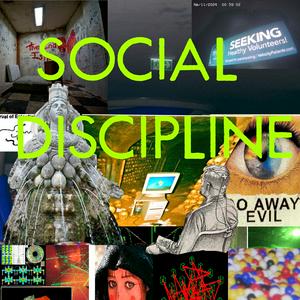
In the vast, unpredictable theater of now, Mattin and Miguel Prado surrendered to the whims of the unconscious, that masterful improviser, seeking to conjure into being a future that, once distant, now beckoned with the inevitability of a forgotten prophecy slowly, inexorably coming to fruition.
Sitio web del podcastEscucha Social Discipline, Pulso Geopolítico y muchos más podcasts de todo el mundo con la aplicación de radio.es
Descarga la app gratuita: radio.es
- Añadir radios y podcasts a favoritos
- Transmisión por Wi-Fi y Bluetooth
- Carplay & Android Auto compatible
- Muchas otras funciones de la app
Descarga la app gratuita: radio.es
- Añadir radios y podcasts a favoritos
- Transmisión por Wi-Fi y Bluetooth
- Carplay & Android Auto compatible
- Muchas otras funciones de la app
Social Discipline
Escanea el código,
Descarga la app,
Escucha.
Descarga la app,
Escucha.
 España