
Escucha gratis este podcast en la aplicación: Descarga gratuita en la App Store
radio.es
Sleep timer
Favoritos
299 episodios
Episode 298 - Lights, Camera, Capital! How Scottish Lensmen Saved Joburg’s Gold
25/10/2026 | 25 minWelcome back to the History of South Africa podcast with me your host, Des Latham. This is episode 298 - Lights, Camera, Capital! How Scottish Lensmen Saved Joburg’s Gold.
I was contacted recently by a listener who’s built an app - it’s called learnclash - a mini-quiz, where people duel each other on history questions — and science. Play real people in quick trivia duels on LearnClash, free on iPhone and Android. Code DESMOND gets you a month of Premium free: https://learnclash.com/sahistory.
Back to the episode.
The Cape Colony had succeeded the imperial government in administering the diamond fields around Kimberley starting in 1880. Over time, Cape rule was influenced to a great extent by Cecil Rhodes, then the rule was dominated by this colossus. He was the most visible of the new crop of mine owners who were to loom over South Africa’s economic and political history for the next fifty years — until the Nationalist party government came to power in 1948.
By 1890, De Beers’s owner had played a significant role in the extension of British rule into Bechuanaland, and then beyond into Central Africa. All the while Rhodes developed an astonishing ideology of empire, creating what he saw as a unique role for what he called the English Race. What is not as well known, or remembered, was how Rhodes was above all a pragmatist and opportunist, an ideological shape-shifter, who transferred his allegiances from imperial to Cape Settler, and then back again. A little bit of modern tech bro mixed with starry eyed silicon valley.
It was this shape-shifting that caused deep mistrust, particularly amongst the white working class of the period — and ironically from the view of South Africans in the 21st Century — it was these workers who would create some of the first major confrontations between mine owners, and mine workers. These days its presumed that the National Union of Mineworkers, allied as it was to the African National Congress, was the home of an anti-capitalist sentiment but radical white marxists threatened Johannesburg’s capitalists repeatedly — particularly in the early 20th Century.
Starting in the diamond fields, then Barberton and Johannesburg, new identities were being forged by the discovery of valuable resources — new identities which transformed South Africa. In the early days, before gold was discovered on the Witwatersrand in 1886, the Zuid Afrikaanse Republiek was regarded as the poor cousin — even of the Orange Free State. Endless poverty wracked the region, it could not collect any taxes of value, and it’s citizens, the people of the Transvaal, were rebels, frontiersmen, almost impossible to control.
The Transvaal had been annexed by the British, then fought their first war against the empire, and won. Natal’s English residents had delighted in the annexation, and now delighted in the discovery of gold. Like Rhodes, these residents shifted allegiances from the empire, to settler logic, and back to empire. The mixture of people and politics was almost unending.
In London, the dominant political view of South Africa was that it was better governed under a British dominated state - and be the paramount power. Meanwhile, Dutch Afrikaners had changed their identity partly due to the continuous and vexatious struggle against the British view and partly due to the encroaching reality of late Victorian innovations. Like Electricity, the steam trains, and new sciences, geology, chemistry.
The coming of gold increased the ZARs capacity to become an economic actor. Paul Kruger’s government latched onto two main ideas. One was to turn the mines into cash through a dynamite monopoly owned by the Transvaal state, and the other was the railway franchise.Episode 297 - Dinuzulu’s horse riding tours of St Helena and Lobengula loses it
18/10/2026 | 21 min297 dear listener, is what’s known as a Kaprekar Number - if you square 297 the resulting digits can be split into two parts - right side and left side. If you add up those two parts you get the original number 297 squared is 88, 209.
Left part is 88, right part is 209. Add these together and voila! 297, a Kaprekar Number.
Maths is fascinating - so too, the story of Zulu king Dinuzulu necklace. IN the annals of historical facts, Dinuzulu’s necklace was claimed to have been found by Robert Baden-Powell, who started the scout movement. These beads are presented to Scout leaders following their Wood Badge leadership training. There’s a lot of conflicting evidence about this of course, did Baden-Powell find the beads, or take them? Were they Dinuzulu’s beads - or those of a Zulu woman, possibly one of Dinuzulu’s wives? Which was important, because In 1888 Baden-Powell was serving with the British Army in Africa. During this period Baden-Powell visited an abandoned camp where Chief Dinizulu, had been based.
The beads were traditionally carved from South African yellowwood, or acacia wood, with a soft central pith that allowed them to be threaded on a rawhide lace.
As you heard last episode, Dinuzulu had surrendered to the British, and was placed in a Pietermaritzburg jail — although jail is probably too strong a word. He was invited to spend time indoors with his retinue at the cost of the Natal taxpayer - arrested as the Zulu rebellion ebbed away in 1888.
It was the three main ringleaders, Dinuzulu, Ndabuko and Shingana, who faced the much more serious charge of high treason and public violence. They had to wait until February 1889 for their trial to begin, and by 27th April it was over. Although energetically defended by one of the best advocates of the province, Harry Escombe, all three were found guilty and were sentenced - ten years for Dinuzulu, 15 for Ndabuko and 12 for Shingana.
While the isolated rock in the Atlantic may seem a harsh sentence, it was not as cruel as it appeared at first glance. As a royal man, Dinuzulu would live in a house, not a cell. He would be joined by his attendants. Ndabuko and Shingana were married, each was allowed to bring one of their wives. But Dinuzulu was too young to have taken a wife, and was allotted two umndlunkulu, young women born of chiefly houses as his friends with benefits.
One was Umkasilomo, the daughter of Ntuzwa of the Mdlalose, and Zihlazile, whose father was Qethuka of the Magwaza. An Inyanga, Paul Mthimkhulu, was also packed off along with the uncles, the nephew and their women companions to St Helena to mind their spiritual and physical health.
Eventually, after a series of hearings and appeals, the party was taken by train from Eshowe to Durban amidst tight security, where in February 1890, they embarked on the mail steamer Anglican bound for St Helena.
Back in Episode 290 I covered some of the details of the build up to this Charter being awarded by the British government — part of Cecil John Rhodes’ grand plan to colonise Africa on Great Britain’s behalf.
By early June 1889 the Charter for the British South Africa Company had achieved the approval of enough influential people in London to move forward - it now needed government sign-off, and Queen Victoria’s stamp of approval.
There were stumbling blocks, two of the senior staff at the Colonial Office, John Bramston and Edward Fairfield, opposed the idea. They were overruled by the secretary of state for the Colonies, Lord Knutsford, as well as the permanent undersecretary, Robert Herbert.
Lobengula had written to the colonial office, repudiating the Rudd Concession which lay at the very heart of Rhodes’ claim to have convinced the Ndebele king to allow him into Matabeleland and surrounding regions to explore for gold. The three men who’d negotiated with Lobengula included James Maquire, who was in London.Episode 296 - kwaCeza Prayers and 20-something Dinizulu kaCetshwayo leads his men into battle
11/10/2026 | 17 minLast episode we had joined Dinuzulu on his tour of the Boer New Republic as it was known in 1888, the area around modern day Utrecht. Piet Meyer the Republic leader thought it best to step back, wary of the fact that the Zulu chief had crossed the boundary line and was openly talking in treasonable terms at least from the British perspective.
But the Qulusi branch of the Usuthu whom he led were impressed by the young chief, they had been cut off from the rest of Zululand, and began to muster on the large, imposing flat-topped Ceza Mountain. This bold geographical feature would become crucial in Zulu historiography - the site holds deep cultural and spiritual importance for the Zulu nation. An annual KwaCeza Mountain Prayer is held here, attended by Zulu Monarchs and provincial leaders who honour the resistance of King Dinuzulu.
By March 1888 word spread in Zululand, and Natal, that the uSuthu had become a sanctuary for those defying the British, as well as their collaborator, Zibhebhu of the Mandlakazi. In April Dinuzulu rode to the Phongolo River, rallying support from the outlying villages — and as you heard last episode, it was during this period that local magistrate Addison tried to arrest the uSuthu leaders he’d left behind in the Ndwandwe district - modern day Nongoma.
You’d remember that Zibhebhu used the chaos to mobilise his warriors, the Zululand police were on the move from Eshowe, backed up by a couple of hundred British troops. Dinuzulu realised he’d reached a point of no return, and in May he and his men withdrew to Ceza Mountain.
The uSuthu Rebellion - as it became known - had begun. They began raiding from their hilltop refuge, attacking those they regarded as friends of the British - victims included Mnyamana and Ziwedu, who sought refuge at the British military camp as Nkonjeni just north of Ulundi.
In early June, a force of African levies from Myamana’s Buthelezi joined the Zululand police force and British troops as they advanced on Ceza planning to arrest Dinuzulu and Ndabuko, along with the other rebel chiefs. This left Addison’s camp at Ndunu hill exposed, a small garrison remained, so he asked Zibhebhu and his Mandlakazi to encamp on the hill as insurance against a surprise attack. The British mobilised more of their troops, 515 infantry and 455 mounted men swelled the ranks along with 22 officers. Eshowe resident commissioner Melmoth Osborn managed to mobilise about four thousand black auxiliaries in southern Zululand - so the order of battle began to develop quickly.Episode 295 - Dabulamanzi’s Murder roils northern Zululand and Dinuzulu Rebels
04/10/2026 | 23 minOn 27 April 1994, South Africa inaugurated a new constitutional democracy which embraced the freedom and equality of all sectors of the South African society. The Preamble of the Constitution states one of its aims was to “heal divisions of the past and establish a society based on democratic values, social justice and fundamental human rights”. This goal was to be realised by, among others, section 211 which recognised the institution, status and role of traditional leadership and entrenches indigenous African law as a source of South African law alongside the common law.
Ironically, on the very same day, 27 April, in 1889, the British Administration rejected the time-honoured institution of traditional leadership in Africa and decided finally to remove the hereditary traditional leaders from Zulu society. This is generally regarded as the final act which caused irreparable harm to Zulu solidarity and has resonated down the ages.
The British had tired of the constant warring, the tension amongst the descendants of Senzangakhona. But more importantly, they were seeking to shore up their northern marches against both the Boers and the increasingly aggressive European nations like Germany who were also seeking colonies in Africa. It has perhaps been forgotten just how active Germany was in Mozambique. German companies were buying up land in Lourenzo Marques by the late 1880s, in order to gain a foothold over south eastern Africa. Nine-tenths of the transit business along the Mozambique coast into Tanzania and even further north was in the hands of German companies, and the press in Germany were as jingoistic as any other European nation of the time.
So as we consider what was going to happen from here on in, we must keep an eye on the global effect.
When we last heard about Dinizulu was back in episode 281 where the Boers and induna’s had annointed him as King of the Zulu.
Ever since the Anglo-Zulu war of 1879, the territory had been in turmoil and from the time that Dinizulu succeeded his father Cetshwayo he was caught up in a series of conflicts which eventually destroyed him. Dinizulu fought three major contests, against Usibebu the British government sponsored chief of the Amandhlakazi, against the Transvaal Boers who were eager to make use of the Zulu civil wars to appropriate land and cattle in Zululand - eventually claiming what they called the New Republic. Dinizulu fought a third battle against the Natal colonists and government which history has described in various ways, including as a rebellion.Episode 294 - Ndebele Envoys in England and Selous Translates
23/09/2026 | 18 minThe Ndebele chief said the Rudd concession document did not reflect his verbal agreements. His induna’s who’d negotiated the concession disputed the terms as well, along with missionary Charles Helms who’d translated for Lobengula.
Nevertheless, chief negotiator Charles Rudd had returned to Kimberley clutching the concession, a single page document which purported to give Rhodes’ British South Africa company sole rights to mining gold throughout Matabeleland and Mashonaland, and other adjacent territories, in exchange for one thousand Martini Henry Rifles, 100 000 rounds of ammunition, one hundred pounds, and a gunboat on the Zambezi River.
Lobengula said he’d only agreed to the rights for ten men to dig for gold at one spot rather than the general rights throughout the region to the north of the Limpopo river. Once they discovered what Rhodes was claiming, some Ndebele induna’s threatened to revolt.
At least one, Gambo, approached the Boers of the Transvaal. To the East, there was also much trouble brewing in Manicaland. That lay between Delagoa Bay and the highlands of eastern Mashonaland, where the Portuguese lay claim.
In a nutshell, like the headwaters of the Nile and the importance of the Suez Canal, the vast territories north of the Limpopo became the means through which southern Africa and the Cape could be controlled by the British Empire.
The discovery of gold on the Witwatersrand gave the Transvaal the cash to expand northwards and towards the coast and the Boers could rival the existing British dominance in the region north of the Cape. The Portuguese had ancient claims to Mozambique, stretching back almost 500 years and they posed a threat to the sea route between England and India. Then in 1887 Portugal laid claim to the a swath of land stretching coast to coast from Mozambique to Angola through the region north of the Limpopo.
In the British colonial office, Lord Salisbury of the conservative party was trying to stymie the Portuguese, and supported Cecil John Rhodes at least nominally, but only north of the Limpopo. The more grandiose all red-route touted by Rhodes of the Cape to Cairo was a pipedream, thought Salisbury.
He brushed aside the Portuguese protests based on their pre-existing treaties signed by Mashonaland chiefs stretching back to 1629, but then was warned that a Portuguese expedition had set off from the coast led by Colonel Joaquim Carlos Pavia d’Andrada heading towards Mashonaland.
Backed by the newly created Companhia de Mozambique he was joined by Manuel Antonio de Sousa - half Portuguese, half African, mixed race soldier feared by the British because he had mobilised 7000 black irregulars — local warriors.
Before they arrived in upper Manicaland, Lobengula’s two emissaries would arrive in London. Babayane and Mshete were joined by Edward Maund, Rhodes’ adversary in the concession-making business, and Natal translator, John Colenbrander.
As you heard last episode, the emissaries carried two bits of information. One was a letter for Queen Victoria, complaining of Portuguese threats to his east, the other was for the Queen’s ears only, and would be delivered verbally directly to her, face-to-face. Lobengula was going to formally renounce the Rudd concession.
Eventually, on February 6 1889, Maund, Colenbrander, Babayane and Mshete boarded the the steamship Moor, and sailed to London. The next day, a telegram arrived at Robinson’s official residence, apparently the Queen wouldn’t have enough time to meet the envoys because she was preparing for a European trip. Robinson was relieved. Perhaps all the waylaying was going to work out and he wondered, were Babayane and Mshete on a doomed mission?
Más podcasts de Cultura y sociedad










Podcasts a la moda de Cultura y sociedad





























Acerca de History of South Africa podcast
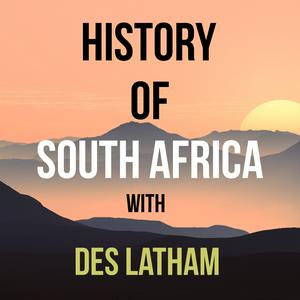
A series that seeks to tell the story of the South Africa in some depth. Presented by experienced broadcaster/podcaster Des Latham and updated weekly, the episodes will take a listener through the various epochs that have made up the story of South Africa.
Sitio web del podcastEscucha History of South Africa podcast, La Fórmula Del Éxito con Uri Sabat y muchos más podcasts de todo el mundo con la aplicación de radio.es
Descarga la app gratuita: radio.es
- Añadir radios y podcasts a favoritos
- Transmisión por Wi-Fi y Bluetooth
- Carplay & Android Auto compatible
- Muchas otras funciones de la app
Descarga la app gratuita: radio.es
- Añadir radios y podcasts a favoritos
- Transmisión por Wi-Fi y Bluetooth
- Carplay & Android Auto compatible
- Muchas otras funciones de la app

History of South Africa podcast
Escanea el código,
Descarga la app,
Escucha.
Descarga la app,
Escucha.
History of South Africa podcast: Podcasts del grupo
 España