

Escucha gratis este podcast en la aplicación: Descarga gratuita en la App Store
radio.es
Sleep timer
Favoritos
32 episodios
The Surprisingly Messy History of Mayonnaise
22/09/2026 | 33 minMayonnaise is the world's most popular sauce, but nobody agrees on who invented it.
This episode traces the history of mayonnaise from a Spanish port battle to a Paris pharmacist's ointment. Caroline and Emily examine the competing French origin stories, the codification of the sauce by Antonin Careme's critics, and how mustard, eggs, and oil became the modern formula loved and hated worldwide.
Podcast Show Notes
In this episode:
• The legend of the Duke of Richelieu inventing mayonnaise at Port Mahon in 1756
• Competing 18th and 19th century spellings, bayonnaise, mahonnaise, and mayonnaise
• The Duke of Mayenne's 16th century version and its unfortunate ending
• Antonin Careme's attempt to codify the correct spelling and origin
• Culinary historian Pierre Leclercq's theory that Paris perfected the sauce
• Andre Viard's early recipes, including a mayonnaise made with veal brains
• Why French cuisine names dishes after their texture, and English rarely does
• How to make mayonnaise from scratch with egg yolk, mustard, and oil
• French idioms built around mayonnaise, including "faire monter la mayonnaise"
• Global mayonnaise culture, from Japanese Kewpie mayo to wartime chocolate cake
Key Takeaways
• Mayonnaise's true origin is disputed between French and Spanish claims.
• The Duke of Richelieu legend places the sauce's invention at Port Mahon in 1756.
• Andre Viard's cookbook contains the earliest known recipe resembling mayonnaise, thickened with egg.
• Antonin Careme argued the sauce should be called "magonnaise," from the French verb "manier."
• Culinary historian Pierre Leclercq traces mayonnaise's roots to medieval pharmacists' egg and oil ointments.
• Traditional American mayonnaise contains no mustard, while French mayonnaise almost always does.
• Japan's Kewpie mayonnaise originated in 1925 after a Ministry of Agriculture intern encountered mayo in the UK.
• Homemade mayonnaise is made by whisking egg yolk with mustard while slowly adding oil.Is French Cheese Doomed? Climate Change Threatens Comté and Beaufort
15/09/2026 | 40 minRecord heat and historic drought are forcing France's most protected cheeses to break their own rules.
Caroline and Emily unpack how the AOP charters for Comté, Beaufort, and Abondance have been temporarily loosened after historic drought hit the Alps and Jura. They explain what changes when cows eat grain and hay instead of mountain grass, why terroir shapes the flavor, and what happened to producers like Salers, who could not adapt in time.
Podcast Show Notes
In this episode:
• France's record-breaking heat waves and wildfires in summer 2026
• The INAO's historic dryness declaration for the Alps and Jura
• Temporary charter changes for Abondance, Beaufort, and Comté cheese
• How terroir shapes the flavor of mountain cheese
• The three jobs behind every wheel of Comté, farmer, cheesemaker, and ager
• Why Abondance is so tightly tied to its valley and cattle breed
• Beaufort's three tiers and the disappearing Bleu de Termignon
• Why Salers producers switched to cheaper Cantal cheese this year
• The UNESCO-protected transhumance tradition and its uncertain future
• A parallel case in Châteauneuf-du-Pape and possible reform of French irrigation rules
Key Takeaways
• July 2026 was the hottest month on record in France, with more than 90,000 hectares of forest and vegetation burned since spring.
• The INAO declared historic dryness in the Alps and Jura on August 10, 2026.
• Abondance, Beaufort, and Comté are AOP cheeses whose charters normally require a set percentage of local grazing.
• Abondance's summer grazing requirement temporarily dropped from 50 percent to 15 percent of local grassland, and outside hay is now allowed.
• Beaufort's local feed requirement dropped from about 70 percent to 50 percent, with grain now permitted as a supplement.
• Comté's rules changed the least of the three, allowing green corn feed from outside the AOP zone through the end of October.
• Salers cheese producers in the Auvergne could not modify their charter in time and switched to making cheaper Cantal instead.
• Transhumance, the tradition of moving herds up to summer pastures, was named UNESCO Intangible Cultural Heritage in 2023.Why French People Don't Bake at Home Like Americans Do
08/09/2026 | 36 minFrench people rarely bake elaborate pastries at home, and Versaille-based pastry chef Molly Wilkinson says that is by design.
Caroline and Emily talk with Wilkinson, an American pastry chef trained at Le Cordon Bleu, about why French home bakers stick to simple recipes like mousse au chocolat and yogurt cake while buying croissants and tarts from professionals. They compare that mindset to the American love of ambitious home baking projects, from layer cakes to laminated dough.
Podcast Show Notes
In this episode
Why Caroline avoids baking croissants at home despite loving French pastry
How Molly Wilkinson learned lamination and croissant making after Le Cordon Bleu
The difference between viennoiserie, patisserie, and home style French desserts
Why French people would rather buy a pastry from an expert than bake one
The most common French home desserts, including mousse au chocolat and yogurt cake
How packet baking powder and boxed recipes shape French home baking
Why French pastry certification starts as young as age sixteen
What Molly teaches American home bakers in Le Baking Club, including a Marie Antoinette themed entremet
Why cookies and donuts have become newly popular in French bakeries
Molly's plans to open an American style cafe near the Chateau de Versailles
Key Takeaways
Croissant dough is a laminated, yeasted dough that takes about three days to make properly.
French people generally do not bake difficult pastries at home and prefer to buy them from experts.
Simple one bowl desserts like mousse au chocolat, fondant au chocolat, and yogurt cake are French home baking staples.
Many classic French home recipes originated on the backs of packaged ingredients like Nestle chocolate and baking powder sachets.
French pastry chefs typically earn formal certification starting around age sixteen.
American baking culture values ambitious home projects and DIY effort in a way French baking culture does not.
Molly Wilkinson teaches American home bakers French pastry techniques through her membership, Le Baking Club.
Molly Wilkinson is opening a cafe near the Chateau de Versailles in fall 2026.The Surprisingly Italian History of the French Macaron
01/09/2026 | 24 minMacarons may be one of France’s most recognizable culinary exports, but their history is much messier than the pastel boxes suggest.
In this episode, Caroline and Emily dig into the Italian origins of the macaron and the role Catherine de’ Medici supposedly played in bringing almond cookies to the French court. They explore the roughly 40 regional versions still found around France, including macarons that look nothing like the famous Parisian sandwich cookie.
Then it’s on to Paris and Ladurée, where the macaron evolved into the polished luxury pastry tourists recognize today. Caroline breaks down exactly why macarons are so technically difficult to make, from meringue and macaronage to achieving the elusive “foot.”
Finally, they taste their way through macarons from Pierre Hermé, Lautrec, and Picard. The biggest shock isn’t a rare flavor or an expensive Parisian creation: it’s just how good the frozen supermarket macarons are.
Key Takeaways
Macarons are generally traced back to Italian almond cookies, with Catherine de’ Medici associated with bringing them to France.
France has around 40 regional variants, many of which are rustic, undyed and completely unlike the Parisian sandwich macaron.
Ladurée helped create and popularize the modern Parisian form, rather than inventing the macaron itself.
Macarons use relatively simple ingredients but require considerable technical precision to make well.
Macarons actually benefit from aging, as moisture moves from the filling into the shell and creates the desired texture.
In the tasting, Picard’s frozen macarons perform surprisingly well against much more expensive pâtisserie versions.Season 2 Trailer: Fishwives Is Going Weekly
26/08/2026 | 2 minishwives of Paris is back for Season 2—and this time, we’re going weekly.
Starting September 1, Caroline and Emily will be bringing you a new episode every week. Some will be our full studio productions, some will be more casual webcam episodes, and we’ll be welcoming more guests into the Fishwives universe.
We also want to hear from you. We’ll be sharing listener stories and questions on the show—and yes, we’re introducing corrections, because occasionally even Fishwives get things wrong.
Have a story we need to hear? A question about French food or wine? Think we got something wrong?
Email us at bonjour@fishwivesofparis.com.
Fishwives of Paris Season 2 begins September 1, with new episodes every week.
Más podcasts de Arte
 Grandes InfelicesArte
 Un Libro Una HoraArte
 Tercer ActoArte, Cultura y sociedad
 Qué estás leyendo. El podcast de libros de EL PAÍSArte, Cultura y sociedad, Libros
 The Book ClubArte, Educación, Historia, Libros
 El DescampaoArte
 Fashion SucksArte, Moda y belleza
 Historias y cuentos para dormirArte, Ficción, Libros, Salud mental, Salud y forma física
 Aquí hay dragonesArte
 Una hora más entre librosArte, Libros
Podcasts a la moda de Arte
 Ruthie's Table 4Arte, Gastronomía
 Royal Academy of ArtsArte
 La Mirada LiterariaArte, Libros
 The EmeraldArte, Cultura y sociedad, Religión y espiritualidad
 La contracobertaArte, Libros
 Secret Life of BooksArte, Educación, Historia, Libros
 LA PICAETAArte, Gastronomía
 Especialmente Café | YellowTulipCoffeeArte, Gastronomía
 文化有限Arte, Cine y Televisión, Críticas de cine, Drama, Ficción, Libros
 MUNDO BABELArte
 El espejo de Vivian y FrancescaArte
 Mucho Más Que FotosArte, Artes visuales
 Se me Antoja by MontagudArte, Gastronomía
 Audiolibros en CastellanoArte, Libros
 Charlando con libros - Adrián SussudioArte, Libros
- Una hora más entre librosArte, Libros
 Trucos de acuarela con DanielaArte, Artes visuales
 Quédate a Comer de La VanguardiaArte, Carrera, Cultura y sociedad, Economía y empresa, Gastronomía
 Calle OscuraArte
 Hardcore LiteratureArte, Cursos, Educación, Libros
 Historias de papel - Manuel PedrazArte
 Audiolibro En EspañolArte, Libros
 Entrevistas A FondoArte, Cine y Televisión, Cultura y sociedad, Historia, Libros
 La Maraldina: El pòdcast dedicat a l'obra de Mercè RodoredaArte, Libros
Acerca de Fishwives of Paris
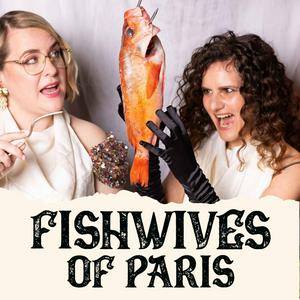
Flipping the table on French food mythology and serving the real stories behind your favorite cuisine, with culinary journalist Emily Monaco and wine expert Caroline Fazeli.
Want to watch us in 4k? Head over to https://youtube.com/@fishwivesofparis
Sitio web del podcastEscucha Fishwives of Paris, Grandes Infelices y muchos más podcasts de todo el mundo con la aplicación de radio.es
Descarga la app gratuita: radio.es
- Añadir radios y podcasts a favoritos
- Transmisión por Wi-Fi y Bluetooth
- Carplay & Android Auto compatible
- Muchas otras funciones de la app
Descarga la app gratuita: radio.es
- Añadir radios y podcasts a favoritos
- Transmisión por Wi-Fi y Bluetooth
- Carplay & Android Auto compatible
- Muchas otras funciones de la app

Fishwives of Paris
Escanea el código,
Descarga la app,
Escucha.
Descarga la app,
Escucha.
 España