PodcastsGobiernoSCOTUS Intelligence

SCOTUS Intelligence

Brian Dennison
SCOTUS Intelligence
Último episodio

27 episodios

  • SCOTUS Intelligence

    Case v. Montana: Health Emergency Warrant Exception

    22/02/2026 | 18 min
    In the unanimous decision of Case v. Montana, the Supreme Court of the United States affirmed that police may enter a residence without a warrant to provide emergency assistance. The Court clarified that such entries are lawful if officers have an objectively reasonable basis to believe an occupant is in immediate danger, a standard that does not require the higher threshold of probable cause. In this specific instance, the Court found the entry justified because officers reasonably believed the petitioner was suicidal and potentially already injured. While the majority focused on this reasonableness standard, Justice Sotomayor’s concurrence highlighted the risks of escalation in mental health crises, and Justice Gorsuch’s concurrence linked the ruling to common-law traditions regarding property and safety. Ultimately, the ruling maintains the sanctity of the home while ensuring officials can act swiftly to preserve human life during dire emergencies.
  • SCOTUS Intelligence

    Berk v. Choy: Federal Proedural Preempiton of State Affidavit Requitement

    22/02/2026 | 19 min
    In the legal case of Berk v. Choy, the Supreme Court of the United States determined that a Delaware state law requiring medical malpractice plaintiffs to file an affidavit of merit does not apply in federal court. Writing for the majority, Justice Barrett concluded that Federal Rule of Civil Procedure 8 already dictates what a plaintiff must provide at the start of a lawsuit, and this federal standard displaces conflicting state requirements. The Court clarified that while states may impose evidentiary hurdles, federal courts must follow the Rules Enabling Act, which prioritizes uniform federal procedural rules over state laws that demand more than a "short and plain statement" of a claim. Although Justice Jackson concurred with the final judgment, she argued that the state law actually conflicts with Federal Rules 3 and 12 rather than Rule 8. Ultimately, the decision ensures that plaintiffs in diversity jurisdiction cases are not subjected to state-level pleading burdens that exceed federal standards. This ruling reinforces the principle that federal procedural law governs the commencement and sufficiency of lawsuits brought in federal district courts.
  • SCOTUS Intelligence

    Borst v. Ilinois: Standing to Challenge Elections under Article III

    22/02/2026 | 19 min
    This Supreme Court syllabus and opinion from Bost v. Illinois State Board of Elections addresses whether political candidates have Article III standing to challenge state election rules. The petitioners argued that Illinois’s policy of counting mail-in ballots received after election day violated federal law, but lower courts dismissed the case for lack of a specific injury. The Supreme Court reversed this decision, ruling that a candidate's personal stake in an election is inherently different from that of the general public. Writing for the majority, Chief Justice Roberts established that candidates possess a particularized interest in the fairness and legality of the results, regardless of whether a rule change would definitively cause them to lose. The Court reasoned that forcing candidates to prove a substantial risk of defeat would improperly turn judges into political forecasters and delay essential legal resolutions. While a concurrence suggested standing should rest on financial costs like hiring poll watchers, the majority held that the integrity of the process itself constitutes a cognizable interest for those seeking office.
  • SCOTUS Intelligence

    Trump v. V.O.S. Selections (The Tariff Case)

    21/02/2026 | 19 min
    📔 
    Untitled notebook 
    This legal petition asks the Supreme Court to review a federal appeals court decision that struck down Presidential tariffs on foreign goods. The executive branch justifies these taxes using the International Emergency Economic Powers Act (IEEPA), claiming they are vital to ending trade deficits and stopping the flow of illegal narcotics. While the government argues the President has broad discretion to manage national security and foreign policy, lower courts ruled that these specific financial levies exceed his statutory authority. Opponents, including private importers and several states, contend that the law allows the regulation of trade but does not grant the power to impose unilateral taxes. The case centers on whether the separation of powers prevents the executive from using emergency economic laws to bypass congressional taxation authority. This dispute highlights a significant conflict between presidential emergency powers and the legislative branch’s control over international commerce.
  • SCOTUS Intelligence

    Unilateral Executive Power Versus Education's Future

    16/07/2025 | 16 min
    This document presents a dissenting opinion from Justice Sotomayor, joined by Justices Kagan and Jackson, regarding the Supreme Court's decision to grant a stay in the case of Linda McMahon, Secretary of Education, et al. v. New York, et al.The core of the dissent is a strong objection to the Executive Branch's unilateral efforts to dismantle the Department of Education through actions like mass terminations of staff and a subsequent Executive Order. Justice Sotomayor argues that only Congress has the authority to abolish a Cabinet-level agency and that the Executive's actions violate the separation of powers and the Take Care Clause of the Constitution. The opinion highlights the critical functions the Department of Education performs, such as administering student aid and enforcing civil rights laws, and details the harms already experienced or anticipated by states and educational institutions due to the Department's reduction in force, concluding that the majority's decision is an unjustified intervention that rewards executive overreach.
Más podcasts de Gobierno

Acerca de SCOTUS Intelligence

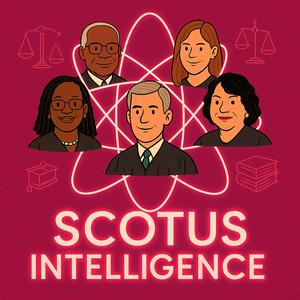
SCOTUS Intelligence” delivers sharp, AI-assisted analysis of the latest decisions from the U.S. Supreme Court. With the help of Notebook LM, we don’t just summarize—we interrogate. We track shifts in doctrine, spotlight ideological undercurrents, and extract the quiet signals embedded in every concurrence and dissent. Perfect for lawyers, educators, and the legally curious, this podcast brings you intelligence—not just information—on how the High Court is shaping American life.
Sitio web del podcast

Escucha SCOTUS Intelligence, The Interview y muchos más podcasts de todo el mundo con la aplicación de radio.es

Descarga la app gratuita: radio.es

  • Añadir radios y podcasts a favoritos
  • Transmisión por Wi-Fi y Bluetooth
  • Carplay & Android Auto compatible
  • Muchas otras funciones de la app

SCOTUS Intelligence: Podcasts del grupo

Aplicaciones
Redes sociales
v8.8.13| © 2007-2026 radio.de GmbH
Generated: 4/30/2026 - 1:21:35 PM