PodcastsMedicina alternativaPRETTY WELL - Anti-Aging, Beauty, Balanced Hormones, Inflammation, Gut Health, IBS, Evidence-based

PRETTY WELL - Anti-Aging, Beauty, Balanced Hormones, Inflammation, Gut Health, IBS, Evidence-based

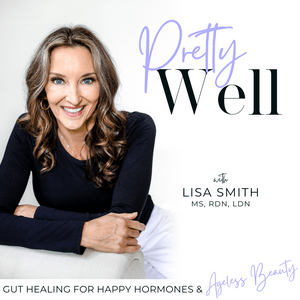
Lisa Smith, MS, RD, LDN |Functional Wellness| Holistic Gut:Mitochondria Expert
PRETTY WELL - Anti-Aging, Beauty, Balanced Hormones, Inflammation, Gut Health, IBS, Evidence-based
Último episodio

225 episodios

  • PRETTY WELL - Anti-Aging, Beauty, Balanced Hormones, Inflammation, Gut Health, IBS, Evidence-based

    Pain You've Been Told Is "Normal"? It Might Not Be — The New Rules of Women's Health"

    24/06/2026 | 51 min
    #217 -Pain You've Been Told Is "Normal"? It Might Not Be — The New Rules of Women's Health"

    If you've ever walked out of a doctor's appointment feeling dismissed, confused, or like you somehow "did it wrong," this episode is your reset.

    You were never meant to navigate your health blindly. In this conversation, award-winning health journalist Meghan Rabbitt pulls back the curtain on what women haven't been told — from the real impact of stress on your brain to why your period, your pregnancy history, and even your hot flashes hold critical data about your future health.

    This isn't surface-level wellness advice. It's the missing user manual for your body.

    This episode will change how you think about:

    Why women are still underdiagnosed, misunderstood, and under-researched — and how that affects your care

    The silent connection between pregnancy complications and heart disease

    Why your stress response is biologically different — and what it's doing to your brain right now

    The health signals you've been taught to ignore (heavy periods, pain, "normal" symptoms that aren't)

    How to walk into any doctor's appointment like a CEO, not a bystander

    The simple, non-negotiable habits that actually move the needle in your health

    Timestamps:

    [04:00] – "Bikini medicine" and everything it leaves out about women's health

    [12:00] – The link between pregnancy history, menopause symptoms, and heart disease

    [14:00] – The breast cancer risk test most doctors aren't talking about

    [31:00] – The female stress response: why burnout hits women differently

    [46:00] – Perimenopause decoded: what to track, what's not normal, what to do

    What's been normalized (but shouldn't be):
    Pain brushed off as "just stress." Periods that are debilitating but labeled "normal." Chronic fatigue, brain fog, and anxiety that get minimized. One of the biggest shifts in this episode: just because something is common doesn't mean it's normal.

    Takeaways you can use immediately:

    Track your symptoms like data, not complaints

    Bring a prioritized list to your next doctor's appointment

    Know your breast cancer lifetime risk score

    Pay attention to your cycle, stress, and digestion — they're connected

    Stop waiting to feel "bad enough" to take action

    This episode doesn't just give you information — it changes how you relate to your body. You stop outsourcing your health, stop minimizing your symptoms, and start asking better questions.


    🔗 Resources & Links  (As An Amazon Associate I Earn A Small Commission From Qualifying Purchases At No Extra Cost To You):

    New Rules of Women’s Health: Your Guide to Thriving at Every Age  https://amzn.to/4e6aNFL 


    Tyrer-Cuzick Assessment (Calculator) for Breast Cancer Risk https://magview.com/ibis-risk-calculator/


    The Morning Mindset Journal https://lisasmithwellness.com/the-morning-mindset-journal

    ✨Join the conversation:

    Share your thoughts with us on social media or in the comments!

    🎙 Subscribe, Share & Review:

    If you loved this episode, please take a moment to subscribe and leave a review on Apple Podcasts! Your support helps us reach more people who need these insights. Thanks for tuning in to Pretty Well! See you next week!

    Contact Meghan and buy The New Rules of Women's Health from her website: https://newrulesofwomenshealth.com/


    Contact Lisa:

    Website: www.lisasmithwellness.com 

    IG: https://www.instagram.com/prettywell_podcast/


    Disclaimer: 

    Nothing in this podcast is to be taken as medical advice, please take informed accountability and speak to your provider before making changes to your health routine.

    The primary purpose of The Pretty Well Podcast being to educate. This content is for informational and educational purposes only. It is not intended to provide medical advice nor to take the place of such 

    advice or treatment from a personal physician. By listening to this content, you agree to consult your own physician or qualified health professional regarding specific health questions. Neither Lisa Smith, The Pretty Well Podcast, nor any guest takes responsibility for possible health consequences of any person or persons following the information in this educational content. All listeners of this content, especially those who are pregnant or taking prescription or over-the-counter medications, should consult their physicians before beginning any nutrition, supplement, or lifestyle program. The Pretty Well Podcast is for private non-commercial use and our guests do not necessarily reflect any agency, organization, or company that they work for. In addition, opinions of interview guests do not necessarily reflect the opinions of Lisa Smith and/or The Pretty Well Podcast. This content is not guaranteed to be correct, complete, or up to date.
  • PRETTY WELL - Anti-Aging, Beauty, Balanced Hormones, Inflammation, Gut Health, IBS, Evidence-based

    Is It Food Cravings... Or Is Your Body Trying To Tell You Something?

    17/06/2026 | 43 min
    # 216 - Is It Food Cravings... Or Is Your Body Trying To Tell You Something?

    You eat well. You do the work. And you still feel like something is missing — a kind of emptiness that has nothing to do with what's on your plate.

    For high-achieving women, food often becomes the answer to a question the body is asking about something else entirely.

    And until you understand what you're actually craving, nothing will fill it.

    Amber Caudle has lived this — and spent decades helping women find their way through it. She's a chef, author, and founder of The Source Cafe in Hermosa Beach, CA.

    In this conversation, we go beneath the surface of emotional eating, perfectionism, and the exhausting cycle of overgiving to explore what your body is really hungry for — and why your nervous system keeps reaching for food when the real need is something else.

    -In this episode:Why high-achieving women often use food to manage emotions they don't have language for
    -The difference between physical hunger and emotional hunger and how to tell them apart in real time
    -How perfectionism and people-pleasing quietly drive depletion and disconnect you from your actual needs
    -Why guilt, productivity addiction, and "never enough" thinking aren't personality flaws, they're nervous system patterns
    -The surprising link between emotional nourishment and your relationship with food
    -What your body is really asking for when you reach for something out of stress or exhaustion
    -How to start giving yourself what you actually need and why it's harder than it sounds
    -Why healing isn't linear, and how to stay compassionate with yourself through the process

    If you've ever eaten well and still felt empty (or reached for food when what you really needed wasn't food at all), this episode will give you language for something you've felt for a long time but couldn't explain.

    The Part Worth Sitting With:

    Many women spend years trying to fix themselves when they were never broken.

    The constant drive to do more, achieve more, help more, and be more isn't always coming from ambition. Sometimes it's coming from a deeper belief: that rest must be earned, worth must be proven, love must be deserved.

    And no amount of productivity can satisfy a need that was never about productivity in the first place.

    When we start to understand what we're truly hungry for (connection, peace, play, purpose, support, or simply permission to slow down) something shifts. Not just in our relationship with food, but in our relationship with ourselves.

    If this episode resonated, send it to the woman in your life who always seems to have it together... and always seems exhausted.

    And if you want a simple way to stay grounded in what actually matters day to day, the Morning Mindset Journal is linked below. No protocol. No pressure. Just a place to come back to yourself. ❤️

    Timestamps

    00:00 Why so many women never feel fully nourished
    04:30 The hidden connection between food and emotional needs
    10:15 When success and productivity stop feeling fulfilling
    16:40 Why rest feels dangerous for so many high achievers
    22:10 The relationship between self-worth and overachievement
    28:20 Emotional hunger versus physical hunger
    35:00 What you're really craving when food isn't the answer
    37:00 Why a 15-minute break can feel so hard to take
    39:00 The deeper beliefs underneath the inability to slow down
    40:00 Rebuilding self-trust and learning to receive
    42:00 Why healing isn't linear — and how to stay compassionate with yourself

    Resources & Links
    (As an Amazon Associate I earn a small commission from qualifying purchases, at no extra cost to you)

    Amber's book Hungry: https://amzn.to/4xb0PcY

    Amber's website: https://www.nourishyourpowers.com
    Amber's Instagram: https://www.instagram.com/ambercaudlela/

    The Morning Mindset Journal: https://lisasmithwellness.com/the-morning-mindset-journal


    ✨ Join the conversation
    Share your thoughts in the comments or tag us on Instagram @prettywell_podcast

    🎙 Subscribe, Share & Review
    If this episode hit home, please subscribe and leave a review on Apple Podcasts. It helps more women find this conversation when they need it most. Thank you for being here — see you next week.

    Contact Lisa:

    Website: www.lisasmithwellness.com 

    IG: https://www.instagram.com/prettywell_podcast/


    Disclaimer: 

    Nothing in this podcast is to be taken as medical advice, please take informed accountability and speak to your provider before making changes to your health routine.

    The primary purpose of The Pretty Well Podcast being to educate. This content is for informational and educational purposes only. It is not intended to provide medical advice nor to take the place of such 

    advice or treatment from a personal physician. By listening to this content, you agree to consult your own physician or qualified health professional regarding specific health questions. Neither Lisa Smith, The Pretty Well Podcast, nor any guest takes responsibility for possible health consequences of any person or persons following the information in this educational content. All listeners of this content, especially those who are pregnant or taking prescription or over-the-counter medications, should consult their physicians before beginning any nutrition, supplement, or lifestyle program. The Pretty Well Podcast is for private non-commercial use and our guests do not necessarily reflect any agency, organization, or company that they work for. In addition, opinions of interview guests do not necessarily reflect the opinions of Lisa Smith and/or The Pretty Well Podcast. This content is not guaranteed to be correct, complete, or up to date.
  • PRETTY WELL - Anti-Aging, Beauty, Balanced Hormones, Inflammation, Gut Health, IBS, Evidence-based

    The Doctor Says You're Fine. You Nod. But Don't Believe It.

    10/06/2026 | 1 h
    #215 - The Doctor Says You're Fine. You Nod. But Don't Believe It.

    At some point, you get past the diagnosis. You finally start to feel physically better or the flare passes.

    And everyone—including you—thinks: okay, this is where life goes back to normal.

    Except… it doesn’t.

    In this episode, I’m joined again by Amy Kurtz—patient advocate, bestselling author of Kicking Sick, and her new book But You Look Fine—and we’re talking about the healing phase no one prepares you for:

    What happens after the illness because for a lot of people, that’s where a different kind of struggle begins.

    Amy shares her experience of finally getting answers after years of chronic illness (we’re talking 30+ doctors), beginning to heal physically, and then being hit with something she didn’t expect:

    Debilitating anxiety. Hypervigilance. A nervous system that refused to stand down.

    Even though she moved beyond the illness, her body had been in survival mode for so long, it didn’t know how to be anything else.

    What we unpack in this episode:

    The “in-between” phase of healing—when you’re not sick, but you’re not okay either

    Why your nervous system doesn’t automatically catch up just because your labs look better

    The concept of Medical Trauma Brain (MTB)—Amy’s term for the imprint chronic illness leaves behind

    How years of survival mode can turn into anxiety, fear, or obsessive control even after you improve

    The grief that comes with lost time, missed seasons, and a life that didn’t go the way you thought

    Why healing isn’t just physical—and what happens when we ignore the emotional and neurological layers

    The connection between chronic illness and trauma (including how this differs from traditional PTSD)

    What it actually looks like to start regulating your nervous system in a practical, doable way

    We also go here:

    The subtle ways people self-abandon in medical settings—and how to stop doing that

    Why “doctor knows best” can keep you stuck (and what to do instead)

    The fawn response in healthcare—and why it feels so hard to advocate for yourself

    How to choose the right practitioner for you (not just the most recommended one)

    The reality that 80% of your healing happens outside the doctor’s office


    A few moments to listen for:

    08:30 – Her husband's provocative question that made Amy realize she wasn’t actually “better”

    14:00 – What Medical Trauma Brain really is—and why you've never heard of it

    19:00 – Living in constant fear even after your body improves

    27:00 – The fawn response and why patients stay in bad medical relationships

    36:30 – “It all starts with peeing” (stay with us—it’s actually profound)

    44:00 – Why meditation can feel impossible—and what that tells you

    52:00 – What Amy would do differently if she could go back


    The part that stays with you:

    This idea that you can spend years fighting to get better… finally get there… and still feel trapped.

    If this sounds familiar, you’re not failing. It's just that no one told you there’s an aftermath to surviving something so hard.

    Amy calls it the “shadowlands”—that space where you look fine on the outside, but internally, your system is still bracing for impact.

    If you’ve ever thought:

    Why can’t I just relax?

    Why am I still on edge?

    Why do I feel like something’s about to go wrong—even when it’s not?

    This episode will put language to that.

    If this is you right now, there’s a way to actually teach your body that it’s safe again.

    And the steps are easier than you think.

    This conversation isn’t just about chronic illness. It’s about what happens when you’ve been in survival mode for so long that you don’t know how to turn it off. And how to start finding your way back.

    🔗 Resources & Links (As an Amazon Associate I earn a small commission from qualifying purchases, at no extra cost to you):

    Amy Kurtz's new book: But You Look Fine https://amykurtz.com/

    But You Look Fine: Trapped in the Hell Between Sick and Well and How to Break Free by Amy Kurtz https://amzn.to/4upNgUY 

    Amy Kurtz's first book: Kicking Sick https://amzn.to/4fZVRtp 

    ✨Join the conversation:

    Share your thoughts with us on social media or in the comments!


    🎙 Subscribe, Share & Review:

    If you loved this episode, please take a moment to subscribe and leave a review on Apple Podcasts! By subscribing and reviewing, you help us (more than you know) to reach more people who are looking for great health information. Thanks for tuning in to Pretty Well! See you next week!


    Contact Lisa:

    Website: www.lisasmithwellness.com 

    IG: https://www.instagram.com/prettywell_podcast/


    Disclaimer: 

    Nothing in this podcast is to be taken as medical advice, please take informed accountability and speak to your provider before making changes to your health routine.

    The primary purpose of The Pretty Well Podcast being to educate. This content is for informational and educational purposes only. It is not intended to provide medical advice nor to take the place of such 

    advice or treatment from a personal physician. By listening to this content, you agree to consult your own physician or qualified health professional regarding specific health questions. Neither Lisa Smith, The Pretty Well Podcast, nor any guest takes responsibility for possible health consequences of any person or persons following the information in this educational content. All listeners of this content, especially those who are pregnant or taking prescription or over-the-counter medications, should consult their physicians before beginning any nutrition, supplement, or lifestyle program. The Pretty Well Podcast is for private non-commercial use and our guests do not necessarily reflect any agency, organization, or company that they work for. In addition, opinions of interview guests do not necessarily reflect the opinions of Lisa Smith and/or The Pretty Well Podcast. This content is not guaranteed to be correct, complete, or up to date.

  • PRETTY WELL - Anti-Aging, Beauty, Balanced Hormones, Inflammation, Gut Health, IBS, Evidence-based

    If You're Struggling With Bloating and Fatigue, This Might Be Why

    03/06/2026 | 1 h
    #214 - If You're Struggling With Bloating and Fatigue, This Might Be Why

    There’s a version of gut health that a lot of people are still operating from...even in functional medicine.
    Test. Treat. Kill. Replace. It’s an oversimplification of the 5Rs, but it's often how gut healing gets translated into real-world practice.

    It’s structured. It’s logical. It’s been the model for a while. It's talked about over and over. And sometimes, it works. 

    But there’s a growing number of people doing everything by the book, working with practitioners, investing serious money, running the protocols all the way through, and still not getting all the way there.

    They're not failing, but they're also not getting on the other side of their health issue. This episode is about that gap.

    Behind the scenes, there’s a different layer of research starting to come forward. The kind that doesn’t just tweak the current approach, but begins to suggest that the model itself is missing something.

    In this conversation with Oscar Coetzee from Designs for Health, we get into what happens when you look at the microbiome less like something to control and more like a system that responds to pressure, balance, and environment. And why that shift is so important.

    We talk about why certain protocols look right on paper but stall in real life, how aggressive approaches can sometimes work against the system they’re trying to fix, and why outcomes aren’t always explained by what shows up on a lab report. 
    There’s also a bigger conversation here about the people who don’t fall into a clear diagnosis.

    The ones who are told everything looks fine, but don’t feel fine, and end up cycling through solutions without fully getting resolution. 

    And then there’s the shift that reframes everything we've been told about gut health.
    What if it’s not about getting more aggressive with what you remove, but more intentional about what you build in?

    What if the goal isn’t constant intervention, but creating the conditions where the system starts regulating itself?

    And you don’t have to keep relying on supplements month after month.

    We also get into how this plays out in real life.
    Food, flexibility, and the reality that we don’t have to live in a perfectly controlled environment. 

    So the question becomes less about doing everything perfectly, and more about how to balance your ecosystem so that it can handle real life without constantly needing another protocol or set of supplements. 

    What we get into:
    • Why the current gut health model doesn’t fully explain real-world outcomes
    • What newer research is starting to suggest about microbiome behavior
    • Why some protocols stall even when they look right
    • The difference between controlling the system and supporting it
    • The “in-between” space where many people get stuck
    • How to think about food and lifestyle without losing progress

    Timestamps
    00:00 The model most people are still using
    04:20 When “doing everything right” doesn’t resolve things
    09:10 Why some protocols stall out
    15:00 The shift in how we think about the microbiome
    22:30 The gray zone between fine and fully well
    30:00 What this looks like in real life

    The need-to-know part:
    If the protocol you’ve been on is incomplete, no matter how much effort you put into it, it won’t fix the problem. It just keeps you on a loop.

    If this episode made you rethink how you’ve been approaching gut health or any health issue, send it to someone who’s been stuck in that in-between space.

    And if you want a simple way to stay consistent with what actually matters day to day, the Morning Mindset Journal is linked in the show notes. It helps you stay grounded without turning your life into yet another protocol. ❤️

    🔗 Resources & Links:
      The Morning Mindset Journal https://lisasmithwellness.com/the-morning-mindset-journal


    ✨Join the conversation:
    Share your thoughts with us on social media or in the comments!

    🎙 Subscribe, Share & Review:
    If you loved this episode, please take a moment to subscribe and leave a review on Apple Podcasts! Your support helps us reach more people who need these insights.

    Thanks for tuning in to Pretty Well! See you next week!
    Contact Lisa:
    Website: www.lisasmithwellness.com 
    IG: https://www.instagram.com/prettywell_podcast/

    Disclaimer: 
    Nothing in this podcast is to be taken as medical advice, please take informed accountability and speak to your provider before making changes to your health routine.
    The primary purpose of The Pretty Well Podcast being to educate. This content is for informational and educational purposes only. It is not intended to provide medical advice nor to take the place of such 
    advice or treatment from a personal physician. By listening to this content, you agree to consult your own physician or qualified health professional regarding specific health questions. Neither Lisa Smith, The Pretty Well Podcast, nor any guest takes responsibility for possible health consequences of any person or persons following the information in this educational content. All listeners of this content, especially those who are pregnant or taking prescription or over-the-counter medications, should consult their physicians before beginning any nutrition, supplement, or lifestyle program. The Pretty Well Podcast is for private non-commercial use and our guests do not necessarily reflect any agency, organization, or company that they work for. In addition, opinions of interview guests do not necessarily reflect the opinions of Lisa Smith and/or The Pretty Well Podcast. This content is not guaranteed to be correct, complete, or up to date.

  • PRETTY WELL - Anti-Aging, Beauty, Balanced Hormones, Inflammation, Gut Health, IBS, Evidence-based

    Your Habits Start Strong. Then Fade Out. I Wish Someone Had Told Me This Sooner.

    27/05/2026 | 17 min
    #213 - Your Habits Start Strong. Then Fade Out. I Wish Someone Had Told Me This Sooner.

    If you keep falling back into old patterns no matter how motivated you feel at the beginning, this episode may explain why.

    Because the problem usually is not your habits.
    And it’s not that you lack discipline.

    It’s that your brain is designed to prioritize what feels familiar, even when those patterns are no longer serving you.

    In this episode, we’re talking about the deeper reason change feels so difficult, especially when part of you genuinely wants something different.

    We get into how identity shapes behavior, why your nervous system resists unfamiliar versions of yourself, and what’s actually happening when you feel like you’re “starting over” again and again.

    Most habits fail for one reason:
    they were built on top of an identity your brain still doesn’t fully recognize as safe, true, or sustainable.

    This conversation is about the uncomfortable space between who you’ve been and who you’re becoming.

    The part where growth can feel strangely vulnerable.
    Where consistency feels harder than it “should.”
    And where your old patterns keep pulling you backward, even when you consciously want to move forward.

    What we get into:
    • Why habits don’t stick even when you’re motivated
    • How identity quietly shapes your behavior
    • Why your brain prefers familiar patterns over positive change
    • The hidden nervous system component behind self-sabotage
    • Why growth can feel uncomfortable or emotionally unsafe
    • How small repeated actions reshape identity over time
    • The mindset shift that finally makes consistency feel natural

    Timestamps:
    00:00 Why you keep starting over
    02:30 The real reason habits don’t stick
    05:40 How identity shapes behavior
    09:10 The uncomfortable space between old and new versions of you
    14:20 A simple framework to create lasting change

    The part that matters most:
    Your habits were never the root issue.
    They were the output.
    And when your identity begins to shift, the things that once felt forced start becoming natural.

    Not because you suddenly became more disciplined.
    But because your brain finally stopped experiencing the new version of you as unfamiliar.

    If you’re trying to create change that actually lasts, the Morning Mindset Journal was designed to help reinforce that identity through small, repeatable daily actions that build self-trust over time.
    You can grab it free below.

    And if this episode made you feel a little more understood, send it to someone who keeps thinking they just need more willpower.If you’re ready to stop starting over, the Morning Mindset Journal was designed to help you reinforce that identity in a simple, repeatable way.

    It takes a couple of minutes, gives your day direction, and helps you build real consistency without overthinking it. You can grab it below and start tomorrow differently. ❤️

    Because at some point, you stop trying to change.
    And realize. You already have.

    🔗 Resources & Links:
      The Morning Mindset Journal https://lisasmithwellness.com/the-morning-mindset-journal

    ✨Join the conversation:
    Share your thoughts with us on social media or in the comments!

    🎙 Subscribe, Share & Review:
    If you loved this episode, please take a moment to subscribe and leave a review on Apple Podcasts! Your support helps us reach more people who need these insights. Thanks for tuning in to Pretty Well! See you next week!

    Contact Lisa:
    Website: www.lisasmithwellness.com 
    IG: https://www.instagram.com/prettywell_podcast/

    Disclaimer: 
    Nothing in this podcast is to be taken as medical advice, please take informed accountability and speak to your provider before making changes to your health routine.
    The primary purpose of The Pretty Well Podcast being to educate. This content is for informational and educational purposes only. It is not intended to provide medical advice nor to take the place of such 
    advice or treatment from a personal physician. By listening to this content, you agree to consult your own physician or qualified health professional regarding specific health questions. Neither Lisa Smith, The Pretty Well Podcast, nor any guest takes responsibility for possible health consequences of any person or persons following the information in this educational content. All listeners of this content, especially those who are pregnant or taking prescription or over-the-counter medications, should consult their physicians before beginning any nutrition, supplement, or lifestyle program. The Pretty Well Podcast is for private non-commercial use and our guests do not necessarily reflect any agency, organization, or company that they work for. In addition, opinions of interview guests do not necessarily reflect the opinions of Lisa Smith and/or The Pretty Well Podcast. This content is not guaranteed to be correct, complete, or up to date.
Más podcasts de Medicina alternativa
Acerca de PRETTY WELL - Anti-Aging, Beauty, Balanced Hormones, Inflammation, Gut Health, IBS, Evidence-based
TOP 2% GLOBAL PODCASTYour science-backed guide to longevity, energy, and ageless skin. Tired of feeling older than you are? Spent way too much time and money on “miracle” fixes that don’t work? If you’re done feeling tired, achy, or like you're aging too fast—welcome home. I’m Lisa, a Functional Health Practitioner who helps women find the why behind their inflammation, fatigue, and hormone chaos so they can feel and look amazing again. Each week, we dive into the root causes of aging—from gut and hormone health to mitochondrial repair—so you can take the guesswork out of what your body really needs to thrive.
Sitio web del podcast

Escucha PRETTY WELL - Anti-Aging, Beauty, Balanced Hormones, Inflammation, Gut Health, IBS, Evidence-based, Feel Better, Live More with Dr Rangan Chatterjee y muchos más podcasts de todo el mundo con la aplicación de radio.es

Descarga la app gratuita: radio.es

  • Añadir radios y podcasts a favoritos
  • Transmisión por Wi-Fi y Bluetooth
  • Carplay & Android Auto compatible
  • Muchas otras funciones de la app
PRETTY WELL - Anti-Aging, Beauty, Balanced Hormones, Inflammation, Gut Health, IBS, Evidence-based: Podcasts del grupo