
Escucha gratis este podcast en la aplicación: Descarga gratuita en la App Store
radio.es
Sleep timer
Favoritos
33 episodios
33 | Battery Humanity: Ecosystem Gaps, Stereotypes, AI/ML, and Collaborative Scale-Up — with Dr. Sama Aghniaey, founder and president of The Battery Saloon and fractional CCO of Ion Gates Consulting
06/07/2026 | 30 min🌉 What are the biggest fatal mistakes battery startups make? How do we close battery ecosystem gaps and collaborate domestically to compete with China? How is AI being used in batteries? What actions combat stereotypes and cultural barriers to enhance gender representation in the battery industry? For answers, host Nate Kirchhofer speaks with Dr. Sama Aghniaey, founder and president of The Battery Saloon and fractional CCO of Ion Gates Consulting, about the battery industry through a systems-level lens. Sama’s expertise spans occupant thermal comfort, energy informatics, high-voltage battery safety, automotive product delivery, startup support, and commercialization. Across all of those domains, she sees a common thread: energy technologies are ultimately about human experience, safety, resilience, and how people interact with the built environment.
The conversation explores why The Battery Saloon was created to support one of the most under-resourced parts of the battery ecosystem: startups. Sama explains that battery founders need more than a strong technical result. They need access to customers, investors, manufacturers, service providers, test labs, standards, supply chains, and public communication channels. She also highlights customer discovery as one of the most common failure points for startups, especially when teams build a lab-proven technology before validating whether the market actually needs or can adopt it.
Nate and Sama also discuss culture, gender equity, and the barriers women still face in batteries and automotive. Sama shares a candid perspective on stereotypes, unequal expectations, harassment, and the ways male-dominated technical cultures can push women out of the field. They emphasize that healthier companies require more than good intentions; they require active training, enforcement, accountability, and a founder-level commitment to creating workplaces where underrepresented professionals can thrive.
The episode then moves into battery safety, thermal management, AI, and commercialization. Sama explains that thermal systems are not just about cooling batteries or preventing thermal runaway; they help keep cells within the right operating window for safety, lifetime, charging performance, balance, and reliability. She compares LFP and NMC safety behavior, discusses why LFP’s stability and manufacturability make it a strong near-term chemistry, and explains how machine learning, digital twins, sensors, and battery management systems are already being used for diagnostics, state-of-charge and state-of-health estimation, proactive maintenance, controls, and future product development.
Finally, Sama offers a realistic view of emerging battery technologies and business models. She argues that the future will likely be segmented across multiple chemistries, including LFP, sodium-ion, lithium metal, solid-state, silicon anodes, and others, rather than dominated by one universal winner. She also cautions that solid-state batteries are not automatically safer unless manufacturing, interfaces, pressure, and system integration are solved. The episode closes with advice for founders and early-career engineers: study both chemistry and techno-economics, talk to customers early, design for manufacturing and safety from the beginning, and remember that no battery succeeds in isolation. The ecosystem is the competitive unit.32 | Circular-Economy Truths, Purple Batteries, Low-V Backbone, & 45X — with Roger Miksad, President & Executive Director of Battery Council International
05/12/2025 | 38 min🪨 What product is the cornerstone of the US economy, enabling workers to commute every single day? What is the real trick to a truly circular economy? And how is this all tied to the end of World War I? For answers, we turn to Roger Miksad, president and Executive Director of Battery Council International, in discussion with Nate Kirchhofer, CEO of BioZen Batteries.
The rise of the electric starter and returning WWI service members-turned-mechanics helped launch a century-long battery industry that still powers modern life. Roger shares how BCI, founded in 1924, grew from a handful of “garage-scale” manufacturers into the longest-running trade association for the North American battery industry, now steering its second century at the heart of the energy transition.
Learn about Roger’s path: a lawyer who engaged with batteries by way of environmental compliance, worker safety, and end-of-life rules for an intensely regulated industry. Nate and Roger unpack how BCI’s members voluntarily operate with worker-exposure standards far tighter than federal requirements, and how standardization—right down to knowing which battery fits every mass-market vehicle on the road—became a hidden superpower for innovation rather than a constraint. Along the way, they highlight “low-voltage” batteries: starter and 12-volt systems underpin everything from conventional cars and EVs to forklifts, mining equipment, telecom, and backup power, even as new chemistries and applications emerge.
The episode then steps into energy storage for AI-era data centers and critical infrastructure. Nate brings in a real-world conversation about insurability as a gating feature for battery adoption, while Roger explains why fire codes, safety engineering, and early engagement with fire marshals can make or break a project long before a single cell is installed. Together they explore how flow batteries and other aqueous systems are entering the conversation, why BCI chose to support the flow battery community through events like Flow Batteries North America, and how pre-competitive collaboration can give customers confidence without dulling competition. It’s a nuanced look at how technology choice, risk, and regulation all collide.
Finally, Nate and Roger connect policy and circularity, from BCI’s 1980s model recycling law that helped create a profitable closed loop for lead batteries—no subsidies required—to the chemistry-agnostic 45X Advanced Manufacturing Production Credit that’s now similarly reshaping where and how batteries are made in the US.
Roger makes the case that batteries are politically “purple” rather than a niche green add-on, and shares candid advice for anyone who wants to work in energy storage: show up, meet people, and bring your best ideas to an industry that actively welcomes new blood. If you’ve ever wondered how standards, safety, recycling, and smart incentives quietly determine which chemistries win—and how you can be part of that story—this conversation is your invitation.
[Recorded 11 November 2025]31 | FBNA, Macro Shifts in Market/Policy/45X, Season 2 kickoff — with Russ Weed, President of CleanTech Strategies
13/10/2025 | 15 min📈 Are Flow Batteries poised to break out in North America? How do AI and data centers compare to electric utilities in their priorities? What is FBNA and how can I attend? Kicking off Season 2 of Beyond Lithium, returning guest Russ Weed (President, CleanTech Strategies) sits down with Nate Kirchhofer (CEO, BioZen Batteries) to unpack how the policy winds have shifted, why private demand from data & AI centers is reshaping storage, and what that means for commercialization. They spotlight the inaugural Flow Batteries North America (FBNA) conference 27-29 October in Chicago: what it is, who it’s for, and why it’s arriving at exactly the right moment.
Russ previews the FBNA program: keynote from the Illinois Commerce Commission chair, three real-world case studies, sessions on use cases, controls/software, bankability, supply chain, an address from Flow Batteries Europe, and a finale on data/AI center applications. Expect a practical, commercialization-first vibe—not just lab talk—including a special video from Dr. Maria Skyllas-Kazacos on the history of the vanadium flow battery, plus an in-person tour of a nearby flow battery facility.
The conversation zooms out to the macro picture: the 45X production tax credit and the IRA’s treatment of energy storage (including standalone eligibility) have kept momentum intact—even as solar/wind face new cliffs—paving the way for a North American supply chain for Flow Batteries. Russ makes the case for proven tolling agreements and revisits the classic cost-schedule-performance triangle: utilities tend to optimize for cost + performance, while data/AI centers prioritize schedule + performance—an opening for flow batteries to scale and drive costs down. If you’re building, buying, or financing long-duration storage, this episode is your roadmap. And Chicago is your next stop.
[Recorded 13 October 2025]30 | Doug Wilson — Sr. Fire Plans Examiner, Scottsdale AZ Fire Department
17/04/2025 | 19 min🚒🧯 What’s the best strategy to prevent future battery fires? What type of energy storage system (ESS) does the fire department think is best? How do we build safe energy storage systems? For answers, we turn to Doug Wilson—Senior Fire Plans Examiner for Scottsdale, AZ Fire Department—in conversation with BioZen Batteries’ CEO Nate Kirchhofer.
You’ll hear about Doug’s 30+ year background in both public and private Fire Protection as a registered Fire Protection Engineer, and some insights about the unique career path that that role entails, as well as some of the handful of universities that offer 4-year and/or Masters degrees in Fire Protection Engineering.
The conversation dives into the challenge of proactively staying ahead of new ESS technologies while working from a retrospectively-published 3-year code cycle for the International Fire Code (IFC) from the International Code Council (ICC). Doug comments that, “the Fire Code is published every three years. … The previous one was 2021 and the next edition will be the 2024 Code. When the 2021 code first started being written, it was in 2018, using 2018 technology. It wasn't adopted until 2022. So, in 2024, we were working with the best technology we had in 2018. We're six years behind right now.”
The episode moves to a conversation about the 2.16 MWh Li-ion battery ESS fire and deflagration event that occurred in Surprise, AZ in 2019, and some thoughts about the best practices to avoid similar in the future. (Spoiler: get the Fire Protection Engineers involved early!) It’s hard to know what you don’t know about the safety of a new technology, and the tension between the urgency of deployment and maintaining rigorous safety and testing makes it challenging.
Below are some links for the “what's required” (ICC), “how to do it” (NFPA), and “testing it” (UL) resources for ESS discussed in the episode:
The International Code Council (ICC), including International Fire Code (IFC):
ICC IFC Section 1206: Stationary Fuel Cell Power Systems
ICC IFC Section 1207: Electrical Energy Storage Systems
The National Fire Protection Association (NFPA) Standards:
NFPA 13: Standard for the Installation of Sprinkler Systems
NFPA 855: Standard for the Installation of Stationary Energy Storage Systems
The Underwriters Laboratories (UL) Standards
UL 9540: Energy Storage Systems and Equipment
UL 9540A: Test Method for Battery Energy Storage Systems (BESS)—the only consensus standard explicitly cited in NFPA 855
[Recorded 10 December 2024]29 | Constantin Eis & Giovanni Damato — CEO & US President, CMBlu Energy
09/01/2025 | 25 min🐳 Why doesn’t Nature store energy using metal? And what does it use? And how many kWh of energy per liter is stored in a Blue Whale?! For answers, we turn to the dynamic duo of Constantin Eis (CEO, CMBlu Energy AG—the mothership) & Giovanni Damato (President, CMBlu Energy, Inc.—the CA, US manufacturing subsidiary) who sit down (in person!) with BioZen’s CEO Nate Kirchhofer at RE+ in Anaheim, CA—the most comprehensive clean energy industry event in North America.
This discussion covers the “secret sauce” working mechanism of CMBlu’s flagship Organic SolidFlow technology, combining elements of both flow batteries and solid state energy storage, as well as its advantages in:
safety (no fire)
sustainability (recyclable earth-abundant conflict free materials)
security (local, mature, vertically integrated supply chains)
footprint (efficient built environment; stack vertically)
flexibility / modularity (separate scaling of power and energy)
serviceability (conventional parts for repairs and (de)commissioning)
Hear about CMBlu’s market traction, including pilot projects with WEC Energy Group in Wisconsin, Salt River Project in Phoenix Arizona, and the DOE and National labs—not to mention their first commercial order by Mercedes.
Stick around for more info about the Organic SolidFlow battery cycle life and its “Depots” and “Shuttles”, its differentiation from lithium ion technology, audacious goals of getting to $0.01/kWh LCOS, some thoughts on the petroleum industry, and advice on relentless pursuit of innovation: "I think what we needed to learn is that no one is really waiting for you apparently, so you really need to do it by yourself."
We also discuss the continued positive impacts of the 2022 IRA and BIL, trends in utilities’ energy storage going from current 4h discharge to 8h+, forecasts for 2035 and even 50 years from now, and some things that surprised Giovanni and Constantin during the commercialization process.
[Recorded 10 Sept 2024]
Más podcasts de Tecnología







Podcasts a la moda de Tecnología

















Acerca de Beyond Lithium
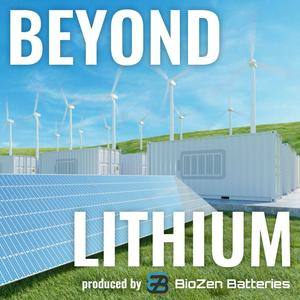
The success of renewable and green energy (like wind and solar) requires a diversity of energy storage options — beyond lithium-ion batteries. What will those alternatives look like? Each episode, we bring you a new perspective from a leading authority in batteries and energy storage focused on expanding the electrical grid with up-and-coming technology.
Sitio web del podcastEscucha Beyond Lithium, Inteligencia Artificial y muchos más podcasts de todo el mundo con la aplicación de radio.es
Descarga la app gratuita: radio.es
- Añadir radios y podcasts a favoritos
- Transmisión por Wi-Fi y Bluetooth
- Carplay & Android Auto compatible
- Muchas otras funciones de la app
Descarga la app gratuita: radio.es
- Añadir radios y podcasts a favoritos
- Transmisión por Wi-Fi y Bluetooth
- Carplay & Android Auto compatible
- Muchas otras funciones de la app
Beyond Lithium
Escanea el código,
Descarga la app,
Escucha.
Descarga la app,
Escucha.
 España