PodcastsAdministraciónLeadership Launchpad

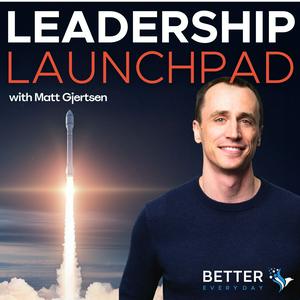
Leadership Launchpad

Matt Gjertsen - Better Every Day Studios
Leadership Launchpad
Último episodio

191 episodios

  • Leadership Launchpad

    Building a Training Program for a Technical Team with Roy Samson

    16/06/2026 | 49 min
    Most technical training programs fail before the first technician ever sets foot in the room. Not because the content is wrong. Because the entire design is wrong.
    Traditional training asks: did they understand it? Technical training asks something harder: can they actually do it? And in aerospace, where it takes a million things to go right and one thing to go wrong.
    In this first ever live episode of the Leadership Launchpad, Matt sits down with Roy Samson, a technical training veteran from the aerospace industry. Together they break down what it actually takes to build a training program for a technical team.
    What you'll learn:
    Why "passing the course" isn't the same as being ready — and how to handle the gap
    How to decide how much theory a technician actually needs (and when to skip it entirely)
    What "building an OS for quality" means and why it matters more than any curriculum
    How to build credibility with subject matter experts when you don't have a technical background
    Why training will happen in your org whether you plan it or not — and why that should scare you

    For engineering managers, technical leads, and L&D professionals trying to build real capability in hard tech environments.
    New episodes weekly. Subscribe and drop a comment if you want us to go deeper on any of these topics.
    Learn more at BuiltLeaders.com
  • Leadership Launchpad

    How Great Leaders Build Alignment Without Slowing Down Execution

    09/06/2026 | 35 min
    Most leaders talk about speed. Ian Walsh doesn’t.
    In this conversation, he separates speed from what actually matters in leadership: velocity, meaning speed with direction. Ian has spent his career in aerospace and defense, from flying Marine Cobra attack helicopters to leading companies through scale and transformation. Now as CEO of FDH Aero, he is operating inside an industry that is growing fast and getting more complex.
    He starts every new role in listen and learn mode. No immediate changes, no playbook, just understanding how the business actually works. That mindset carries through how he thinks about scaling. Fixing a business is about rebuilding capability. Scaling is about making sure the core can support growth without breaking when conditions change.
    A big part of his approach is how decisions move through an organization. Push them closer to the work, but keep clear guardrails and one accountable owner for each outcome. He also focuses on a few simple questions: do people know where they are going and how fast, are decisions stuck at the top, and do people actually feel accountable.
    At the center of it all is communication. When people are guessing, alignment breaks. And when alignment breaks, everything slows down, even if it looks like progress. This episode is a grounded look at leadership inside complex environments where clarity and ownership matter more than anything else.
    If you are early in your career, this is a blueprint for how leaders think. If you are more experienced, it is a check on whether you are still getting the basics right.
    EPISODE HIGHLIGHTS
    [00:00] Speed is dangerous, velocity requires direction
    [00:02:49] Aerospace as a constantly evolving global industry
    [00:06:36] Starting any new role in listen and learn mode
    [00:10:24] The difference between fixing and scaling a business
    [00:14:45] Speed versus velocity in decision making
    [00:18:22] Communication as the foundation of alignment
    [00:22:53] Why delegation fails without training and support
    [00:27:13] Values versus performance in leadership decisions
    [00:28:53] Lessons on risk and judgment from aviation
    [00:31:27] Building better risk awareness through experience
    [00:32:54] Sustaining a high performance culture over time

    KEY TAKEAWAYS
    Speed without direction creates risk rather than progress
    Every new organization requires time spent listening and understanding
    Leadership playbooks rarely transfer cleanly between companies
    Scaling requires leveraging fixed systems, not only adding resources
    Decentralization only works when paired with clear guardrails
    Accountability breaks down when ownership is unclear
    Most bottlenecks are caused by misalignment, not lack of effort
    Communication needs to match the pace of change in the organization
    Values can be identified, performance can be developed
    High performance cultures are built through consistent behavior over time

    If this episode resonates with you, subscribe to the show, share it with someone who leads a team, and leave a review so more people building in complex environments can find it.
    Links & Resources
    Ian Walsh
    LinkedIn: https://www.linkedin.com/in/ian-walsh-76864a2b/
    Website: https://fdhaero.com/
    YouTube: https://www.youtube.com/@FDHAero

    Matt Gjertsen
    Website: https://www.bettereverydaystudios.com/
    LinkedIn: https://www.linkedin.com/in/matthewgjertsen/
    YouTube: https://www.youtube.com/@BetterEveryDayStudios
  • Leadership Launchpad

    Stop Waiting for Permission to Lead w/ Keith Ferrazzi

    02/06/2026 | 31 min
    Most people think leadership starts when someone gives them authority.
    I don't think that's true.
    One of the ideas that kept coming up in my conversation with Keith Ferrazzi is that leadership is rarely granted before it's demonstrated. The people who create outsized impact inside organizations aren't waiting for the title, the promotion, or the perfect moment. They're already acting like leaders long before anyone officially calls them one.
    That matters more today than ever.
    The pace of change is accelerating. Industries are being reshaped by AI, supply chain volatility, shifting markets, and entirely new ways of working. In that environment, technical expertise alone isn't enough. The people who continue to grow are the ones who know how to learn faster, build stronger relationships, challenge ideas constructively, and bring others with them.
    Keith has spent decades studying high-performing teams and advising some of the world's largest organizations. What stood out to me most wasn't a complicated leadership framework. It was how much of great leadership comes down to simple, repeatable practices that most teams never adopt.
    The uncomfortable reality is that most teams are mediocre. They avoid conflict. They don't challenge each other when it matters. They don't hold each other accountable. They don't create the kind of trust that allows great work to happen.
    The good news is that you don't need permission to change that.
    This conversation explores what it means to lead without authority, how high-performing teams are built through practice rather than personality, and why taking responsibility for your own growth is still one of the highest leverage decisions you can make.
    If you're early in your leadership journey, this episode is a blueprint. If you've been leading for years, it's a reminder that the fundamentals still matter.
    EPISODE HIGHLIGHTS
    [00:00] Intro
    [04:28] Is the MBA Still Worth It in an AI-Driven World?
    [07:48] Why Relationships Drive Opportunity, Learning, and Execution
    [12:08] Why Most Teams Never Reach High Performance
    [15:09] The Stress Test Framework for Better Team Decisions
    [19:58] Building Teams That Care About Each Other's Energy
    [21:53] The Three Types of Trust Every Leader Must Understand
    [26:00] Why Most Leaders Are Still Mediocre
    [29:37] Building a Peer Group That Won't Let You Fail
    KEY TAKEAWAYS
    Leadership begins before you receive a title or formal authority
    The fastest learners build relationships with people already doing what they aspire to do
    Everything meaningful in your career happens with and through other people
    High-performing teams are built through practice, not personality
    Most teams avoid the difficult conversations that create trust and accountability
    Trust is not one thing; it includes personal, professional, and structural trust
    Changing behavior is often easier than changing mindset
    Simple collaboration practices can dramatically improve team performance
    The bar for exceptional leadership is lower than most people realize
    Taking responsibility for your own development is a competitive advantage

    Links & Resources
    Keith Ferrazzi
    LinkedIn: linkedin.com/in/keithferrazzi
    Website: https://ferrazzigreenlight.com/
    Book: https://shop.givingtons.com/products/never-lead-alone

    Matt Gjertsen
    Website: https://www.bettereverydaystudios.com/
    LinkedIn: https://www.linkedin.com/in/matthewgjertsen/
    YouTube: https://www.youtube.com/@BetterEveryDayStudios
  • Leadership Launchpad

    Why High Performers Learn to Stay Uncomfortable

    26/05/2026 | 17 min
    Most teams don’t fail because they lack talent. They fail because they lose their ability to operate under discomfort.
    In this solo episode of Leadership Launchpad, I look at why the ability to stay effective when things get uncomfortable has become a defining factor in how modern teams perform.
    I draw a distinction between pressure that sharpens performance and pressure that overwhelms it, and why the difference between the two shows up in how teams are built, led, and developed over time.
    This matters because most organizations are operating in environments where change is constant, expectations shift quickly, and comfort is no longer a reliable indicator of stability or success.
    The real question for leaders is not whether their teams can avoid pressure, but whether they can function inside it without losing clarity or speed.
    That is what this episode is ultimately about.
    Episode Highlights:
    [00:00] Why uncomfortable teams outperform comfortable ones
    [03:19] Why the Body Only Grows Under Pressure
    [06:48] What Discomfort Looks Like Inside Organizations
    [07:50] Accountability vs Committee Culture
    [10:50] The Leadership Challenge of Pushing People
    [12:12] Why AI and Rapid Change Are Increasing Organizational Stress
    [15:08] Building Trust Before Raising Standards
    [17:31] The Key Question Every Manager Should Ask
    Key Takeaways:
    High-performing teams expand their capacity for discomfort over time
    Not all pressure reduces performance, some of it improves it
    Growth comes from exposure, not avoidance
    Feedback and accountability shape how teams respond under stress
    Fast-changing environments reward adaptability over stability
    Leadership is often about deciding what level of pressure a team can sustain
    The future belongs to teams that can stay clear and effective under uncertainty

    If this resonates with how you think about leadership and performance, subscribe for more conversations on building teams that operate well in complex environments.
    Links & Resources
    Website: https://www.bettereverydaystudios.com/
    LinkedIn: https://www.linkedin.com/in/matthewgjertsen/
    YouTube: https://www.youtube.com/@BetterEveryDayStudios
  • Leadership Launchpad

    How to Scale Chaos Without Losing Control w/AstroForge COO Chapman Snowden

    19/05/2026 | 35 min
    Most companies don’t fail because they lack process. They fail because they keep the wrong ones alive for too long.
    Process starts as a survival tool. It reduces chaos, aligns people, and turns scattered effort into repeatable execution. But at scale, the same systems that create clarity slowly become the thing that blocks it. The real challenge isn’t building structure, it’s knowing when it stops serving the work.
    Chap Snowden, COO of AstroForge, has had to live inside that tension in one of the most extreme environments possible: building a company trying to mine asteroids. When your timeline is measured in mission cycles and your risks are existential, there’s no room for process that exists “just because it used to work.”
    What emerges instead is a different operating principle: processes are temporary hypotheses. They exist to solve problems inside a specific window of time, sometimes 60 days, sometimes 180. After that, they either prove their value or they get removed without hesitation.
    This episode explores what it actually takes to build that kind of operating system in practice. Not in theory, not in frameworks, but in real organizational decision-making where speed, alignment, and clarity constantly collide.
    It’s a conversation about how companies scale without calcifying, how leaders stay aligned when they don’t always agree, and why the most dangerous thing in any growing organization is an unexamined process that no one remembers the origin of.
    Episode Highlights:
    [00:00] When processes quietly become the problem (and why most teams miss it)
    [03:53] From Banking to Building: The Search for Meaningful Systems
    [08:35] Choosing High-Binary Bets and Aligning Under Uncertainty
    [14:57] Disagree Fast, Design Light: The Minimum Viable Process Mindset
    [20:56] Minimum Viable Process: Killing Tribal Knowledge and Friction
    [24:16] Instructional Design and Respecting User Attention
    [27:06] Communication Speed Over Perfection
    [31:27] Bad Process Starts With Unclear Problem
    Key Takeaways
    Process is temporary and should expire when the problem changes
    The real failure in scaling is keeping outdated process too long
    Misalignment in mental models is a bigger problem than lack of effort
    Minimum viable process means only what is necessary for repeatability
    Speed forces clarity and exposes weak assumptions early
    Tribal knowledge does not scale and eventually breaks systems
    Operations should be designed like product experiences
    The hardest skill in leadership is removing process not adding it

    If this resonates with how you are thinking about leadership and scaling teams, subscribe for more conversations like this.
    Links & Resources
    Chapman Snowden
    LinkedIn: https://www.linkedin.com/in/chapmansnowden
    Website: https://www.astroforge.com/
    Matt Gjertsen
    Website: https://www.bettereverydaystudios.com/
    LinkedIn: https://www.linkedin.com/in/matthewgjertsen/
    YouTube: https://www.youtube.com/@BetterEveryDayStudios

Más podcasts de Administración
Acerca de Leadership Launchpad
Welcome to the Leadership Launchpad where we help technical managers improve themselves, their teams, and their organizations. Host Matt Gjertsen — former Air Force instructor pilot and head of training and development at SpaceX — brings hard-won lessons from the world's most demanding organizations to help new managers lead with clarity and confidence. Each episode cuts through the noise with practical frameworks, real stories, and straight talk on what it actually takes to build high-performing teams in aerospace, defense, and beyond. Whether you're managing engineers, navigating organizational chaos, or just trying not to let your team down, Leadership Launchpad gives you the tools to get better every day.
Sitio web del podcast

Escucha Leadership Launchpad, Masters of Scale y muchos más podcasts de todo el mundo con la aplicación de radio.es

Descarga la app gratuita: radio.es

  • Añadir radios y podcasts a favoritos
  • Transmisión por Wi-Fi y Bluetooth
  • Carplay & Android Auto compatible
  • Muchas otras funciones de la app