

Escucha gratis este podcast en la aplicación: Descarga gratuita en la App Store
radio.es
Sleep timer
Favoritos
94 episodios
Discussing Pulmonary Fibrosis | Medical English Podcast (S5E10)
20/09/2026 | 7 minIn this episode of the Medical English Podcast, we do a deep dive into pulmonary fibrosis, a progressive lung disease, with a focus on the precise English vocabulary you need to explain it clearly to both colleagues and patients.
You'll learn how to:
• Pronounce and use "idiopathic," "fibrosis," "alveoli," "exacerbation," and "interstitial" with clinical confidence
• Explain how thickened, scarred lung tissue makes oxygen transfer harder over time
• Translate dense terminology into patient-friendly language like "scarring," "air sacs," and "a sudden flare-up"
• Avoid frightening direct translations like "your interstitial is ruined"
• Use gentler, more accurate alternatives such as "the tissue around your air sacs is stiff"
We explore the clinical context behind pulmonary fibrosis, the essential terminology for handovers and case presentations, and how patient-friendly language builds trust during a serious diagnosis.
This episode is perfect for doctors, nurses, respiratory teams, international medical graduates, and healthcare professionals preparing for exams like the OET, who want to sharpen both their clinical English vocabulary and patient communication skills.
Enhance your practical medical English with the Medical English Collection: https://australiabiomed.com/med
🎧 Free transcript & practice quiz for this episode: https://australiabiomed.com/mep-s5e10/
Structured lessons, real-world case dialogues, pronunciation practice, and exam preparation — all designed for healthcare professionals who want to communicate with confidence.
Disclaimer: This podcast is for educational purposes only and does not provide medical advice.Hepatitis and Liver Inflammation | Medical English Podcast (S5E9)
16/09/2026 | 11 minIn this episode of the Medical English Podcast, we follow a consultation with David, a patient presenting with fatigue and yellowing eyes, as his doctor works through a differential between hepatitis A, B, and C based on his travel and tattoo history.
You'll learn how to:
• Use key vocabulary including "jaundice," "liver function tests (LFTs)," "transmission," "antiviral treatment," and "cirrhosis"
• Take a history that identifies risk factors for different hepatitis types
• Explain the difference in treatment approach between acute hepatitis A and chronic hepatitis B or C
• Discuss modern antiviral therapy and its high cure rates for hepatitis C
• Advise patients on precautions to protect their liver and reduce transmission risk to family
We explore a full hepatitis consultation from history-taking through to diagnosis, treatment planning, and safety-netting, and how clear explanations ease a worried patient's mind.
This episode is perfect for doctors, nurses, gastroenterology and hepatology teams, international medical graduates, and healthcare professionals preparing for exams like the OET, who want to sharpen both their clinical English vocabulary and patient communication skills.
Enhance your practical medical English with the Medical English Collection: https://australiabiomed.com/med
🎧 Free transcript & practice quiz for this episode: https://australiabiomed.com/mep-s5e9/
Structured lessons, real-world case dialogues, pronunciation practice, and exam preparation — all designed for healthcare professionals who want to communicate with confidence.
Disclaimer: This podcast is for educational purposes only and does not provide medical advice.Rundown, Under the Weather, Wiped Out | Medical English Podcast (S5E8)
13/09/2026 | 8 minIn this episode of the Medical English Podcast, we map out the everyday spectrum of fatigue — from mild to severe — through three expressions patients and colleagues use constantly: rundown, under the weather, and wiped out.
You'll learn how to:
• Use "rundown" correctly as an adjective, not a verb ("I'm rundown," not "I'm running down")
• Recognise "under the weather" as mild, short-term unwellness with no specific diagnosis
• Reserve "wiped out" for intense, event-driven exhaustion rather than everyday tiredness
• Translate all three casual expressions into correct clinical documentation like "malaise" and "fatigue"
• Choose the right expression depending on severity and context
We explore the pronunciation, grammar, and golden rule behind this fatigue spectrum: speak in idioms with your patients, but document like a clinician.
This episode is perfect for doctors, nurses, allied health workers, international medical graduates, and healthcare professionals preparing for exams like the OET, who want to sound more natural and confident in everyday clinical conversations.
Enhance your practical medical English with the Medical English Collection: https://australiabiomed.com/med
🎧 Free transcript & practice quiz for this episode: https://australiabiomed.com/mep-s5e8/
Structured lessons, real-world case dialogues, pronunciation practice, and exam preparation — all designed for healthcare professionals who want to communicate with confidence.
Disclaimer: This podcast is for educational purposes only and does not provide medical advice.Gastrointestinal (GI) Exams | Medical English Podcast (S5E7)
09/09/2026 | 7 minIn this episode of the Medical English Podcast, we do a deep dive into endoscopy and colonoscopy — two procedures patients often find intimidating — with a focus on explaining them clearly so patients can safely prepare and consent.
You'll learn how to:
• Pronounce and use "endoscopy," "colonoscopy," "sedation," "biopsy," and "polyp" with clinical confidence
• Explain fasting and bowel preparation instructions in a way that avoids dangerous misunderstandings
• Replace technical terms with patient-friendly alternatives like "a camera test" and "a tiny tissue sample"
• Avoid the direct-translation trap of telling a patient to "drink nothing" before bowel prep
• Reassure anxious patients about sedation and what to expect during recovery
We explore the patient's journey through a GI exam from fasting to sedation to recovery, and how the right words prevent complications, cancellations, and unnecessary fear.
This episode is perfect for doctors, nurses, gastroenterology teams, international medical graduates, and healthcare professionals preparing for exams like the OET, who want to sharpen both their clinical English vocabulary and patient communication skills.
Enhance your practical medical English with the Medical English Collection: https://australiabiomed.com/med
🎧 Free transcript & practice quiz for this episode: https://australiabiomed.com/mep-s5e7/
Structured lessons, real-world case dialogues, pronunciation practice, and exam preparation — all designed for healthcare professionals who want to communicate with confidence.
Disclaimer: This podcast is for educational purposes only and does not provide medical advice.Urinary Tract Infections (UTIs) | Medical English Podcast (S5E6)
06/09/2026 | 10 minIn this episode of the Medical English Podcast, we follow a consultation with Sophie, a teenage patient, and her mum, Karen, as they describe classic UTI symptoms and work through diagnosis and treatment together.
You'll learn how to: • Use key vocabulary including "dysuria," "urinary frequency and urgency," "cloudy or foul-smelling urine," "midstream urine sample (MSU)," and "a course of antibiotics" • Take a clear symptom history from both a young patient and a parent • Explain why a midstream sample reduces contamination and improves test accuracy • Discuss why finishing a full antibiotic course matters, even once symptoms improve • Recognise the warning signs that suggest an infection may be spreading to the kidneys
We explore a full UTI consultation from first complaint through to home-care advice and safety-netting, and how clear communication reassures both patient and parent.
This episode is perfect for doctors, nurses, GPs, paediatric teams, international medical graduates, and healthcare professionals preparing for exams like the OET, who want to sharpen both their clinical English vocabulary and patient communication skills.
Enhance your practical medical English with the Medical English Collection: https://australiabiomed.com/med
🎧 Free transcript & practice quiz for this episode: https://australiabiomed.com/mep-s5e6/
Structured lessons, real-world case dialogues, pronunciation practice, and exam preparation — all designed for healthcare professionals who want to communicate with confidence.
Disclaimer: This podcast is for educational purposes only and does not provide medical advice.
Más podcasts de Aprendizaje de idiomas
 Coffee Break SpanishAprendizaje de idiomas, Cursos, Educación
 6 Minute EnglishAprendizaje de idiomas, Educación
 Learning Easy EnglishAprendizaje de idiomas, Educación
 Hoy Hablamos: Podcast diario para aprender español - Learn Spanish Daily PodcastAprendizaje de idiomas, Cursos, Educación
 Aprender ingles with Reza and CraigAprendizaje de idiomas, Educación
 All Ears English PodcastAprendizaje de idiomas, Economía y empresa, Educación
 Luke's ENGLISH Podcast - Learn British English with Luke ThompsonAprendizaje de idiomas, Educación, Humor
 Learning English ConversationsAprendizaje de idiomas, Educación
 Learning English For WorkAprendizaje de idiomas, Educación
 Inglés desde ceroAprendizaje de idiomas, Educación
Podcasts a la moda de Aprendizaje de idiomas
 Learn Catalan - The Lazy Linguist PodcastAprendizaje de idiomas, Cultura y sociedad, Educación
 Aprende A Hablar FrancésAprendizaje de idiomas, Economía y empresa, Educación, Empresa
 StoryLearning SpanishAprendizaje de idiomas, Educación
 Simple Stories in SpanishAprendizaje de idiomas, Arte, Educación, Ficción
 Notes in Spanish AdvancedAprendizaje de idiomas, Educación
 Coffee Break GermanAprendizaje de idiomas, Cursos, Educación
 The Show With no NameAprendizaje de idiomas, Educación
 Coffee Break ChineseAprendizaje de idiomas, Cursos, Educación
 Coffee Break ItalianAprendizaje de idiomas, Cursos, Educación
 潘吉Jenny告诉你|学英语聊美国|开言英语 · PodcastAprendizaje de idiomas, Educación
 14 Minuten - Deine tägliche Portion Deutsch - Deutsch lernen für FortgeschritteneAprendizaje de idiomas, Educación
 Easy Italian: Learn Italian with real conversations | Imparare l'italiano con conversazioni realiAprendizaje de idiomas, Cultura y sociedad, Cursos, Educación, Lugares y viajes
 Aprende chino con Hanyu | Nivel HSK 2 (Temporada 1)Aprendizaje de idiomas, Educación
 Aprende inglés con Coffee Break EnglishAprendizaje de idiomas, Educación
 Learn Russian with Max | Comprehensible Russian PodcastAprendizaje de idiomas, Educación
 No Hay Tos (Real Mexican Spanish)Aprendizaje de idiomas, Educación, Humor
 Notes in Spanish IntermediateAprendizaje de idiomas, Educación
 Español en 10 minutosAprendizaje de idiomas, Educación
 Langsam Gesprochene Nachrichten | Audios | DW Deutsch lernenAprendizaje de idiomas, Educación
 Immersive SpanishAprendizaje de idiomas, Cursos, Educación
 Italiano con AmoreAprendizaje de idiomas, Educación
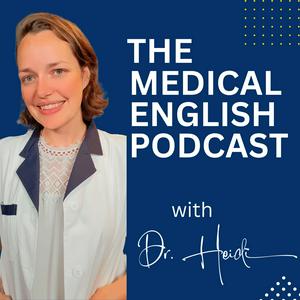
Acerca de The Medical English Podcast
Welcome to The Medical English Podcast, designed to help healthcare professionals sharpen their English language skills. Hosted by Dr. Heidi, this podcast delves into vital medical terminology, common phrases, and specialised language across diverse healthcare settings. From patient consultations to medical conferences, we break down complex jargon, share real-life scenarios, and offer practical tips to elevate your language proficiency. Tune in and elevate your professional communication with The Medical English Podcast!
Sitio web del podcastEscucha The Medical English Podcast, Coffee Break Spanish y muchos más podcasts de todo el mundo con la aplicación de radio.es
Descarga la app gratuita: radio.es
- Añadir radios y podcasts a favoritos
- Transmisión por Wi-Fi y Bluetooth
- Carplay & Android Auto compatible
- Muchas otras funciones de la app
Descarga la app gratuita: radio.es
- Añadir radios y podcasts a favoritos
- Transmisión por Wi-Fi y Bluetooth
- Carplay & Android Auto compatible
- Muchas otras funciones de la app
The Medical English Podcast
Escanea el código,
Descarga la app,
Escucha.
Descarga la app,
Escucha.
The Medical English Podcast: Podcasts del grupo
 España