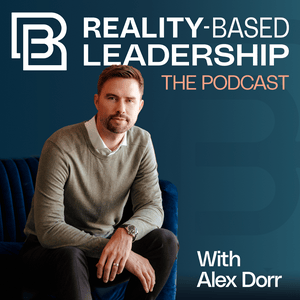
PodcastsAdministraciónReality-Based Leadership

Reality-Based Leadership

Alex Dorr
Reality-Based Leadership
Último episodio

241 episodios

  • Reality-Based Leadership

    111: Why Change Isn't Hard at Work (and How to Better Lead Through It)

    27/05/2026 | 13 min
    Are your leaders apologizing for the very changes your business needs to survive? Are your teams using the word "change" like it's a four-letter word?
    In this episode of the Reality Based Leadership Podcast, we tackle one of the most common traps leadership teams fall into: mistaking sympathy for empathy and hedging on change announcements in ways that quietly signal to your team that you don't believe they can handle what's next.
    Change isn't hard. It's only hard for the unready. And the leaders who master that distinction stop coddling their teams and start calling them up to greatness, without the drama.
    We break down four myths about change that are keeping your teams stuck. "Change is hard" and why leading with that belief exposes your low expectations. "We need to grieve this change" and why hospice frameworks don't belong in your all-hands meeting. "There's too much change" and the simple word swap that instantly shifts your team's energy. "We're change fatigued" and why bite-sized continuous development is the real antidote.
    If you're a senior leader, HR executive, or culture change champion responsible for building teams that execute through uncertainty, this episode gives you a new lens and a new language to lead change without resistance.
    Episode Highlights:
    00:00:50 – Why navigating change is a core leadership skill (and 13% of workplace drama)
    00:02:05 – The mistake leaders make: apologizing for what the business needs
    00:03:13 – Key principle: Change isn't hard — it's only hard for the unready
    00:04:20 – Empathy vs. sympathy when communicating change to your team
    00:05:09 – How to rehearse and deliver change announcements cleanly
    00:06:40 – The 4 myths of change: Myth #1 — Change is hard
    00:06:57 – Myths #2 & #3 — Grieving change and "there's too much change"
    00:08:43 – The "replace change with next" exercise for teams
    00:09:40 – Myth #4 — Change fatigue and why bite-sized development is the antidote
    00:12:13 – Closing thoughts: Staying ready or falling behind
  • Reality-Based Leadership

    110: Why Opinions No Longer Add Value at Work

    20/05/2026 | 11 min
    In this episode, Alex Dorr tackles one of the most overlooked culture killers in leadership today: allowing opinions to replace expertise in team conversations…In this episode, Alex Dorr tackles one of the most overlooked culture killers in leadership today: allowing opinions to replace expertise in team conversations without even realizing the damage it's doing.
    Alex breaks down why the most experienced, most passionate people on your team are often the ones derailing your meetings. Not because they don't care, but because they're bringing gut feelings instead of frameworks, resistance instead of recommendations, and backstory instead of solutions. He draws a clear line between opinions focused on why it won't work and expertise focused on how it could work given the concerns.
    He then gives listeners two simple but powerful tools to shift the dynamic. The "We Could If" reframe interrupts the "we can't because" spiral and redirects the same energy into forward momentum. The SBAR framework (Situation, Background, Analysis, Recommendation) turns venting into value by structuring conversations around data, best practice, and actionable next steps.
    The result is a team where the loudest voice is no longer the most resistant one, but the most informed one. Where preference stops trumping potential. And where leaders stop managing drama and start pulling greatness out of the people already in the room.
    Alex closes with a challenge that lands hard: if you have a lot of passion and a lot of input but nobody seems to be listening, that's not a communication problem. That's an expertise problem. And this episode gives you the tools to fix it.
    Episode Highlights:
    00:00:38 – Core principle: expertise over opinions
    00:01:53 – Opinions = why it won't work; Expertise = how it could work
    00:02:22 – The experienced-but-resistant team member problem
    00:03:18 – Opinions vs. expertise defined
    00:04:07 – People with the most opinions often have the least expertise
    00:04:33 – Tool #1: "We Could If" reframe
    00:05:31 – How the reframe unlocks contribution
    00:06:23 – Tool #2: SBAR framework
    00:06:43 – S = Situation
    00:07:07 – B = Background
    00:07:41 – A = Analysis (the expertise section)
    00:09:40 – R = Recommendations
    00:10:34 – Leader's responsibility to model expertise
  • Reality-Based Leadership

    109: Why Accountability Drives Results

    12/05/2026 | 27 min
    In this episode, Alex Dorr simplifies one of the most misunderstood concepts in leadership: personal accountability. Far from being a buzzword or a blame tool, Alex reframes accountability as a mindset that directly drives happiness, engagement, and results.
    He breaks down why accountability has been watered down in leadership conversations—and why that's a problem. Drawing on research and real-world leadership patterns, Alex introduces a powerful framework built on four key elements: commitment, resilience, ownership, and continuous learning. Together, these form the foundation of high-performing, highly engaged teams. The episode ultimately challenges leaders to stop avoiding accountability conversations and instead coach it intentionally, using simple but powerful questions that shift teams out of excuses and into ownership and action.
    Episode Highlights:
    00:00:00 — Why accountability has become overcomplicated—and why it's not a dirty word.
    00:01:30 — The problem: accountability as a buzzword that leaders ignore or misunderstand.
    00:03:00 — The truth: accountability is a mindset, not a skill set.
    00:05:30 — Internal vs. external locus of control and how it shapes performance.
    00:07:30 — The 50-10-40 model: where happiness and results actually come from.
    00:10:30 — Why accountability drives both engagement and performance.
    00:13:00 — The four factors of accountability: commitment, resilience, ownership, and learning.
    00:17:30 — The danger of "conditional buy-in" and how it leads to excuses.
    00:21:00 — Coaching accountability: asking "Are you all in?" and getting real commitment.
    00:24:30 — Practical questions leaders can use to build accountability on their teams.
  • Reality-Based Leadership

    108: Suffering at Work is Optional

    05/05/2026 | 16 min
    In this episode, Alex Dorr tackles a foundational mindset shift that can radically change how leaders experience work: suffering is optional—and often self-imposed. Through relatable stories and practical frameworks, Alex unpacks how most workplace stress doesn't come from reality itself, but from the stories we attach to it.
    He introduces three common patterns—pre-suffering, post-suffering, and group suffering—that quietly drain energy and derail teams. From "Sunday scaries" to reliving past frustrations, these habits keep leaders stuck in cycles of unnecessary stress. Alex challenges listeners to separate facts from the narrative their minds create, using simple tools like asking, "What do I know for sure?" to interrupt reactive thinking. The result? Clearer decisions, better energy management, and more engaged teams.
    Episode Highlights:
    00:00:00 — The core idea: you can choose to experience work with joy or misery.
    00:01:30 — Why suffering at work is often self-imposed, not caused by reality.
    00:03:00 — Pre-suffering: stressing about future events before they even happen.
    00:04:30 — Post-suffering: reliving past problems that are already resolved.
    00:05:45 — Group suffering: how teams normalize negativity and shared frustration.
    00:07:00 — The real source of stress: the story you tell yourself—not the situation itself.
    00:08:30 — The "tape vs. rat" story: how quickly we escalate harmless situations into crises.
    00:10:30 — A practical tool: separating facts from assumptions to reduce emotional reactivity.
    00:12:00 — How teams turn simple changes into worst-case scenarios.
    00:14:00 — Why energy management—not circumstances—is the real competitive advantage.
  • Reality-Based Leadership

    107: Stop Judging, Start Helping

    28/04/2026 | 21 min
    In this episode, Alex Dorr zeroes in on one of the most powerful and transformative principles in leadership: "stop judging, start helping." If there were only one mindset shift to improve culture, collaboration, and results, this would be it.
    Drawing from real-world leadership moments, Alex explains how quickly teams fall into judgment—blaming others, telling negative stories, and disengaging from solutions. But the moment leaders interrupt that pattern and redirect toward helpful action, everything changes. From workplace dynamics to personal relationships to innovation, this simple principle unlocks clarity, accountability, and forward momentum. Ultimately, this episode challenges leaders to make "stop judging, start helping" a daily, non-negotiable habit that reshapes how teams think, communicate, and perform.
    Episode Highlights:
    00:00:00 — The one principle that can transform your team: stop judging, start helping.
    00:01:00 — Why leaders default to thinking "someone else needs this" instead of applying it themselves.
    00:03:00 — The core truth: the moment you start judging is the moment you stop leading.
    00:05:00 — Brain science: why you can't judge and help at the same time.
    00:07:30 — How judgment spreads through teams and shapes culture ("where the leader goes, so goes the team").
    00:10:00 — Coaching in real time: shifting a high performer from judgment to helpful action.
    00:12:30 — Breaking silos and conflict by replacing blame with collaboration.
    00:15:30 — How removing judgment unlocks creativity and innovation in teams.
    00:18:30 — Setting boundaries in life: using "start helping" to redirect negative conversations.
    00:20:30 — The practical takeaway: make "stop judging, start helping" a team-wide habit.

Más podcasts de Administración
Acerca de Reality-Based Leadership
The average person spends 2.5 hours a day in drama at work. That's lost time, lost energy, and lost results. Leading beyond drama isn't optional anymore. It's the skill that separates reactive managers from transformational leaders. So how do you reclaim those hours, call your team to greatness, and restore sanity to your workplace? Welcome to Reality-Based Leadership. Hosted by Alex Dorr, CEO of Reality-Based Leadership, this podcast delivers the mindset shifts and practical tools leaders need to eliminate emotional waste, build true accountability, and turn excuses into measurable results. With years of experience working alongside leaders across industries, Alex brings real-world application, bold insight, and next practices that create ROI in the room and momentum long after. If you are ready to elevate performance and lead what's next, you are in the right place.
Sitio web del podcast

Escucha Reality-Based Leadership, Reinvent B2B Customer Growth y muchos más podcasts de todo el mundo con la aplicación de radio.es

Descarga la app gratuita: radio.es

  • Añadir radios y podcasts a favoritos
  • Transmisión por Wi-Fi y Bluetooth
  • Carplay & Android Auto compatible
  • Muchas otras funciones de la app
Reality-Based Leadership: Podcasts del grupo