Escucha gratis este podcast en la aplicación: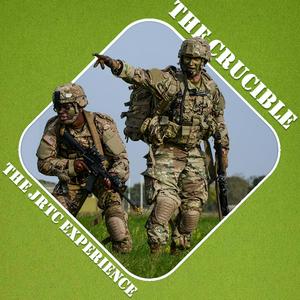 Descarga gratuita en la App Store
radio.es
Sleep timer
Favoritos
125 episodios
127 S13 Ep 09 - Fighting Across Islands: LSCO in an Archipelago Battlespace w/JRTC Subject Matter Experts in Hawaii
31/1/2026 | 22 minThe Joint Readiness Training Center is pleased to present the one-hundredth-and-twenty-seventh episode to air on ‘The Crucible - The JRTC Experience.’ Hosted by MAJ Marc Howle, the Brigade Senior Engineer / Protection Observer-Coach-Trainer, and MAJ David Pfaltzgraff, BDE XO OCT (formerly the BDE S-3 Operations OCT), from Brigade Command & Control (BDE HQ) on behalf of the Commander of Ops Group (COG). Today’s guests are subject experts from the Brigade Command & Control Task Force (BDE HQ) at JRTC: MAJ Steven Yates is the BDE S-6 Signal OCT, MAJ Michael Stewart is the incoming BDE S-3 Operations Officer OCT, MAJ Edward Pecoraro is the Senior Brigade S-2 Intel OCT, MAJ Adeniran Dairo is the Brigade S-4 Logistics OCT,
CW3 Michael Horrace is the Senior Targeting OCT, and SFC Benjamin Pealer is the Brigade CEMA NCOIC OCT.
**There was a technical issue during transcoding and a group image had to be utilized inside of “live” video due to a file corruption. Thanks for your understanding in advance.**
The Joint Pacific Multinational Readiness Center (JPMRC) is the Army’s premier combat training center for preparing joint and multinational forces to fight and win in the Indo-Pacific region. Designed to replicate the complexity of LSCO in an archipelago environment, JPMRC challenges units across dense jungle, mountainous terrain, and dispersed islands while integrating land, sea, air, space, cyber, and the electromagnetic spectrum. To execute these demanding training rotations, JPMRC relies on the expertise of the Joint Readiness Training Center, drawing on JRTC Observer-Coach-Trainers and OPFOR subject-matter experts through borrowed manpower to provide realistic opposition and doctrinally grounded feedback to rotational units.
This episode examines the unique challenges of conducting large-scale combat operations in an archipelago environment, highlighting how terrain, distance, weather, and dispersion fundamentally reshape operations across all warfighting functions. A recurring theme is that island and jungle terrain compresses the fight vertically and horizontally, limiting mobility corridors, restricting observation, and degrading traditional ISR advantages. Dense vegetation and complex terrain reduce the effectiveness of aerial and space-based sensors, forcing units to rely more heavily on dismounted reconnaissance, local security, and detailed terrain analysis. Communications planning emerges as a critical friction point, as triple-canopy jungle and mountainous terrain degrade line-of-sight and satellite-dependent systems, requiring deliberate EMS analysis, redundant pathways, and adaptive low-signature solutions. Across the board, the panel reinforces that archipelago operations demand more time, more reconnaissance, and more deliberate planning than continental fights.
The discussion also underscores how LSCO in an island chain is inherently joint, non-contiguous, and resource-constrained, placing a premium on integration and disciplined execution. Sustainment challenges dominate the problem set: moving personnel, equipment, fires, and supplies across multiple islands requires improvisation, redundancy, and acceptance that weather and the enemy will disrupt even the best plans. Fires and maneuver are constrained by limited positioning options, making predictability a vulnerability and forcing commanders to think in terms of infiltration, distributed operations, and attacking systems and nodes rather than massed formations. Mission command and detailed graphics become essential, as junior leaders may operate semi-independently with limited communications for extended periods. The episode reinforces a clear takeaway: archipelago LSCO magnifies friction across every domain, rewarding formations that plan in detail, rehearse relentlessly, empower subordinate leaders, and integrate effects across land, sea, air, space, and the electromagnetic spectrum.
Part of S13 “Hip Pocket Training” series.
For additional information and insights from this episode, please check-out our Instagram page @the_jrtc_crucible_podcast
Be sure to follow us on social media to keep up with the latest warfighting TTPs learned through the crucible that is the Joint Readiness Training Center.
Follow us by going to: https://linktr.ee/jrtc and then selecting your preferred podcast format.
Again, we’d like to thank our guests for participating. Don’t forget to like, subscribe, and review us wherever you listen or watch your podcasts — and be sure to stay tuned for more in the near future.
“The Crucible – The JRTC Experience” is a product of the Joint Readiness Training Center.126 S05 Ep 12 – Casualties Don’t Wait: Medical Planning for the Hardest Days of Ground Combat w/JRTC Experts
29/1/2026 | 45 minThe Joint Readiness Training Center is pleased to present the one-hundredth-and-twenty-sixth episode to air on ‘The Crucible - The JRTC Experience.’ Hosted by the Senior Enlisted Medical Advisor and Role II Observer-Coach-Trainer for the Task Force Sustainment (BSB / CSSB), MSG Timothy Sargent on behalf of the Commander of Ops Group (COG). Today’s guests are all combat medicine professionals with Live Fire Division. SFC Anthony Norris is the Senior Medical OCT and SFC Tulio Perez is one of the Medical OCTs.
This episode focuses on medical planning, execution, and sustainment requirements for live-fire training at JRTC, emphasizing that success hinges on deliberate preparation rather than improvisation once training begins. The discussion highlights how rotational units must plan medical coverage early, accounting for asset allocation, Class VIII forecasting, casualty evacuation timelines, and route familiarity. A major theme is the gap between briefed plans and executable plans, particularly for CASEVAC and MEDEVAC under realistic conditions. Common friction points include poorly rehearsed CASEVAC plans, vehicles improperly configured for casualty movement, weak communications between objectives and higher headquarters, and a lack of shared understanding of evacuation decision authority. The episode reinforces that medics, leaders, and units must rehearse medical operations at home station, not during validation, to ensure rapid, confident execution when real-world casualties occur.
The conversation also dives deeply into casualty collection points (CCPs), heat injury mitigation, and medical logistics, identifying recurring trends observed across rotations. CCPs are frequently under-planned, poorly resourced, or inadequately communicated below leadership level, creating delays during mass casualty or heat-injury events. The panel stresses the importance of time-distance analysis, realistic evacuation timelines from objectives to Role I and beyond, and prioritizing CASEVAC over waiting for limited MEDEVAC assets. Heat injuries emerge as a dominant driver of casualties, underscoring the need for disciplined hydration, nutrition, sleep, ice resupply, arm-immersion cooling, and sufficient thermometer probes and Class VIII supplies forward. The episode closes by reinforcing that medical success at JRTC—and in LSCO—depends on repetitions, rehearsals, logistics discipline, and leader involvement, ensuring medical systems can sustain tempo, preserve combat power, and return Soldiers to the fight.
Part of S05 “Beans, Bullets, Band-Aids, Batteries, Water, & Fuel” series.
For additional information and insights from this episode, please check-out our Instagram page @the_jrtc_crucible_podcast
Be sure to follow us on social media to keep up with the latest warfighting TTPs learned through the crucible that is the Joint Readiness Training Center.
Follow us by going to: https://linktr.ee/jrtc and then selecting your preferred podcast format.
Again, we’d like to thank our guests for participating. Don’t forget to like, subscribe, and review us wherever you listen or watch your podcasts — and be sure to stay tuned for more in the near future.
“The Crucible – The JRTC Experience” is a product of the Joint Readiness Training Center.125 S05 Ep 11 – BDE S4 vs SPO: No Dumb Questions, Roles and Responsibilities w/JRTC Sustainers
22/1/2026 | 31 minThe Joint Readiness Training Center is pleased to present the one-hundredth-and-twenty-fifth episode to air on ‘The Crucible - The JRTC Experience.’ Hosted by MAJ Amy Beatty, the Task Force Executive Officer Observer-Coach-Trainer from Task Force Sustainment (Division Sustainment Support Battalion / Light Support Battalion) on behalf of the Commander of Ops Group (COG). Today’s guest is CPT Cody Kindle
the S-4 Sustainment Planner for JRTC’s Plans / Exercise Maneuver Control Task Force.
This episode explores sustainment in Large-Scale Combat Operations by breaking down how logistics must be planned, synchronized, and executed to survive and enable maneuver in prolonged, high-tempo fights. A central focus is clarifying the roles of the brigade S4 and the SPO, emphasizing internal versus external sustainment responsibilities and how confusion between the two creates friction, duplicated effort, and missed requirements. The discussion repeatedly returns to the idea that sustainment success is not personality-driven but competency-driven, rooted in disciplined math, running estimates, and forecasting. Log stats are framed not as reports for awareness, but as tools to validate assumptions, detect deviations from forecasts, and drive timely decisions. The episode stresses that effective sustainment requires forecasting 72–96 hours out at a minimum, with deliberate synchronization of consumption from the individual Soldier level through FSCs, the BSB/LSB, and higher sustainment echelons.
The conversation also highlights best practices observed at JRTC, particularly the use of the logistics synchronization matrix as the sustainment fight’s primary combat product. When shared and nested across echelons, the sync matrix allows units to deconflict time and space, avoid emergency resupply, protect limited distribution assets, and maintain tempo without culminating. Leaders discuss how failures in synchronization lead to predictable breakdowns, including overworked distribution platoons, stalled maneuver units, and sustainment “blackout” periods during displacement. The episode concludes by framing sustainment in LSCO as a contested, continuous operation that demands redundancy, disciplined staff processes, and strong working relationships between logisticians at every echelon. Units that treat sustainment planning with the same rigor as maneuver planning are better positioned to endure the hardest days of ground combat and keep combat power forward.
Part of S05 “Beans, Bullets, Band-Aids, Batteries, Water, & Fuel” series.
For additional information and insights from this episode, please check-out our Instagram page @the_jrtc_crucible_podcast
Be sure to follow us on social media to keep up with the latest warfighting TTPs learned through the crucible that is the Joint Readiness Training Center.
Follow us by going to: https://linktr.ee/jrtc and then selecting your preferred podcast format.
Again, we’d like to thank our guests for participating. Don’t forget to like, subscribe, and review us wherever you listen or watch your podcasts — and be sure to stay tuned for more in the near future.
“The Crucible – The JRTC Experience” is a product of the Joint Readiness Training Center.124 S13 Ep 08 - From Order to Action: Why Receipt of Mission Sets the Fight w/JRTC MDMP Subject Matter Experts
15/1/2026 | 22 minThe Joint Readiness Training Center is pleased to present the one-hundredth-and-twenty-fourth episode to air on ‘The Crucible - The JRTC Experience.’ Hosted by MAJ Marc Howle, the Brigade Senior Engineer / Protection Observer-Coach-Trainer, and MAJ David Pfaltzgraff, BDE XO OCT (formerly the BDE S-3 Operations OCT), from Brigade Command & Control (BDE HQ) on behalf of the Commander of Ops Group (COG). Today’s guests are two subject experts of the military decision making process at JRTC: MAJ Brent Paish and MAJ Michael Stewart. MAJ Paish is an Australian Army Exchange Officer serving as the S-3 Operations Officer OCT for TF-3 (IN BN). MAJ Stewart is the incoming BDE S-3 Operations Officer OCT for BC2 (BDE HQ).
This episode focuses on the often-skipped but foundational MDMP step: Receipt of Mission, arguing that many downstream planning failures stem from rushing or ignoring this phase. The discussion highlights why staffs frequently bypass receipt of mission—time pressure, overconfidence, and a desire to jump straight into “productive” planning products—while overlooking its true purpose: baselining the staff, establishing shared understanding, and setting conditions for disciplined execution. Key friction points identified include assuming everyone has read and interpreted the order the same way, failing to properly define task and purpose, and neglecting to separate immediate operational requirements from future planning tasks. Without a deliberate receipt-of-mission process, units routinely miss critical outputs such as a meaningful WARNORD, a coherent planning timeline, and early identification of specified and implied tasks.
The episode also explores best practices observed at JRTC, emphasizing the value of a receipt-of-mission huddle to synchronize the staff, clarify roles, and prevent siloed planning. Effective units use this moment to align planning horizons, assign responsibilities, and ensure subordinate elements can begin parallel planning in accordance with the 1/3–2/3 rule. The panel stresses that receipt of mission is not a formality but a force-multiplier that enables tempo, prevents stagnation, and supports timely movement and transitions once units are already in contact. By deliberately executing this step, commanders and staffs reduce friction, improve mission analysis quality, and create the shared understanding required to operate effectively in LSCO under compressed timelines and degraded conditions.
Part of S13 “Hip Pocket Training” series.
For additional information and insights from this episode, please check-out our Instagram page @the_jrtc_crucible_podcast
Be sure to follow us on social media to keep up with the latest warfighting TTPs learned through the crucible that is the Joint Readiness Training Center.
Follow us by going to: https://linktr.ee/jrtc and then selecting your preferred podcast format.
Again, we’d like to thank our guests for participating. Don’t forget to like, subscribe, and review us wherever you listen or watch your podcasts — and be sure to stay tuned for more in the near future.
“The Crucible – The JRTC Experience” is a product of the Joint Readiness Training Center.123 S05 Ep 10 – Ghost Logistics: How Sustainment Stayed Alive in the Box w/LTC Wilson, 307 Light Support Battalion
08/1/2026 | 42 minThe Joint Readiness Training Center is pleased to present the one-hundredth-and-twenty-third episode to air on ‘The Crucible - The JRTC Experience.’ Hosted by MAJ Amy Beatty, the Task Force Executive Officer Observer-Coach-Trainer from Task Force Sustainment (Division Sustainment Support Battalion / Light Support Battalion) on behalf of the Commander of Ops Group (COG). Today’s guest is LTC Ryan Wilson, the Battalion Commander for the 307th Light Support Battalion, 1st Mobile Brigade Combat Team (MBCT), 82nd Airborne Division.*
The 307th Light Support Battalion, formerly the 307th Brigade Support Battalion, is the sustainment backbone of the 1st Mobile Brigade Combat Team (MBCT), 82nd Airborne Division. Known by its Hollywood call sign “Blackdevil” and guided by the motto “Ready to Support,” the 307th traces its lineage to World War II, where it supported airborne operations in the European Theater before continuing service through the Cold War, the Global War on Terror, and into today’s LSCO-focused force. As a Light Support Battalion, the 307th has evolved from traditional rear-area logistics into a highly mobile, dispersed, and survivable sustainment formation—capable of supporting forced entry, austere operations, and prolonged combat while operating under constant enemy observation.
This episode examines tactical sustainment and logistics in LSCO, focusing on how Brigade Support Battalions must modernize to survive, enable maneuver, and remain relevant on a transparent, multi-domain battlefield. The discussion highlights evolving base cluster design as a survivability and command-and-control problem, not just a logistical one. Rather than mirroring legacy company-based layouts, effective units organize sustainment nodes around capability, unity of command, and protection, deliberately reducing signatures while preserving functionality. The episode also addresses the persistent friction between moving versus maneuvering logistics, emphasizing that sustainment formations are designed to distribute bulk commodities, not fight their way forward without protection. Best practices include integrating FSCs early into planning, rehearsing transitions from bulk to retail distribution, and treating sustainment as a shared responsibility between maneuver and support units rather than a transactional service.
The conversation further explores multi-domain and modernization challenges shaping the sustainment fight, including EMS vulnerability, convoy survivability, and the difficulty of maintaining synchronization during frequent displacement. Leaders discuss how degraded communications, leadership attrition, and mass casualties compound sustainment friction, requiring disciplined initiative and empowered NCO leadership at echelon. Repeated emphasis is placed on concealment, noise and light discipline, timeliness, and rehearsed staff processes as decisive factors that protect sustainment combat power. The episode underscores that logistics in LSCO is not a rear-area function but a contested fight where culture, repetition, and leader-driven standards determine success. Ultimately, the takeaway is clear: units that modernize sustainment through protection, integration, and disciplined execution are better positioned to sustain the fight and enable decisive maneuver during the opening and sustaining battles of LSCO.
Part of S05 “Beans, Bullets, Band-Aids, Batteries, Water, & Fuel” series.
For additional information and insights from this episode, please check-out our Instagram page @the_jrtc_crucible_podcast
Be sure to follow us on social media to keep up with the latest warfighting TTPs learned through the crucible that is the Joint Readiness Training Center.
Follow us by going to: https://linktr.ee/jrtc and then selecting your preferred podcast format.
Again, we’d like to thank our guests for participating. Don’t forget to like, subscribe, and review us wherever you listen or watch your podcasts — and be sure to stay tuned for more in the near future.
“The Crucible – The JRTC Experience” is a product of the Joint Readiness Training Center.
*For the purposes of this podcast, the titles LSB and BSB are interchangeable just as DSSB and CSSB.
Más podcasts de Gobierno
 No es el fin del mundoGobierno, Noticias, Noticias de entretenimiento
 Agro-Mundo PodcastGobierno, Noticias, Política
 Vidas RealesGobierno, Historia, Noticias
 La Ingobernable. Un podcast sobre Marca EspañaGobierno
 GORKA ZUMETAGobierno
 Encuentros Fundación TelefónicaGobierno
 Los Podcast de la Fundación - FMMGobierno
 The InterviewGobierno, Noticias, Política
 El Orden MundialGobierno, Historia, Noticias, Política
Podcasts a la moda de Gobierno
 RTL archives secrètes, François MitterrandGobierno, Historia
 En Modo AviónGobierno
 El Cato PodcastGobierno, Noticias, Comentando la noticia, Política
 下班瀚你聊Economía y empresa, Gobierno, Ocio, Noticias, Cultura y sociedad
 Простая экономикаEconomía y empresa, Gobierno, Historia, Inversión
 Temas de PreparaTIC en formato audioGobierno
 Into AfricaEconomía y empresa, Gobierno, Sin fines de lucro
 Portierramaryaire podcastGobierno
- Vidas RealesGobierno, Historia, Noticias
- GORKA ZUMETAGobierno
 Sig det' løgnGobierno, Noticias, Política
 Any Questions? and Any Answers?Gobierno
 El podcast del president Mas. A favor de la políticaGobierno
 Fora do BaralhoGobierno
 5-4Gobierno, Noticias, Comentando la noticia
 Global Security BriefingGobierno, Noticias, Política
 Strict ScrutinyGobierno, Noticias, Cultura y sociedad, Filosofía
- Encuentros Fundación TelefónicaGobierno
 Our Curious AmalgamEconomía y empresa, Gobierno, Carrera
 Punto de Fuga - Podcast de ArquitecturaGobierno
 GZ PodcastGobierno
 Te acuso de acosoGobierno
 BorgenUdenFilterGobierno
Acerca de The Crucible - The JRTC Experience Podcast
The Joint Readiness Training Center is the premier crucible training experience. We prepare units to fight and win in the most complex environments against world-class opposing forces. We are America’s leadership laboratory.
This podcast isn’t an academic review of historical vignettes or political-science analysis of current events. This is a podcast about warfighting and the skillsets necessary for America’s Army to fight and win on the modern battlefield.
Sitio web del podcastEscucha The Crucible - The JRTC Experience Podcast, No es el fin del mundo y muchos más podcasts de todo el mundo con la aplicación de radio.es
Descarga la app gratuita: radio.es
- Añadir radios y podcasts a favoritos
- Transmisión por Wi-Fi y Bluetooth
- Carplay & Android Auto compatible
- Muchas otras funciones de la app
Descarga la app gratuita: radio.es
- Añadir radios y podcasts a favoritos
- Transmisión por Wi-Fi y Bluetooth
- Carplay & Android Auto compatible
- Muchas otras funciones de la app

The Crucible - The JRTC Experience Podcast
Escanea el código,
Descarga la app,
Escucha.
Descarga la app,
Escucha.
 España